
使用扩展栅型有机场效应晶体管酶传感器检测体液中的生物传感方法。
Biosensing approaches in body fluids using extended-gate-type organic field-effect transistor enzymatic sensors.
作者信息
Sasaki Yui, Minami Tsuyoshi
机构信息
Research Center for Advanced Science and Technology, The University of Tokyo, 4-6-1 Komaba, Meguro-Ku, Tokyo, Japan.
Institute of Industrial Science, The University of Tokyo, 4-6-1 Komaba, Meguro-Ku, Tokyo, Japan.
出版信息
Anal Sci. 2025 May;41(5):523-530. doi: 10.1007/s44211-025-00750-8. Epub 2025 Apr 5.
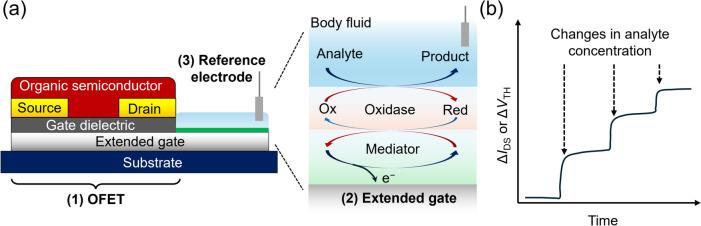
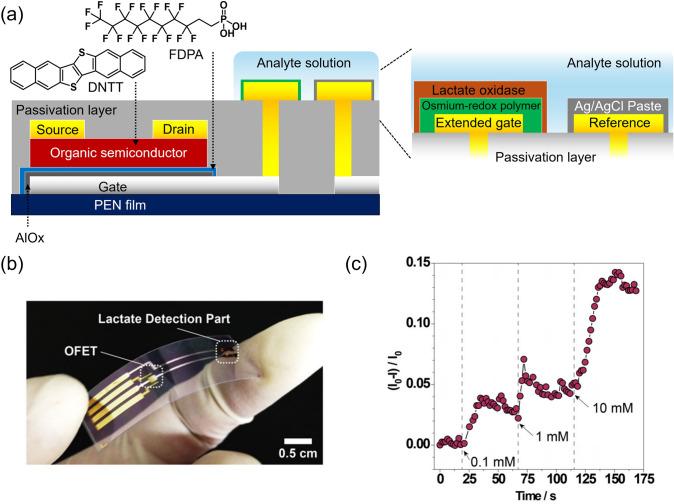
Biomarkers in body fluids provide essential chemical information for examining health conditions; however, unlike conventional instrumental approaches, easy-to-use analytical methods have not yet been fully established. This review introduces extended-gate-type organic field-effect transistors (OFETs) as biosensor platforms for real-sample analysis. OFETs are electronic devices that show switching profiles when gate voltages are applied. Therefore, the gate electrode of OFET functions as a sensing unit combined with appropriate molecular recognition materials. Owing to their signal amplification properties, OFETs enable sensitive biosensing. The extended-gate surfaces are easily functionalized with enzymatic layers using chemical modification, and these surfaces provide a high discrimination ability for specific biomarkers from their analogs. This review presents the designs of the extended-gate structures (i.e., integrated and separated styles) and their enzymatic layers and includes their actual sensing performance.
体液中的生物标志物为检查健康状况提供了重要的化学信息;然而,与传统的仪器方法不同,易于使用的分析方法尚未完全建立。本综述介绍了扩展栅型有机场效应晶体管(OFET)作为用于实际样品分析的生物传感器平台。OFET是一种电子器件,当施加栅极电压时会显示开关特性。因此,OFET的栅电极与适当的分子识别材料结合后可作为传感单元。由于其信号放大特性,OFET能够实现灵敏的生物传感。扩展栅表面可通过化学修饰轻松地用酶层进行功能化,并且这些表面对特定生物标志物与其类似物具有很高的区分能力。本综述介绍了扩展栅结构(即集成式和分离式)及其酶层的设计,并包括它们的实际传感性能。



 Zotero 插件