Zeng Xiangze, Pappu Rohit V
Department of Biomedical Engineering and Center for Biomolecular Condensates, The James McKelvey School of Engineering, Washington University in St. Louis, St. Louis, MO, 63130, USA.
Department of Physics, Hong Kong Baptist University, Kowloon Tong, Hong Kong, China and Teaching and Research Division, School of Chinese Medicine, Hong Kong Baptist University, Kowloon Tong, Hong Kong, China.
Commun Chem. 2025 Apr 6;8(1):106. doi: 10.1038/s42004-025-01502-5.
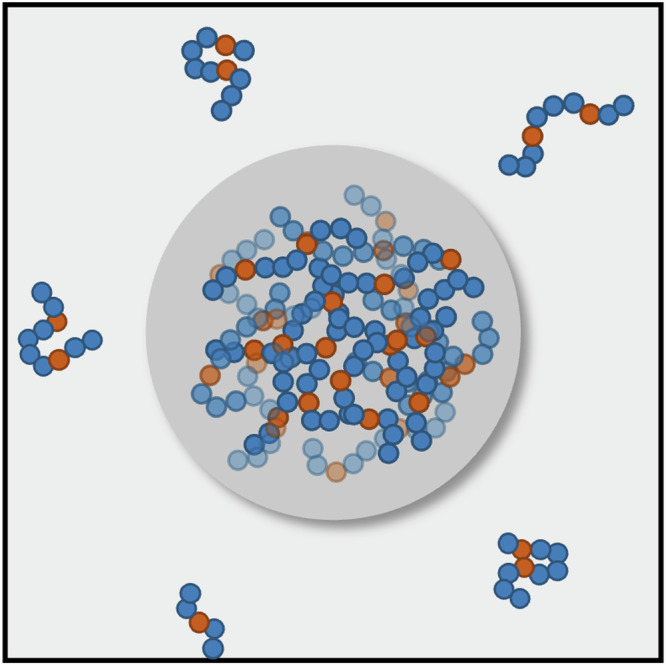
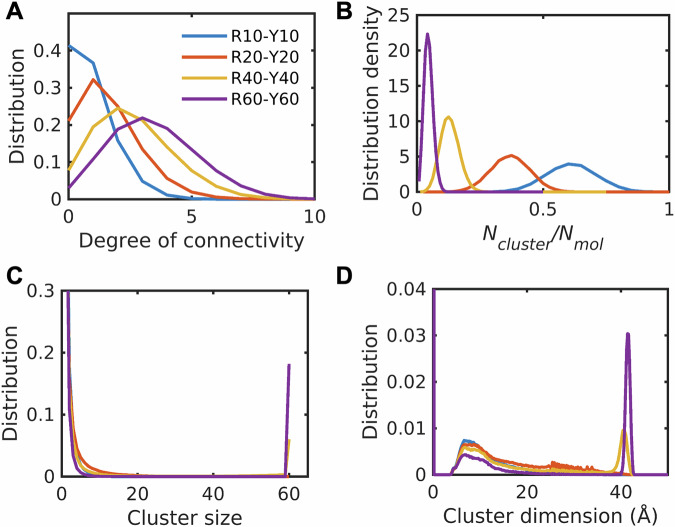
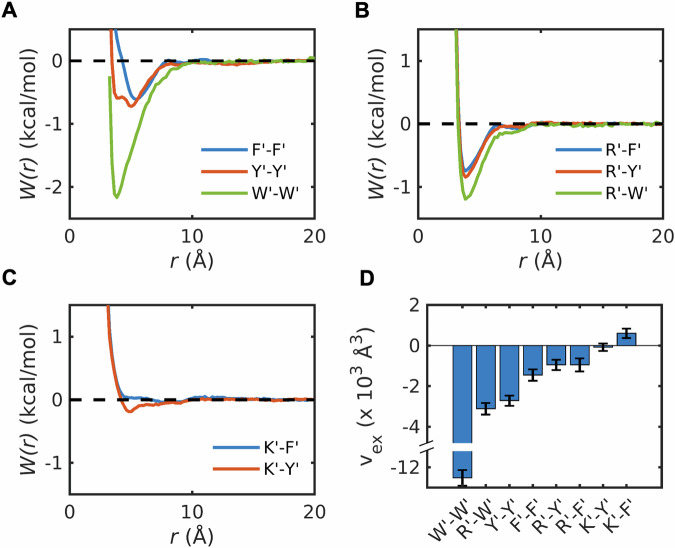
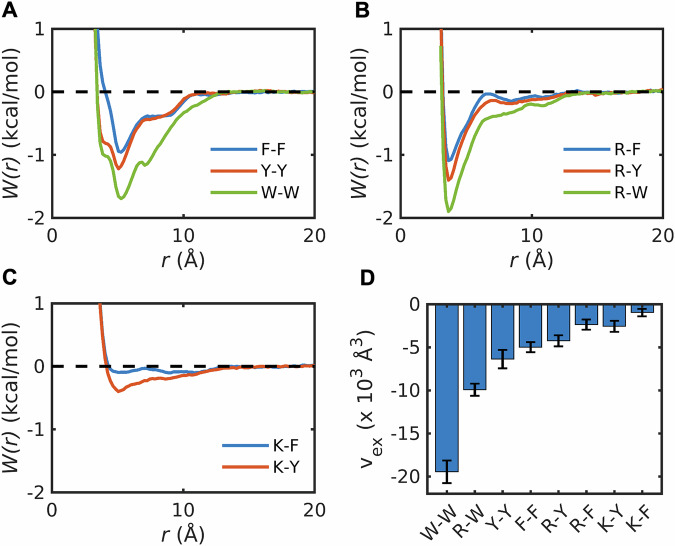
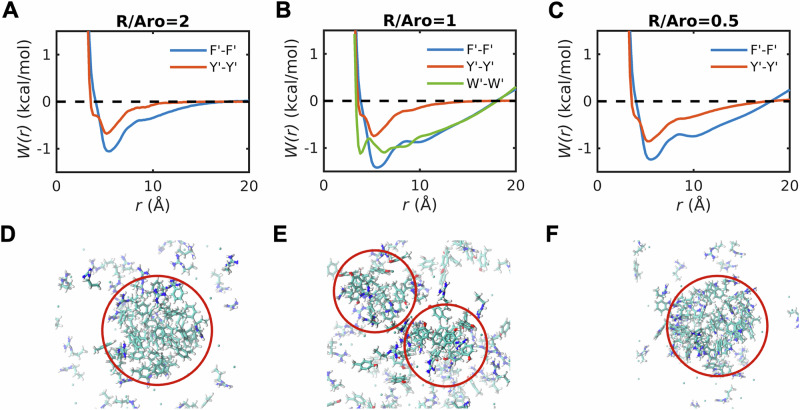
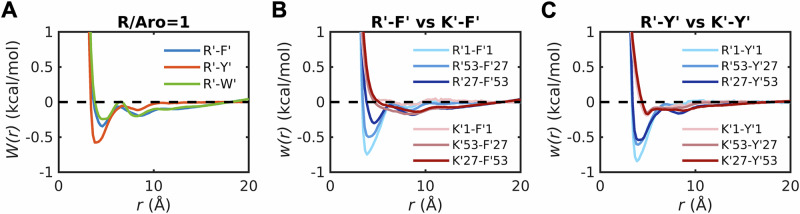
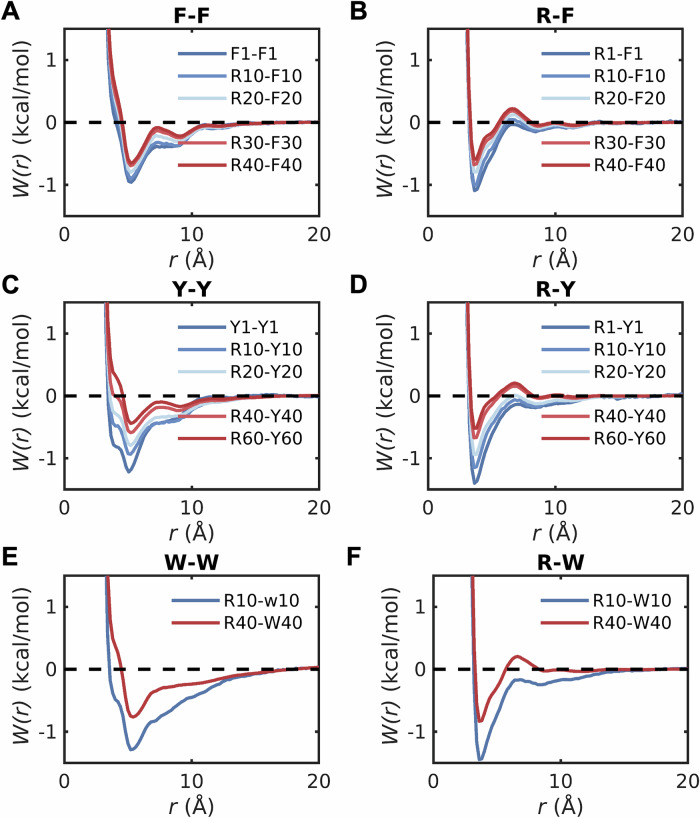
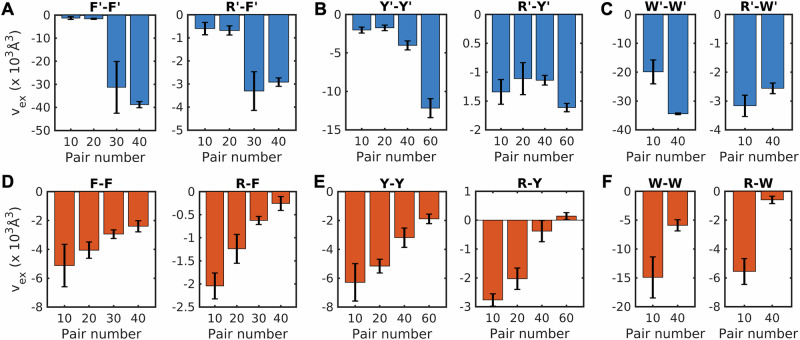
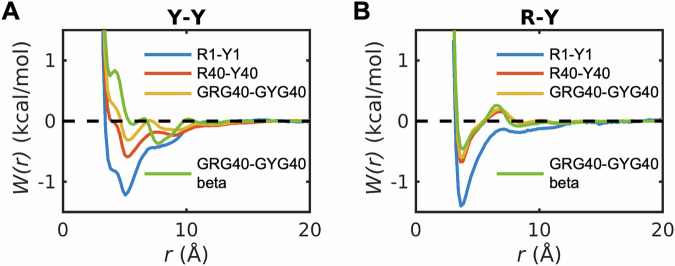
Biomolecular condensates formed by intrinsically disordered proteins (IDPs) are semidilute solutions. These can be approximated as solutions of blob-sized segments, which are peptide-sized motifs. We leveraged the blob picture and molecular dynamics simulations to quantify differences between inter-residue interactions in model compound and peptide-based mimics of dense versus dilute phases. The all-atom molecular dynamics simulations use a polarizable forcefield. In model compound solutions, the interactions between aromatic residues are stronger than interactions between cationic and aromatic residues. This holds in dilute and dense phases. Cooperativity within dense phases enhances pairwise interactions leading to finite-sized nanoscale clusters. The results for peptide-based condensates paint a different picture. Backbone amides add valence to the associating molecules. While this enhances pairwise inter-residue interactions in dilute phases, it weakens pair interactions in dense phases, doing so in a concentration-dependent manner. Weakening of pair interactions enables fluidization characterized by short-range order and long-range disorder. The higher valence afforded by the peptide backbone generates system-spanning networks. As a result, dense phases of peptides are best described as percolated network fluids. Overall, our results show how peptide backbones enhance pairwise interactions in dilute phases while weakening these interactions to enable percolation within dense phases.
由内在无序蛋白(IDP)形成的生物分子凝聚物是半稀溶液。这些可以近似为斑点大小片段的溶液,这些片段是肽大小的基序。我们利用斑点模型和分子动力学模拟来量化模型化合物以及基于肽的浓相和稀相模拟物中残基间相互作用的差异。全原子分子动力学模拟使用可极化力场。在模型化合物溶液中,芳香族残基之间的相互作用强于阳离子和芳香族残基之间的相互作用。这在稀相和浓相中均成立。浓相内的协同作用增强了成对相互作用,导致形成有限大小的纳米级聚集体。基于肽的凝聚物的结果呈现出不同的情况。主链酰胺为缔合分子增加了价态。虽然这增强了稀相中成对的残基间相互作用,但它削弱了浓相中的成对相互作用,且这种削弱以浓度依赖的方式进行。成对相互作用的减弱使得以短程有序和长程无序为特征的流化成为可能。肽主链提供的更高价态产生了跨越系统的网络。因此,肽的浓相最好描述为渗流网络流体。总体而言,我们的结果表明肽主链如何在稀相中增强成对相互作用,同时削弱这些相互作用以实现浓相内的渗流。