Department of Biomedical Engineering and Center for Biomolecular Condensates, Washington University in St. Louis, St. Louis, MO, 63130, USA.
Center of Regenerative Medicine, Washington University in St. Louis, St. Louis, MO, 63130, USA.
Nat Commun. 2024 Apr 22;15(1):3413. doi: 10.1038/s41467-024-47602-z.
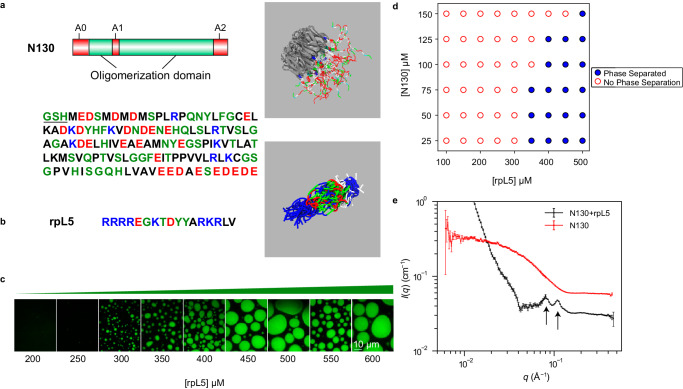
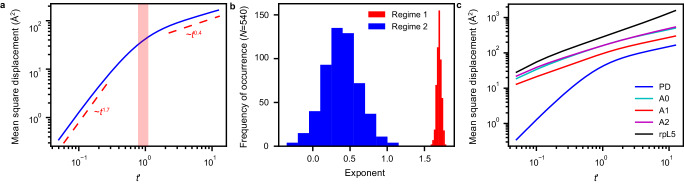
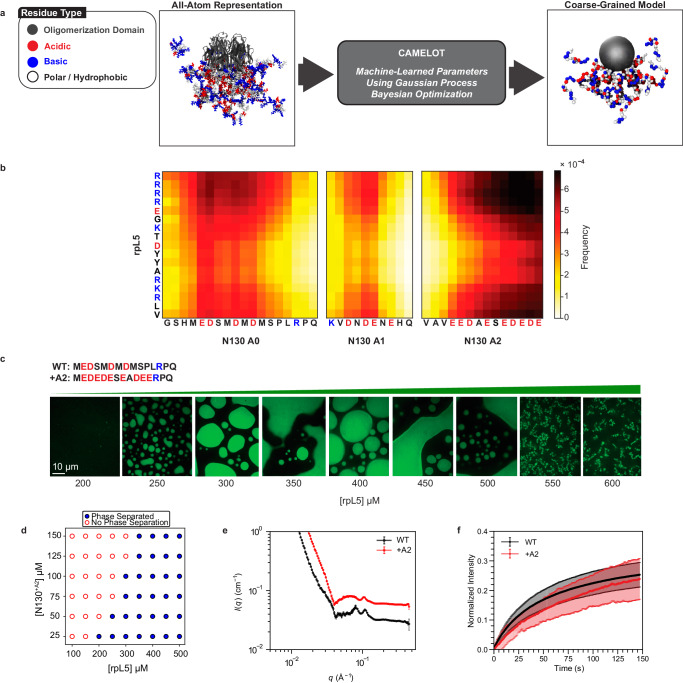
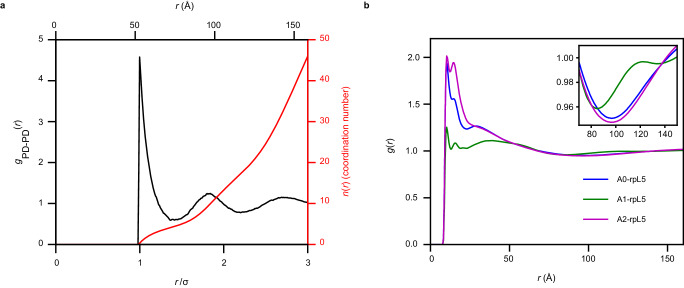
The functions of biomolecular condensates are thought to be influenced by their material properties, and these will be determined by the internal organization of molecules within condensates. However, structural characterizations of condensates are challenging, and rarely reported. Here, we deploy a combination of small angle neutron scattering, fluorescence recovery after photobleaching, and coarse-grained molecular dynamics simulations to provide structural descriptions of model condensates that are formed by macromolecules from nucleolar granular components (GCs). We show that these minimal facsimiles of GCs form condensates that are network fluids featuring spatial inhomogeneities across different length scales that reflect the contributions of distinct protein and peptide domains. The network-like inhomogeneous organization is characterized by a coexistence of liquid- and gas-like macromolecular densities that engenders bimodality of internal molecular dynamics. These insights suggest that condensates formed by multivalent proteins share features with network fluids formed by systems such as patchy or hairy colloids.
生物分子凝聚物的功能被认为受到其物质特性的影响,而这些特性将由凝聚物内部分子的内部组织决定。然而,凝聚物的结构特征具有挑战性,很少有报道。在这里,我们结合小角中子散射、光漂白荧光恢复和粗粒度分子动力学模拟,为核仁颗粒成分 (GC) 的大分子形成的模型凝聚物提供结构描述。我们表明,这些 GC 的最小复制品形成的凝聚物是网络流体,在不同的长度尺度上具有空间不均匀性,反映了不同蛋白质和肽结构域的贡献。网络状的不均匀组织的特点是存在液态和气态大分子密度的共存,导致内部分子动力学的双峰性。这些见解表明,多价蛋白质形成的凝聚物具有与具有斑状或毛茸茸胶体等系统形成的网络流体的特征。