Kim Minjin, Kim Ellie, Lee Hyeongsuk, Piao Meihua, Rosen Brittany, Allison Jeroan J, Zai Adrian H, Nguyen Hoa L, Shin Dong-Soo, Kahn Jessica A
College of Nursing, University of Cincinnati, Cincinnati, OH, United States.
Department of Population and Quantitative Health Sciences, University of Massachusetts Chan Medical School, Worcester, MA, United States.
Asian Pac Isl Nurs J. 2025 Apr 7;9:e71865. doi: 10.2196/71865.
Human papillomavirus (HPV) is the most common sexually transmitted infection (STI) worldwide and is associated with various cancers, including cervical and oropharyngeal cancers. Despite the availability of effective vaccines, significant disparities in HPV vaccination rates persist, particularly among racial and ethnic minorities, such as Korean Americans. Cultural stigma, language barriers, and limited access to tailored health information contribute to these disparities.
This study aimed to develop and evaluate the usability of K-Bot, an artificial intelligence (AI)-powered, culturally tailored, bilingual (Korean and English) chatbot designed to provide culturally sensitive health information about HPV vaccination to Korean immigrants and Korean Americans.
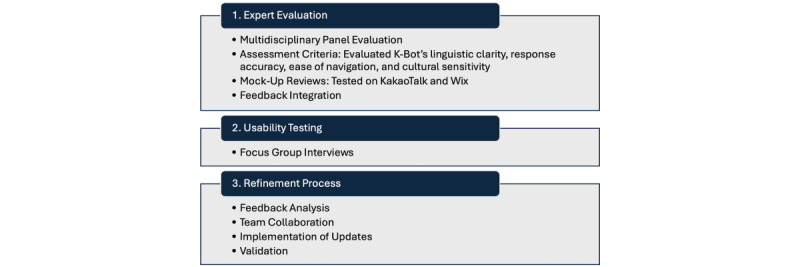
K-Bot was developed using CloudTuring and Google Dialogflow. Its dialogues were created using Centers for Disease Control and Prevention (CDC) evidence-based HPV information and tailored to the Korean American population based on findings from previous studies. The evaluation and refinement process for K-Bot was organized into 3 phases: (1) expert evaluation by a multidisciplinary panel, (2) usability testing, and (3) iterative refinement based on feedback. An online survey collected demographics, HPV awareness, and vaccination status before 6 focus groups (N=21) sessions using semistructured questions guided by Peter Morville's usability framework. Quantitative data were analyzed descriptively, and thematic analysis assessed usability, cultural relevance, and content clarity across 6 dimensions: desirability, accessibility, findability, credibility, usability, and usefulness.
Participants had a mean age of 23.7 (SD 4.7) years, with most being female (n=12, 57.1%), second-generation individuals (n=13, 61.9%), and single (n=20, 95.2%). HPV awareness was high (n=19, 90.5%), vaccine knowledge was also high (n=18, 81.8%), but only 11 (52.4%) participants were vaccinated. Feedback-driven refinements addressed usability challenges, including simplifying navigation and adding visual elements. Participants described K-Bot as a promising tool for promoting HPV vaccination among Korean and Korean American users, citing its bilingual functionality and culturally tailored content as key strengths. Evidence-based information was valued, but participants recommended visuals to improve engagement and reduce cognitive load. Accessibility concerns included broken links, and participants proposed enhancements, such as animations, demographic-specific resources, and interactive features, to improve usability and engagement further.
Usability testing of K-Bot revealed its potential as a culturally tailored, bilingual tool for promoting HPV vaccination among Korean immigrants and Korean Americans. Participants valued its evidence-based information, cultural relevance, and bilingual functionality but recommended improvements, such as enhanced navigation, visual elements, and interactive features, to boost engagement and usability. These findings support the potential of AI-driven tools to improve health care access by addressing key barriers to care. Further research is needed to evaluate their broader impact and optimize their design and implementation for individuals with diverse health care needs.
人乳头瘤病毒(HPV)是全球最常见的性传播感染(STI),与多种癌症相关,包括宫颈癌和口咽癌。尽管有有效的疫苗,但HPV疫苗接种率仍存在显著差异,尤其是在种族和少数族裔群体中,如韩裔美国人。文化耻辱感、语言障碍以及难以获取针对性的健康信息导致了这些差异。
本研究旨在开发并评估K-Bot的可用性,K-Bot是一款由人工智能(AI)驱动、文化定制的双语(韩语和英语)聊天机器人,旨在为韩国移民和韩裔美国人提供关于HPV疫苗接种的具有文化敏感性的健康信息。
K-Bot使用CloudTuring和谷歌Dialogflow开发。其对话内容基于美国疾病控制与预防中心(CDC)基于证据的HPV信息创建,并根据先前研究的结果针对韩裔美国人群体进行了定制。K-Bot的评估和优化过程分为三个阶段:(1)由多学科小组进行专家评估;(2)可用性测试;(3)根据反馈进行迭代优化。一项在线调查在6个焦点小组(N = 21)会议之前收集了人口统计学信息、HPV知晓情况和疫苗接种状况,使用由彼得·莫维尔的可用性框架指导的半结构化问题。对定量数据进行描述性分析,主题分析从六个维度评估可用性、文化相关性和内容清晰度:可取性、可访问性、可查找性、可信度、可用性和有用性。
参与者的平均年龄为23.7(标准差4.7)岁,大多数为女性(n = 12,57.1%)、第二代移民(n = 13,61.9%)且单身(n = 20,95.2%)。HPV知晓率较高(n = 19,90.5%),疫苗知识知晓率也较高(n = 18,81.8%),但只有11名(52.4%)参与者接种了疫苗。基于反馈的改进解决了可用性挑战,包括简化导航和添加视觉元素。参与者将K-Bot描述为在韩国人和韩裔美国用户中推广HPV疫苗接种的有前途的工具,认为其双语功能和文化定制内容是关键优势。基于证据的信息受到重视,但参与者建议添加视觉元素以提高参与度并减轻认知负担。可访问性问题包括链接中断,参与者提出了增强功能的建议,如动画、特定人群资源和交互式功能,以进一步提高可用性和参与度。
K-Bot的可用性测试揭示了其作为一种文化定制的双语工具在韩国移民和韩裔美国人中推广HPV疫苗接种的潜力。参与者重视其基于证据的信息、文化相关性和双语功能,但建议进行改进,如增强导航、视觉元素和交互式功能,以提高参与度和可用性。这些发现支持了人工智能驱动的工具通过解决关键医疗障碍来改善医疗服务可及性的潜力。需要进一步研究以评估其更广泛的影响,并针对具有不同医疗需求的个体优化其设计和实施。