Gómez-Urrego José Fernando, Yepes-Madrid Nathalie, Gil-Artunduaga Mónica Alexandra, Del Pilar Gómez-Mora María, Mejía-Rivera Luis Fernando, Pacheco-López Robinson, Rojas-Hernández Juan Pablo
Universidad Libre Seccional Cali, Cali, Valle del Cauca, Colombia.
Fundación Clínica Infantil Club Noel, Cali, Colombia.
Pediatr Rheumatol Online J. 2025 Apr 8;23(1):39. doi: 10.1186/s12969-025-01088-1.
Juvenile Systemic Lupus Erythematosus (JSLE) is a chronic, systemic autoimmune disease characterized by an increased susceptibility to infections. Fever in these patients can result from infection, heightened lupus activity, or a combination of both. Various clinical factors and biomarkers have been proposed to differentiate between infection and disease activity, but the results remain inconclusive. The Systemic Lupus Erythematosus Disease Activity Index-2000 (SLEDAI-2 k) is used to assess lupus activity in the presence or absence of infection. This study aimed to identify factors associated with bacterial infections in JSLE patients presenting with fever.
A case-control study, approved by the institutional ethics committee, was conducted.
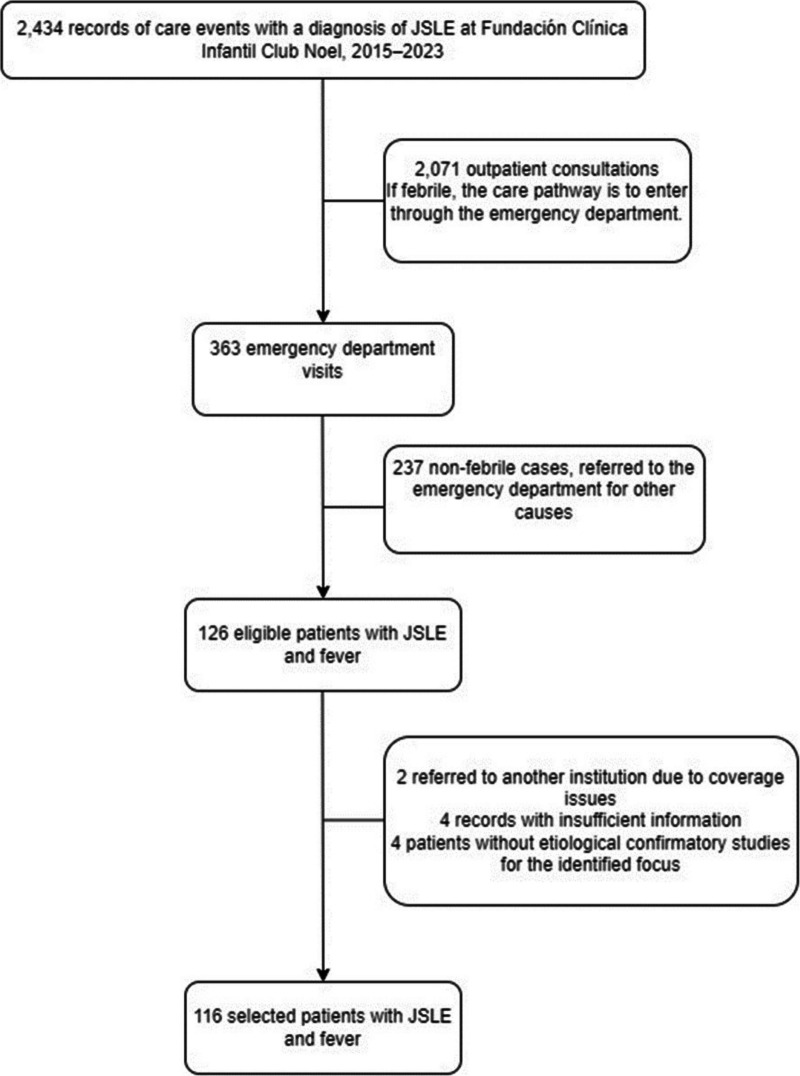
Bacterial infection was identified in 17% of 116 patients. Factors evaluated included immunomodulator use, high-dose steroids, renal replacement therapy, erythrocyte sedimentation rate (ESR) > 20, C-reactive protein (CRP) > 60 and > 90 mg/L, ferritin > 500 ng/mL, neutrophil-to-lymphocyte ratio (NLR) > 6, platelet-to-lymphocyte ratio (PLR) > 133, procalcitonin (PCT) > 0.9 ng/mL, lymphocyte-to-C4 ratio (LC4R) > 66.7, and ESR/CRP ratio < 2. In the adjusted model, PCT > 0.9 ng/mL retained significance with p < 0.01. Nagelkerke's R was 0.65, and the Hosmer-Lemeshow test indicated good internal validity.
Bacterial infection was detected in 17% of JSLE patients with fever. Procalcitonin > 0.9 ng/mL is a critical marker for identifying bacterial infection. NLR, PLR, ESR/CRP ratio, LC4R, and ferritin require further investigation to establish definitive cut-off values for differentiating bacterial infections from other infections or disease activity. Individual patient evaluation remains the recommended approach for diagnosis.
青少年系统性红斑狼疮(JSLE)是一种慢性全身性自身免疫性疾病,其特征是感染易感性增加。这些患者的发热可能由感染、狼疮活动加剧或两者共同引起。已经提出了各种临床因素和生物标志物来区分感染和疾病活动,但结果仍无定论。系统性红斑狼疮疾病活动指数2000(SLEDAI-2k)用于评估有无感染时的狼疮活动情况。本研究旨在确定发热的JSLE患者中与细菌感染相关的因素。
进行了一项经机构伦理委员会批准的病例对照研究。
116例患者中有17%被确诊为细菌感染。评估的因素包括免疫调节剂的使用、大剂量类固醇、肾脏替代治疗、红细胞沉降率(ESR)>20、C反应蛋白(CRP)>60和>90mg/L、铁蛋白>500ng/mL、中性粒细胞与淋巴细胞比值(NLR)>6、血小板与淋巴细胞比值(PLR)>133、降钙素原(PCT)>0.9ng/mL、淋巴细胞与C4比值(LC4R)>66.7以及ESR/CRP比值<2。在调整模型中,PCT>0.9ng/mL具有统计学意义,p<0.01。Nagelkerke's R为0.65,Hosmer-Lemeshow检验表明内部效度良好。
发热的JSLE患者中有17%检测到细菌感染。降钙素原>0.9ng/mL是识别细菌感染的关键标志物。NLR、PLR、ESR/CRP比值、LC4R和铁蛋白需要进一步研究以确定区分细菌感染与其他感染或疾病活动的明确临界值。个体患者评估仍是推荐的诊断方法。