Hidayatik Nanik, Khairullah Aswin Rafif, Yuliani M Gandul Atik, Hestianah Eka Pramyrtha, Novianti Arindita Niatazya, Damayanti Arindita Niatazya, Hisyam Mirza Atikah Madarina, Moses Ikechukwu Benjamin, Ahmad Riza Zainuddin, Wardhani Bantari Wisynu Kusuma, Wibowo Syahputra, Kurniasih Dea Anita Ariani
Division of Basic Veterinary Medicine, Faculty of Veterinary Medicine, Universitas Airlangga, Surabaya, Indonesia.
Research Center for Veterinary Science, National Research and Innovation Agency (BRIN), Bogor, Indonesia.
Open Vet J. 2025 Feb;15(2):541-555. doi: 10.5455/OVJ.2025.v15.i2.5. Epub 2025 Feb 28.
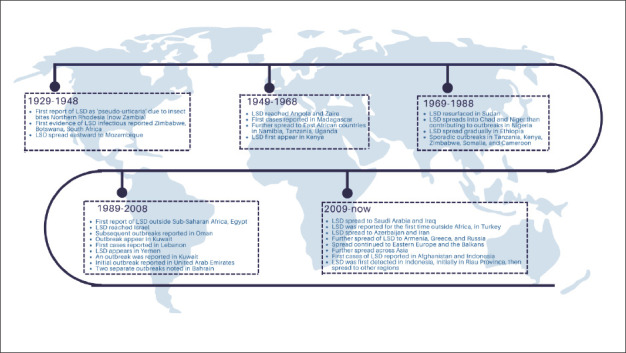
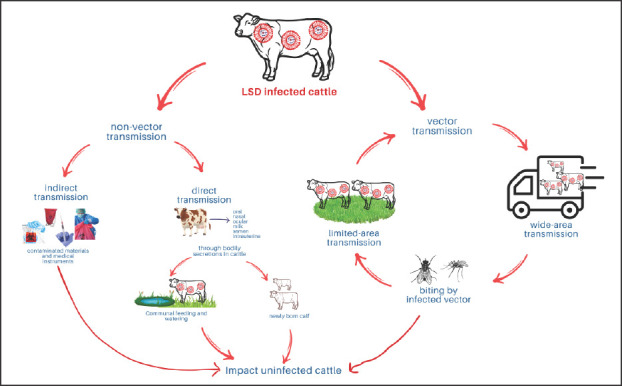
Lumpy Skin Disease (LSD) is an infectious disease in cattle caused by the Lumpy Skin Disease Virus by the Poxviridae family. Historically, LSD was first documented in Northern Rhodesia (now Zambia) in 1929 as a symptom of bug bite poisoning or hypersensitivity, described as pseudo-urticaria. This disease, which causes widespread malaise and persistent weakness, is a serious, economically devastating, and reportable condition that lowers cattle output. The illness starts as a biphasic fever. After fever, emaciation, ocular discharge, and agalactia, the clinical signs of a minor infection develop as one or two nodular lumps appear 2-3 days later. In particular, the skin of the muzzle, back, nostrils, legs, scrotum, eyelids, lower ears, nasal, perineum, oral mucosa, and tail display painful, hyperemic, nodular lesions. A number of diagnostic methods, such as virus isolation in cell culture, transmission electron microscopy, immunohistochemistry, direct and indirect fluorescent antibody testing, agar gel immunodiffusion, enzyme-linked immunosorbent assay, western blotting, and serum neutralization test (SNT), are used to confirm the clinical diagnosis. This disease is spread by arthropods such as flies, mosquitoes, and ticks. It is most common during the rainy season, when there is a high number of biting insects, and it declines during the dry season. LSD has direct and indirect economic impacts on livestock and the industry. Since there is no effective antiviral medication to treat LSD, the only viable method of disease containment is vaccination.
牛结节性皮肤病(LSD)是一种由痘病毒科的牛结节性皮肤病病毒引起的牛传染病。历史上,LSD于1929年在北罗德西亚(现赞比亚)首次被记录,当时被视为蚊虫叮咬中毒或超敏反应的症状,被描述为假性荨麻疹。这种疾病会导致广泛不适和持续虚弱,是一种严重的、对经济具有毁灭性影响且须上报的疾病,会降低牛的产量。该病起初表现为双相热。发热后出现消瘦、眼部分泌物增多和无乳症状,轻微感染的临床症状在2至3天后随着一两个结节状肿块出现而显现。特别是口鼻部、背部、鼻孔、腿部、阴囊、眼睑、耳下部、鼻腔、会阴部、口腔黏膜和尾部的皮肤会出现疼痛、充血的结节性病变。一些诊断方法,如细胞培养中的病毒分离、透射电子显微镜检查、免疫组织化学、直接和间接荧光抗体检测、琼脂凝胶免疫扩散、酶联免疫吸附测定、蛋白质免疫印迹法和血清中和试验(SNT),用于确诊临床诊断。这种疾病通过苍蝇、蚊子和蜱等节肢动物传播。在雨季,当叮咬昆虫数量众多时最为常见,在旱季则发病率下降。LSD对牲畜和畜牧业有直接和间接的经济影响。由于没有有效的抗病毒药物治疗LSD,控制该病的唯一可行方法是接种疫苗。