Piccirillo Marilyn L, Graupensperger Scott, Walukevich-Dienst Katherine, Lehinger Elizabeth, Smith-LeCavalier Kirstyn N, Foster Katherine T, Larimer Mary E
Department of Psychology, University of Washington, Seattle, WA, USA.
Department of Psychiatry, Division of Addiction Psychiatry, Rutgers Robert Wood Johnson Medical School, Piscataway, NJ, USA.
Addiction. 2025 Aug;120(8):1666-1678. doi: 10.1111/add.70044. Epub 2025 Apr 9.
Efficacy of brief alcohol interventions for young adults with internalizing distress (i.e. symptoms of depression, anxiety and stress) is unclear. We tested the moderating effect of internalizing distress on the efficacy of alcohol single- and multicomponent personalized feedback interventions (PFIs).
Secondary data were analyzed from a randomized controlled trial (RCT) testing the efficacy of single and multicomponent PFIs, compared with an attention-only control condition.
Participants were sampled from two West Coast universities in the United States. All study protocols were completed online.
Participants (n = 1137) were college students (63% female; M = 20.1 years; 62.6% non-Hispanic white) who reported on internalizing distress at baseline. Some individuals reported clinically significant symptoms (depression: mild/moderate = 24.0%, severe/extremely severe = 10.5%; anxiety: mild/moderate = 19.6%, severe/extremely severe = 11.4%; and stress: mild/moderate = 37.5%, severe/extremely severe = 6.0%).
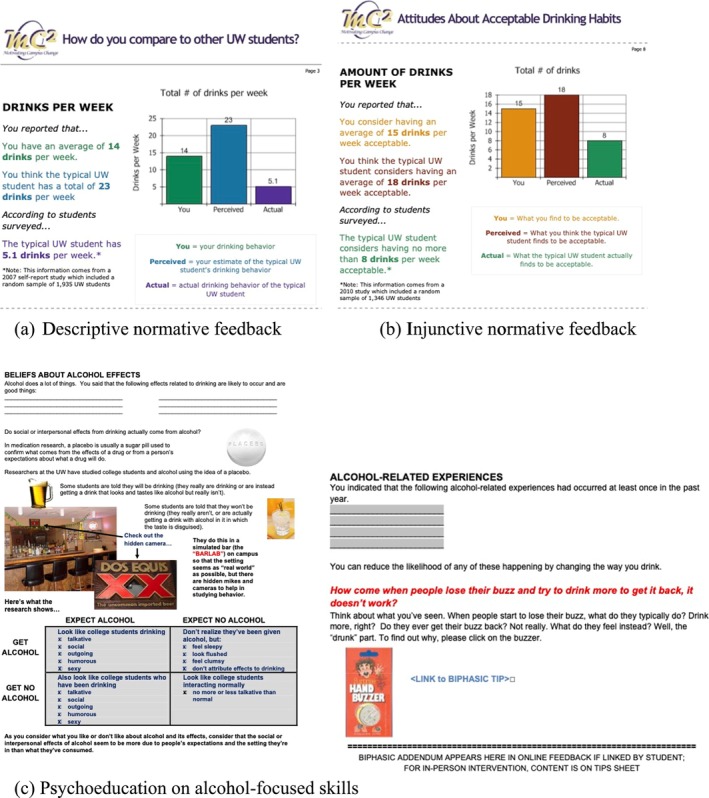
There were four different alcohol single-component PFIs administered and an attention-only PFI control. Alcohol PFIs varied in their complexity and single-component PFIs (i.e. personalized normative feedback) were compared with multicomponent PFI (i.e. containing additional alcohol-focused psychoeducation).
Baseline levels of internalizing distress were measured using the summed total of the Depression, Anxiety and Stress Scales (DASS). Drinking outcomes (alcohol consumption, peak eBAC, alcohol-related consequences) were measured at baseline, 3, 6 and 12 months post-intervention.
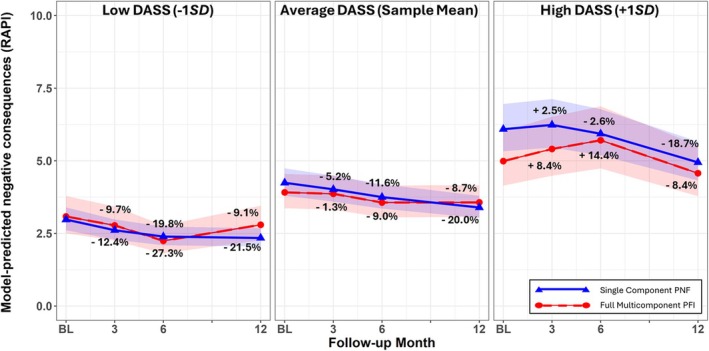
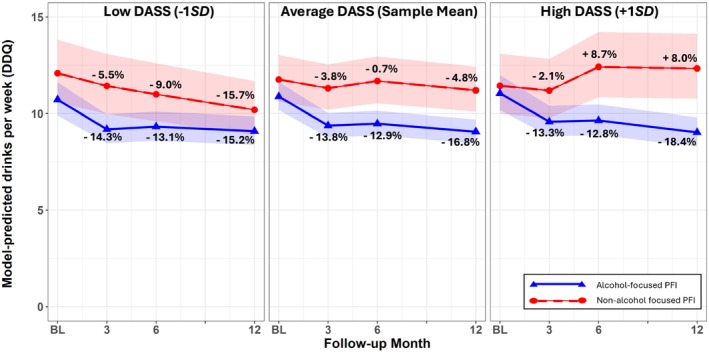
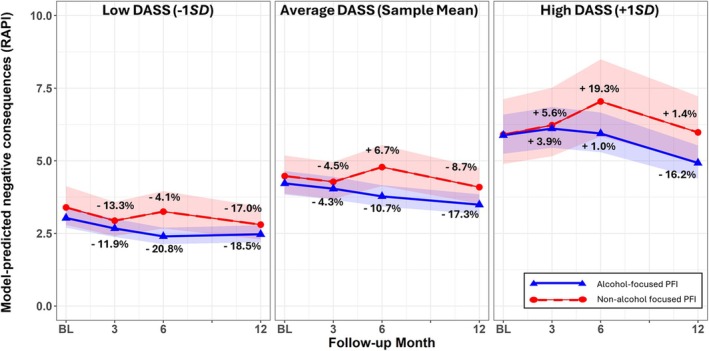
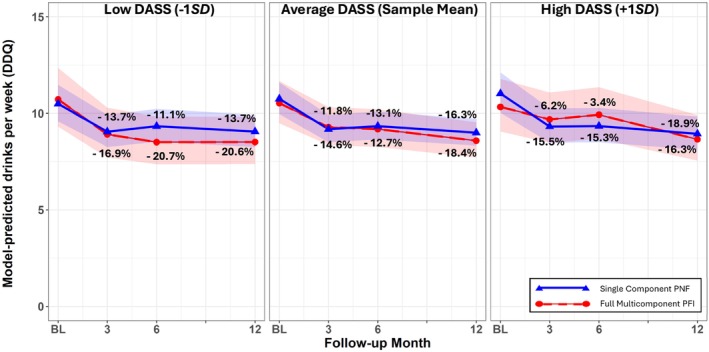
Alcohol PFI (compared with attention-only control) reduced alcohol consumption and related consequences at 6-month [rate ratio (RR) = 0.85, P = 0.004] or 12-month follow-ups (RR = 0.76, P < 0.001; RR = 0.85, P = 0.020), regardless of baseline DASS score. Participants with higher DASS scores (compared with those with lower DASS scores) reported lower 6-month alcohol consumption after receiving a single-component intervention (RR = 0.80, P < 0.001). However, individuals with higher DASS scores (compared to those with lower DASS scores) reported more 6-month alcohol-related consequences after receiving a multicomponent intervention (RR = 0.78, P = 0.004).
Personalized feedback interventions may demonstrate efficacy towards reducing drinking in young adults and appear similarly beneficial across levels of internalizing distress, although lower-complexity interventions may be more efficacious.
针对有内化性困扰(即抑郁、焦虑和压力症状)的年轻人,简短酒精干预的效果尚不清楚。我们测试了内化性困扰对酒精单组分和多组分个性化反馈干预(PFIs)效果的调节作用。
对一项随机对照试验(RCT)的二次数据进行分析,该试验测试了单组分和多组分PFIs的效果,并与仅给予关注的对照条件进行比较。
参与者从美国西海岸的两所大学中抽样选取。所有研究方案均通过在线方式完成。
参与者(n = 1137)为大学生(63%为女性;平均年龄 = 20.1岁;62.6%为非西班牙裔白人),他们在基线时报告了内化性困扰情况。一些个体报告有临床显著症状(抑郁:轻度/中度 = 24.0%,重度/极重度 = 10.5%;焦虑:轻度/中度 = 19.6%,重度/极重度 = 11.4%;压力:轻度/中度 = 37.5%,重度/极重度 = 6.0%)。
实施了四种不同的酒精单组分PFIs,并设置了仅给予关注的PFI对照。酒精PFIs在复杂性方面存在差异,单组分PFIs(即个性化规范反馈)与多组分PFIs(即包含额外的以酒精为重点的心理教育)进行比较。
使用抑郁、焦虑和压力量表(DASS)的总分来测量基线时的内化性困扰水平。在基线、干预后3个月、6个月和12个月测量饮酒结果(酒精摄入量、呼气酒精浓度峰值、与酒精相关的后果)。
无论基线DASS评分如何,酒精PFI(与仅给予关注的对照相比)在6个月(率比(RR) = 0.85,P = 0.004)或12个月随访时(RR = 0.76,P < 0.001;RR = 0.85,P = 0.020)降低了酒精摄入量及相关后果。与DASS评分较低者相比,DASS评分较高的参与者在接受单组分干预后,6个月时报告的酒精摄入量较低(RR = 0.80,P < 0.001)。然而,与DASS评分较低者相比,DASS评分较高的个体在接受多组分干预后,6个月时报告的与酒精相关的后果更多(RR = 0.78,P = 0.004)。
个性化反馈干预可能对减少年轻人饮酒具有效果,并且在内化性困扰水平不同的人群中似乎同样有益,尽管较低复杂性的干预可能更有效。