Tongwu Yu, Jinghui Zhong, Chuanwei Ding, Zijian Zhang, Yuxiong Xu
Capital University of Physical Education and Sports, Beijing, China.
Anhui Communications Vocational and Technical College, Hefei, China.
Front Physiol. 2025 Mar 27;16:1516268. doi: 10.3389/fphys.2025.1516268. eCollection 2025.
This study aimed to compare the consistency of physiological adaptations and inter-individual variability in response to three distinct high-intensity interval training (HIIT) protocols-anaerobic power reserve (APR), maximal aerobic power (MAP), and sprint interval training (SIT)-among elite male rowers. By exploring the impact of individualized intensity prescriptions, we sought to identify the most effective protocol for enhancing training consistency, as well as improving both aerobic and anaerobic performance while minimizing variability in individual responses.
Thirty well-trained male rowers (mean age: 24.9 ± 3.1 years; height: 185 ± 4.4 cm; body mass: 86 ± 7.9 kg; body fat: 12.5% ± 2.4%) participated in the study. All participants were members of a national rowing team with an average of 6 years of competitive experience and regular participation in national and international championships. The intervention involved 6 weeks of individualized HIIT, performed three times per week, with pre- and post-tests assessing VOmax, cardiovascular efficiency (Qmax), anaerobic power (MSP, CP), and 2,000-m rowing performance.
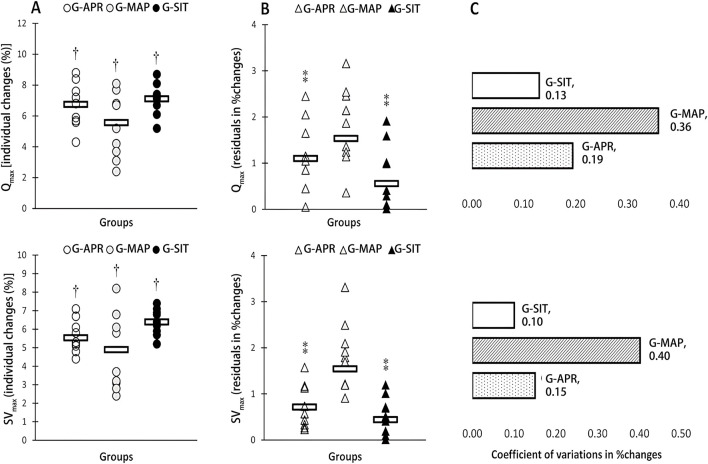
All interventions resulted in significant improvements in VOmax, Qmax, MSP, and 2,000-m rowing time trial performance (p < 0.05). The SIT group exhibited the largest relative improvements, with VOmax increasing by 6.3% (from 51.9 ± 3.2 to 55.2 ± 3.3 mL·kg·min, Cohen's d = 1.05, 95% CI [0.57, 1.53]), Qmax by 6.4% (Cohen's d = 1.15, 95% CI [0.66, 1.64]), and a 3.7% reduction in 2,000-m time (Cohen's d = 0.86, 95% CI [0.39, 1.33]). Notably, SIT demonstrated the lowest variability across all measured outcomes, as evidenced by reduced coefficients of variation and narrower confidence intervals.
The SIT protocol, emphasizing maximal exertion, led to the most consistent adaptations and the greatest improvements across key performance metrics, including VOmax, Qmax, and 2,000-m rowing performance. These results suggest that SIT may be the optimal approach for improving performance consistency and maximizing physiological adaptations in elite rowers. Future research should explore the long-term applicability and potential integration of SIT with other training modalities to further enhance rowing performance.
本研究旨在比较精英男子赛艇运动员对三种不同的高强度间歇训练(HIIT)方案——无氧功率储备(APR)、最大有氧功率(MAP)和冲刺间歇训练(SIT)——的生理适应性一致性和个体间差异。通过探究个性化强度处方的影响,我们试图确定最有效的方案,以提高训练一致性,同时改善有氧和无氧运动表现,并使个体反应的变异性最小化。
30名训练有素的男性赛艇运动员(平均年龄:24.9±3.1岁;身高:185±4.4厘米;体重:86±7.9千克;体脂:12.5%±2.4%)参与了本研究。所有参与者均为国家赛艇队队员,平均有6年的比赛经验,且经常参加国内和国际锦标赛。干预措施包括为期6周的个性化HIIT,每周进行3次,在训练前后分别测试最大摄氧量(VOmax)、心血管效率(Qmax)、无氧功率(MSP、CP)和2000米赛艇成绩。
所有干预措施均使VOmax、Qmax、MSP和2000米计时赛成绩有显著改善(p<0.05)。SIT组的相对改善最大,VOmax增加了6.3%(从51.9±3.2增至55.2±3.3毫升·千克·分钟,科恩d值=1.05,95%置信区间[0.57,1.53]),Qmax增加了6.4%(科恩d值=1.15,95%置信区间[0.66,1.64]),2000米用时减少了3.7%(科恩d值=0.86,95%置信区间[0.39,1.33])。值得注意的是,SIT在所有测量结果中的变异性最低,变异系数降低和置信区间变窄证明了这一点。
强调最大努力程度的SIT方案在关键性能指标(包括VOmax、Qmax和2000米赛艇成绩)方面带来了最一致的适应性变化和最大的改善。这些结果表明,SIT可能是提高精英赛艇运动员成绩一致性和最大化生理适应性的最佳方法。未来的研究应探索SIT的长期适用性以及与其他训练方式的潜在结合,以进一步提高赛艇成绩。