School of Life and Medical Sciences, University of Hertfordshire, Hatfield, UK.
Exp Physiol. 2023 Apr;108(4):581-594. doi: 10.1113/EP090878. Epub 2023 Jan 29.
What is the central question of this study? Does prescribing exercise intensity using physiological thresholds create a more homogeneous exercise stimulus than using traditional intensity anchors? What is the main finding and its importance? Prescribing exercise using physiological thresholds, notably critical power, reduced the variability in exercise tolerance and acute metabolic responses. At higher intensities, approaching or exceeding the transition from heavy to severe intensity exercise, the imprecision of using fixed % as an intensity anchor becomes amplified.
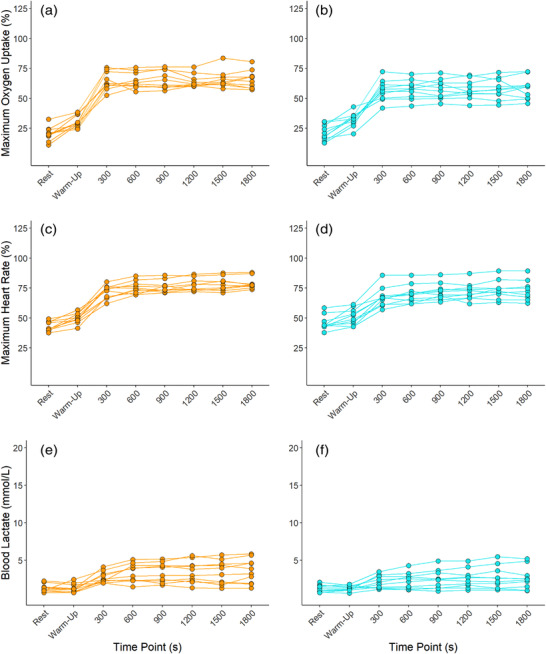
The objective of this study was to determine whether the variability in exercise tolerance and physiological responses is lower when exercise is prescribed relative to physiological thresholds (THR) compared to traditional intensity anchors (TRAD). Ten individuals completed a series of maximal exercise tests and a series of moderate (MOD), heavy (HVY) and severe intensity (HIIT) exercise bouts prescribed using THR intensity anchors (critical power and gas exchange threshold) and TRAD intensity anchors (maximum oxygen uptake; ). There were no differences in exercise tolerance or acute response variability between MOD and MOD . All individuals completed HVY but only 30% completed HVY . Compared to HVY , where work rates were all below critical power, work rates in HVY exceeded critical power in 70% of individuals. There was, however, no difference in acute response variability between HVY and HVY . All individuals completed HIIT but only 20% completed HIIT . The variability in peak (F = 0.274) and average (F = 0.318) blood lactate responses was lower in HIIT compared to HIIT . The variability in W' depletion (the finite work capacity above critical power) after the final interval bout was lower in HIIT compared to HIIT (F = 0.305). Using physiological thresholds to prescribe exercise intensity reduced the heterogeneity in exercise tolerance and physiological responses to exercise spanning the boundary between the heavy and severe intensity domains. To increase the precision of exercise intensity prescription, it is recommended that, where possible, physiological thresholds are used in place of .
本研究的核心问题是什么?使用生理阈值来规定运动强度是否比使用传统强度锚点产生更同质的运动刺激?主要发现及其重要性是什么?使用生理阈值(尤其是临界功率)规定运动强度减少了运动耐量和急性代谢反应的可变性。在更高的强度下,接近或超过从重度到极重度运动强度的转变,使用固定的%作为强度锚点的不准确性会放大。
本研究的目的是确定与传统强度锚点(TRAD)相比,当根据生理阈值(THR)规定运动强度时,运动耐量和生理反应的可变性是否更低。10 名个体完成了一系列最大运动测试和一系列中度(MOD)、重度(HVY)和极重度强度(HIIT)运动,这些运动是使用 THR 强度锚点(临界功率和气体交换阈值)和 TRAD 强度锚点(最大摄氧量; )规定的。MOD 和 MOD 之间的运动耐量或急性反应变异性没有差异。所有人都完成了 HVY,但只有 30%的人完成了 HVY 。与 HVY 相比,HVY 中的工作率都低于临界功率,而 70%的个体 HVY 中的工作率超过了临界功率。然而,HVY 和 HVY 之间的急性反应变异性没有差异。所有人都完成了 HIIT,但只有 20%的人完成了 HIIT 。与 HIIT 相比,HIIT 中峰值(F=0.274)和平均(F=0.318)血乳酸反应的变异性较低。最后一个间隔回合后 W'耗竭(临界功率以上的有限工作能力)的变异性在 HIIT 中比 HIIT 中低(F=0.305)。使用生理阈值规定运动强度减少了在重度和极重度运动强度之间的边界处运动耐量和生理反应的异质性。为了提高运动强度规定的精度,建议在可能的情况下,使用生理阈值代替 。