Center for Evolution and Medicine, School of Life Sciences, Arizona State University, Tempe, AZ, USA.
The Biodesign Center for Immunotherapy, Vaccines and Virotherapy, Arizona State University, Tempe, AZ, USA.
Malar J. 2023 Feb 7;22(1):46. doi: 10.1186/s12936-023-04473-x.
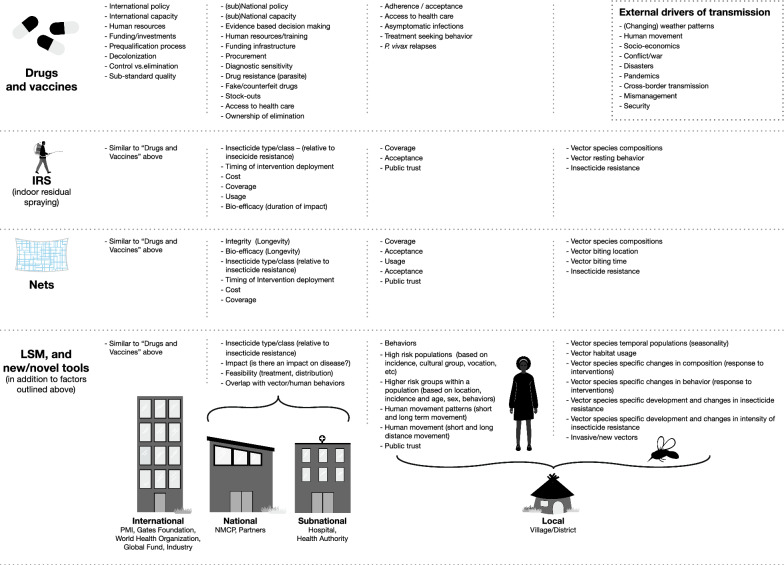
Progress in reducing both malaria cases and deaths has stalled with regression seen in many geographies. While significant attention is given to the contributing challenges of drug and insecticide resistance, 'residual' malaria is often diminished to transmission resulting from outdoor-biting or zoophagic/opportunistic mosquito vectors. These specific vector bionomic traits are only part of the problem, as residual transmission may be driven by (a combination of) (1) sub-optimal intervention coverage, quality, acceptance, and/or usage, (2) drug resistance, (3) insecticide resistance, (4) refractory, resistant and adaptive vector and human behaviours that lower intervention effectiveness, (5) lack of, limited access to, and/or willingness to use healthcare systems, (6) diagnostic sensitivity along with the parallel issue of hrp2/3 mutations, (7) (inter)national policy, (8) the research and development pipeline, and (9) external factors such as natural disasters and conflict zones. Towards combating the minimization of this extensive and multipronged issue among the scientific community, funding agencies, and public health officials responsible for guiding or developing malaria programmes, an alternative way of describing this transmission is proposed by focusing in on the causative 'gaps in protection'. Defining and wording it as such zeros in on the drivers that result in the observed remaining (or increasing) transmission, allowing the malaria community to focus on solutions by identifying the actual causes. Outlining, defining and quantifying the gaps in protection for a given system is of utmost importance to understand what needs to be done, differentiating what can be done versus what cannot be tackled at that moment, along with delineating the technical and financial capacity required.
减少疟疾病例和死亡人数的工作进展已经停滞不前,许多地区出现了倒退。虽然人们非常关注药物和杀虫剂耐药性等挑战,但“残留”疟疾通常被认为是由户外叮咬或食虫/机会性蚊子传播引起的。这些特定的蚊子生物学特征只是问题的一部分,因为残留传播可能是由以下因素(组合)驱动的:(1)干预措施的覆盖范围、质量、接受程度和/或使用情况不理想,(2)药物耐药性,(3)杀虫剂耐药性,(4)蚊子和人类的抗性和适应性行为降低了干预效果,(5)缺乏、有限的获得医疗保健系统的机会以及/或者不愿意使用医疗保健系统,(6)诊断敏感性以及 hrp2/3 突变的平行问题,(7)(国际)政策,(8)研发管道,以及(9)自然灾害和冲突地区等外部因素。为了在科学界、资助机构以及负责指导或制定疟疾规划的公共卫生官员中应对这一广泛而多方面问题的最小化,建议通过关注导致观察到的持续(或增加)传播的“保护差距”来描述这种传播。将其定义和表述为这种方式,可以集中关注导致观察到的持续(或增加)传播的驱动因素,使疟疾界能够通过确定实际原因来专注于解决办法。为特定系统确定、定义和量化保护差距对于理解需要做什么至关重要,可以区分此时可以做什么和不能做什么,并确定所需的技术和财务能力。