Komemi Oded, Orbuch Elina, Jarchowsky-Dolberg Osnat, Brin Yaron Shraga, Tartakover-Matalon Shelly, Pasmanik-Chor Metsada, Lishner Michael, Drucker Liat
Oncogenetic Laboratory, Meir Medical Center, Kfar Saba, Israel.
Faculty of Medical and Health Sciences, Tel Aviv University, Tel Aviv, Israel.
Oncogenesis. 2025 Apr 11;14(1):9. doi: 10.1038/s41389-025-00554-5.
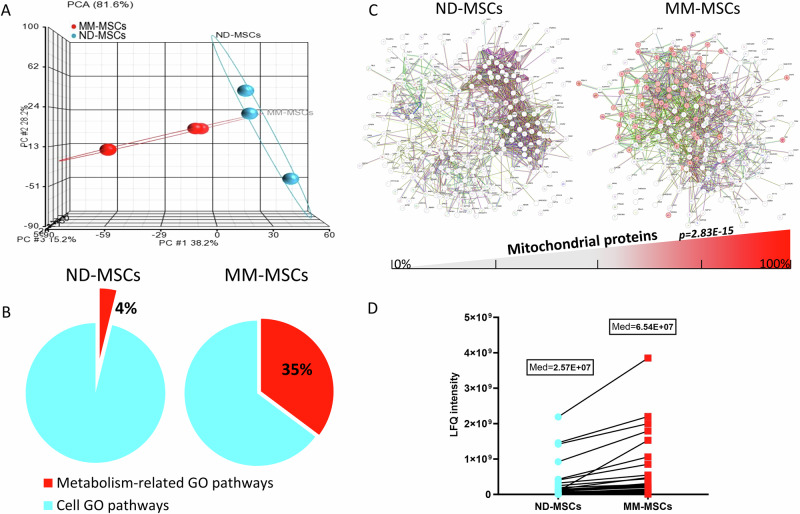
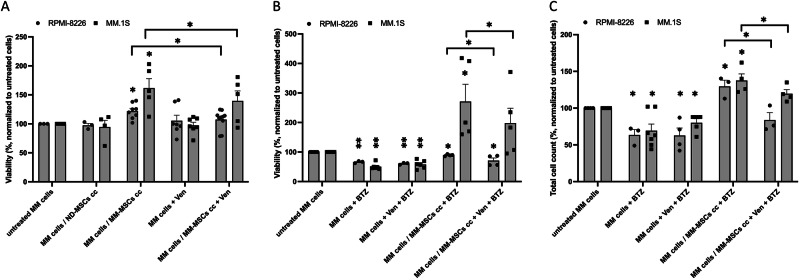
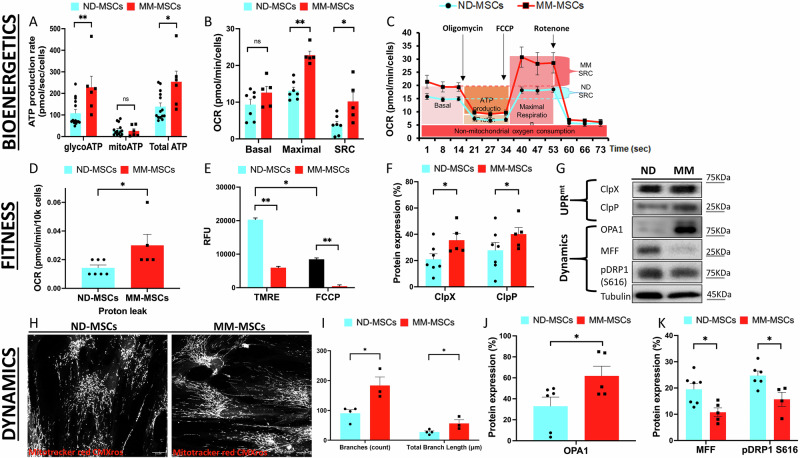
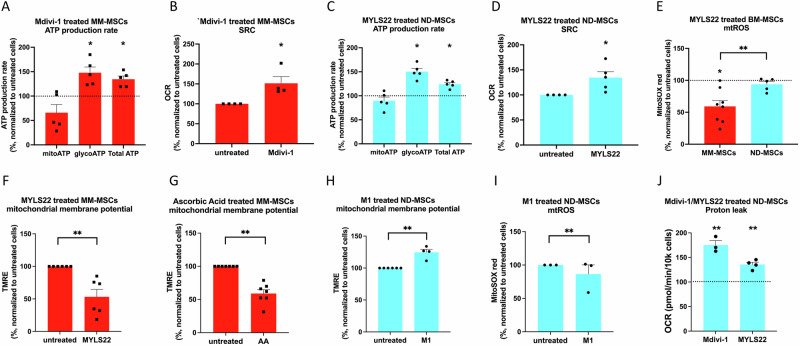
Bone-marrow mesenchymal stem cells (BM-MSCs) rely on glycolysis, yet their trafficked mitochondria benefit recipient cells' bioenergetics in regenerative and cancerous settings, most relevant to BM-resident multiple myeloma (MM) cells. Fission/fusion dynamics regulate mitochondria function. Proteomics demonstrates excessive mitochondrial processes in BM-MSCs from MM patients compared to normal donors (ND). Thus, we aimed to characterize BM-MSCs (ND, MM) mitochondrial fitness, bioenergetics and dynamics with a focus on therapeutics. MM-MSCs displayed compromised mitochondria evidenced by decreased mitochondrial membrane potential (ΔΨm) and elevated proton leak. This was accompanied by stimulation of stress-coping mechanisms: spare respiratory capacity (SRC), mitochondrial fusion and UPR. Interfering with BM-MSCs mitochondrial dynamics equilibrium demonstrated their significance to bioenergetics and fitness according to the source. While ND-MSCs depended on fission, reducing MM-MSCs fusion attenuated glycolysis, OXPHOS and mtROS. Interestingly, optimization of mtROS levels is central to ΔΨm preservation in MM-MSCs only. MM-MSCs also demonstrated STAT3 activation, which regulates their OXPHOS and SRC. Targeting MM-MSC' SRC with Venetoclax diminished their pro-MM support and sensitized co-cultured MM cells to Bortezomib. Overall, MM-MSCs distinct mitochondrial bioenergetics are integral to their robustness. Repurposing Venetoclax as anti-SRC treatment in combination with conventional anti-MM drugs presents a potential selective way to target MM-MSCs conferred drug resistance.
骨髓间充质干细胞(BM-MSCs)依赖糖酵解,但其转运的线粒体在再生和癌症环境中有利于受体细胞的生物能量学,这与骨髓驻留的多发性骨髓瘤(MM)细胞最为相关。裂变/融合动力学调节线粒体功能。蛋白质组学表明,与正常供体(ND)相比,MM患者的BM-MSCs中线粒体过程过多。因此,我们旨在表征BM-MSCs(ND、MM)的线粒体健康状况、生物能量学和动力学,重点关注治疗方法。MM-MSCs显示出线粒体受损,表现为线粒体膜电位(ΔΨm)降低和质子泄漏增加。这伴随着应激应对机制的刺激:备用呼吸能力(SRC)、线粒体融合和未折叠蛋白反应(UPR)。干扰BM-MSCs的线粒体动力学平衡表明,根据来源,它们对生物能量学和健康状况具有重要意义。虽然ND-MSCs依赖裂变,但减少MM-MSCs的融合会减弱糖酵解、氧化磷酸化(OXPHOS)和线粒体活性氧(mtROS)。有趣的是,仅在MM-MSCs中,mtROS水平的优化对于ΔΨm的维持至关重要。MM-MSCs还表现出信号转导和转录激活因子3(STAT3)的激活,该因子调节其OXPHOS和SRC。用维奈托克靶向MM-MSC的SRC可减少其对MM的支持,并使共培养的MM细胞对硼替佐米敏感。总体而言,MM-MSCs独特的线粒体生物能量学是其稳健性的组成部分。将维奈托克重新用作抗SRC治疗并与传统抗MM药物联合使用,为靶向MM-MSCs赋予的耐药性提供了一种潜在的选择性方法。