Oteri Vittorio, Contrafatto Laura, Santoro Gaetano Maria, Barca Ignazio, Tumminia Andrea, Vinciguerra Federica, Frittitta Lucia, Frasca Francesco, Sciacca Laura, Baratta Roberto
Endocrinology Section, Department of Clinical and Experimental Medicine, Garibaldi-Nesima Hospital, University of Catania, 95122 Catania, CT, Italy.
Department of Clinical and Experimental Medicine, University of Catania, 95122 Catania, CT, Italy.
Nutrients. 2025 Mar 30;17(7):1209. doi: 10.3390/nu17071209.
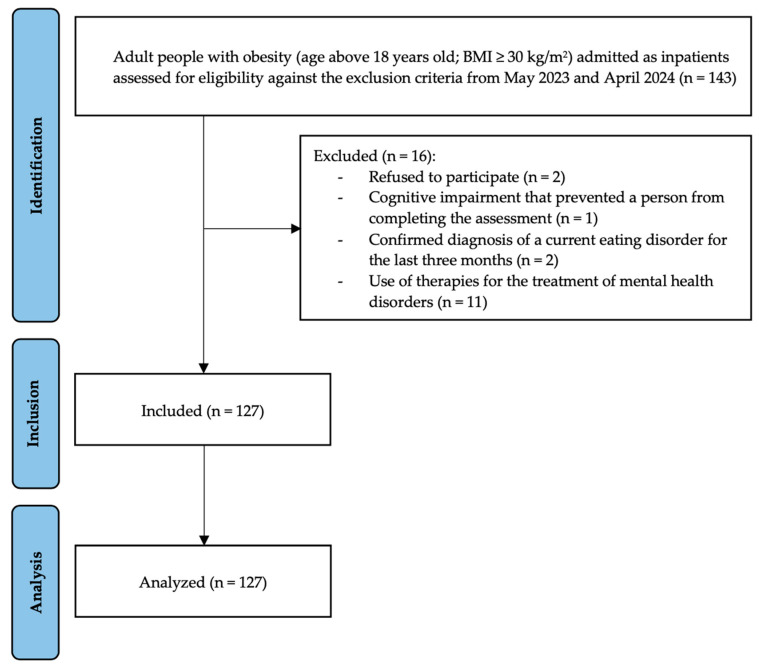
Over the past decade, numerous studies have explored the bidirectional relationship between obesity and mental health, mainly eating disorders (EDs). This study aimed to assess the prevalence and characteristics of altered eating behaviors (AEBs) in a cohort of people with obesity (PwO) using the validated Eating Behaviors Assessment for Obesity (EBA-O). We conducted a cross-sectional study from May 2023 to April 2024, recruiting consecutive PwO seeking weight loss. Participants completed the 18-item EBA-O questionnaire, which focuses on five primary eating behaviors: night eating, food addiction, sweet eating, hyperphagia, and binge eating. Unlike other validated tools, the EBA-O is specifically designed to capture these behaviors in PwO and is easy for patients to self-administer. We also collected sociodemographic and clinical data. A total of 127 participants were included (76 women, median age 52 years, median BMI 42.9 kg/m). We found a significant prevalence of AEBs: 33.1% for sweet eating, 23.6% for hyperphagia, 15.7% for food addiction, 14.2% for binge eating, and 7.1% for night eating. The EBA-O scores correlated positively with BMI (r = 0.201, = 0.024) and increased across BMI categories ( = 0.001). Males had higher scores for night eating and hyperphagia ( = 0.01), and active smokers had higher hyperphagia scores ( = 0.043) than ex-smokers and non-smokers. The night eating scores were inversely correlated with sleep hours (r = -0.197, = 0.026), and food addiction was positively correlated with age (r = 0.261, = 0.003); conversely, hyperphagia (r = -0.198, = 0.025) and binge eating (r = -0.229, = 0.010) were inversely correlated with age. PwO without diabetes had higher scores for food addiction ( = 0.01) and binge eating ( = 0.004) compared to those with diabetes. These results highlight the potential to characterize PwO based on their AEBs, offering new opportunities to tailor treatment strategies for PwO by targeting specific eating behaviors.
在过去十年中,众多研究探讨了肥胖与心理健康之间的双向关系,主要是饮食失调(EDs)。本研究旨在使用经过验证的肥胖饮食行为评估量表(EBA-O)评估肥胖人群队列中饮食行为改变(AEB)的患病率和特征。我们在2023年5月至2024年4月期间进行了一项横断面研究,连续招募寻求减肥的肥胖患者。参与者完成了包含18个条目的EBA-O问卷,该问卷聚焦于五种主要饮食行为:夜间进食、食物成瘾、甜食摄入、食欲过盛和暴饮暴食。与其他经过验证的工具不同,EBA-O是专门为捕捉肥胖患者的这些行为而设计的,并且患者易于自行管理。我们还收集了社会人口统计学和临床数据。总共纳入了127名参与者(76名女性,中位年龄52岁,中位体重指数42.9kg/m²)。我们发现AEB的患病率很高:甜食摄入为33.1%,食欲过盛为23.6%,食物成瘾为15.7%,暴饮暴食为14.2%,夜间进食为7.1%。EBA-O得分与体重指数呈正相关(r = 0.201,P = 0.024),并且在不同体重指数类别中升高(P = 0.001)。男性在夜间进食和食欲过盛方面得分更高(P = 0.01),与已戒烟者和非吸烟者相比,当前吸烟者在食欲过盛方面得分更高(P = 0.043)。夜间进食得分与睡眠时间呈负相关(r = -0.197,P = 0.026),食物成瘾与年龄呈正相关(r = 0.261,P = 0.003);相反,食欲过盛(r = -0.198,P = 0.025)和暴饮暴食(r = -0.229,P = 0.010)与年龄呈负相关。与患有糖尿病的肥胖患者相比,未患糖尿病的肥胖患者在食物成瘾(P = 0.01)和暴饮暴食(P = 0.004)方面得分更高。这些结果突出了根据肥胖患者的AEB对其进行特征描述的潜力,为通过针对特定饮食行为为肥胖患者量身定制治疗策略提供了新机会。