
免提式阿塔兰特外骨骼用于中风后步态和平衡康复:一项安全性研究。
Hands-free Atalante exoskeleton in post-stroke gait and balance rehabilitation: a safety study.
作者信息
Lejeune Thierry, Nuic Dijana, Dehem Stéphanie, Previnaire Jean-Gabriel, Cuenot Céline, Debugne Thierry, Kaps Jerome, Paul Bérénice, Pean Vincent, Perez Sergi Sanz, Juhel Fanny, Tatsidou Soultana, Kerdraon Jacques
机构信息
Cliniques universitaires Saint-Luc, Service d Médecine Physique et Réadaptation; Université catholique de Louvain, Secteur des Sciences de la Santé, Institut de Recherche Expérimentale et Clinique, NMSK, 1200, Avenue Hippocrate 10, Bruxelles, Belgium.
Wandercraft, Paris, France.
出版信息
J Neuroeng Rehabil. 2025 Apr 12;22(1):82. doi: 10.1186/s12984-025-01621-z.
BACKGROUND
Stroke often results in gait dysfunction, impairing daily activities and quality of life. Overground robotic exoskeletons hold promise for post-stroke rehabilitation. This study primarily aimed to assess the safety of hands-free Atalante exoskeleton training in post-stroke subjects, with a secondary aim to assess gait and balance.
METHODS
Forty subjects (10.2 ± 12.1 months post-stroke) with gait dysfunction (Functional Ambulation Category [FAC] score ≤ 3) underwent five training sessions over three weeks with a hands-free exoskeleton (Atalante, Wandercraft, France). Safety, the primary outcome, was evaluated by the number and severity of adverse events (AEs), judged by an independent clinical evaluation committee (CEC). A usability test was performed during the fifth training session followed by the exoskeleton use questionnaire. Gait and balance were assessed pre/post-training via walking capacity score (FAC), gait speed by 10-meter walk test (10MWT), walked distance by 6-minute walk test (6MWT), and balance by Berg Balance Scale (BBS). Spasticity was assessed with the Modified Ashworth scale. Anxiety and depression were quantified using the Hospital Anxiety and Depression Scale. Safety outcomes were analyzed using the Wilson, Lee and Dubin methods for proportions, and occurrence rates were computed. Within-group differences were compared using Wilcoxon, McNemar, and Friedman tests, with significance set at P < 0.05.
RESULTS
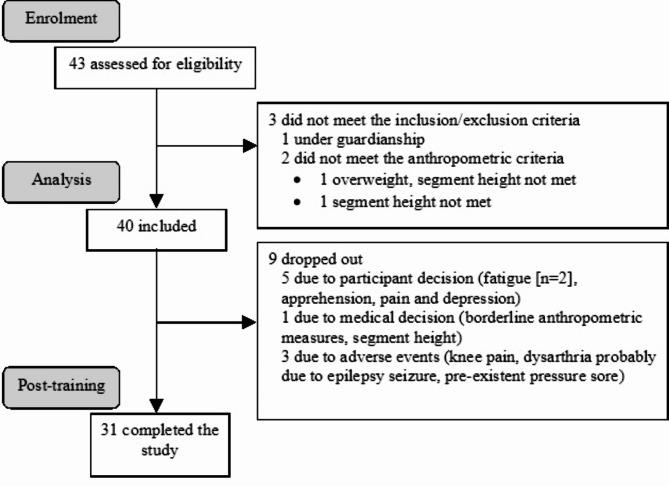
Thirty-one subjects completed the training sessions, while nine discontinued. The study reported two serious adverse events (SAE) (vertigo, dysarthria) and six AEs, with the CEC concluding that no SAE was linked to the device/study procedure. The average AE rate per session was 2.5 ± 1.4%, including four events possibly linked to the device/study procedure (knee pain [n = 1], skin lacerations [n = 3]), classified as negligible or minor by the CEC. A high proportion (82.6%) successfully completed the usability test and reported satisfaction (90%) on the exoskeleton use questionnaire. For gait and balance, favorable changes were observed in FAC, 10MWT, 6MWT, and BBS scores Post-training (p < 0.05, respectively). Spasticity, anxiety, and depression remained unchanged.
CONCLUSIONS
This study indicates that the hands-free Atalante exoskeleton is safe, feasible, and well-tolerated for gait and balance rehabilitation in post-stroke subjects, warranting larger randomized controlled trials to assess its efficacy.
TRIAL REGISTRATION
Evaluation of the Use of the Atalante Exoskeleton in Patients Presenting an Hemiplegia Due to Cerebrovascular Accident (INSPIRE) trial was registered at ClinicalTrials.gov (NCT04694001, registered on 20201231).
背景
中风常导致步态功能障碍,影响日常活动和生活质量。地面机器人外骨骼有望用于中风后的康复治疗。本研究主要旨在评估免提式阿塔兰特外骨骼训练对中风患者的安全性,次要目的是评估步态和平衡能力。
方法
40名中风后(10.2±12.1个月)且伴有步态功能障碍(功能性步行分类[FAC]评分≤3)的受试者,在三周内使用免提外骨骼(法国Wandercraft公司的阿塔兰特)进行了五次训练。安全性作为主要结局指标,由独立临床评估委员会(CEC)通过不良事件(AE)的数量和严重程度进行评估。在第五次训练期间进行了可用性测试,随后进行了外骨骼使用问卷调查。通过步行能力评分(FAC)、10米步行测试(10MWT)的步态速度、6分钟步行测试(6MWT)的步行距离以及伯格平衡量表(BBS)评估训练前后的步态和平衡能力。使用改良Ashworth量表评估痉挛程度。使用医院焦虑抑郁量表对焦虑和抑郁进行量化。使用Wilson、Lee和Dubin方法分析安全性结局指标的比例,并计算发生率。组内差异采用Wilcoxon、McNemar和Friedman检验进行比较,显著性设定为P<0.05。
结果
31名受试者完成了训练课程,9名受试者退出。该研究报告了两起严重不良事件(SAE)(眩晕、构音障碍)和6起AE,CEC得出结论,没有SAE与设备/研究程序相关。每次训练的平均AE发生率为2.5±1.4%,其中4起事件可能与设备/研究程序相关(膝关节疼痛[n = 1]、皮肤撕裂伤[n = 3]),CEC将其分类为可忽略或轻微。高比例(82.6%)的受试者成功完成了可用性测试,并在外骨骼使用问卷中报告了满意度(90%)。对于步态和平衡能力,训练后FAC、10MWT、6MWT和BBS评分出现了有利变化(p分别<0.05)。痉挛、焦虑和抑郁情况保持不变。
结论
本研究表明,免提式阿塔兰特外骨骼对中风患者的步态和平衡康复是安全、可行且耐受性良好的,有必要进行更大规模的随机对照试验来评估其疗效。
试验注册
阿塔兰特外骨骼在脑血管意外偏瘫患者中的应用评估(INSPIRE)试验已在ClinicalTrials.gov注册(NCT04694001,于2020年12月31日注册)。

 Zotero 插件