Huang Sheng-Shiung, Jen Hsiu-Fang, Tsay Shiow-Luan, Wang Ya-Jung, Tung Heng-Hsin
College of Nursing and Health Sciences, Da-Yeh University, Changhua, Taiwan.
Department of General Surgery, China Medical University Beigang Hospital, Yunlin, Taiwan.
J Nurs Manag. 2024 Jan 16;2024:2049627. doi: 10.1155/2024/2049627. eCollection 2024.
The link between organizational culture, organizational trust, job satisfaction, and team-based practice among nurse practitioners (NPs) has not been examined simultaneously.
To identify the effects of organizational culture, organizational trust, and other factors on NPs such as job satisfaction and team-based practice.
We used a cross-sectional design with a national sample. Data were collected using an online survey of 1,100 NPs working in acute care settings. The survey included demographic and working characteristics, the Organizational Culture Scale, the Organizational Trust Scale, the Misener Nurse Practitioner Job Satisfaction Scale (MNPJSS), and the NP-physician relations (NP-PR) subscale of the Nurse Practitioner Primary Care Organizational Climate (NP-PCOCQ). Multiple regression analysis with a stepwise selection method explored potential factors that influence job satisfaction and team-based practice.
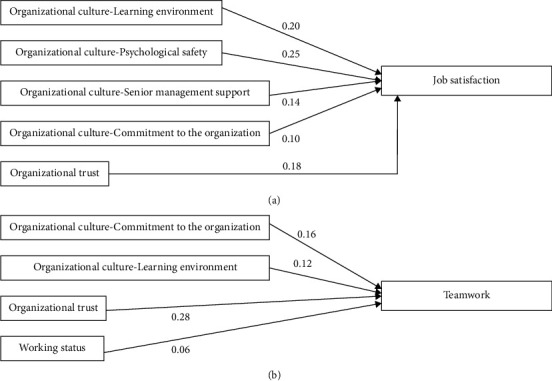
A learning environment, psychological safety, senior leadership support, commitment to the organization, and the organizational culture and trust were positively associated with higher job satisfaction, which accounted for 49.2% of the variance in NPs' job satisfaction. Organizational trust, commitment to the organization, and learning environment promoted better team-based practice significantly. Also, NPs working a fixed shift pattern showed higher levels of team-based practice. These factors accounted for 23.66% of variances in team-based practice.
Organizational culture and organizational trust affect the job satisfaction and team-based practice of NPs in acute care practices. . Acute care hospitals are encouraged to develop policies to enhance a learning environment, a supportive organizational culture, and trust in NPs' practice.
执业护士(NP)的组织文化、组织信任、工作满意度和团队协作实践之间的联系尚未同时进行研究。
确定组织文化、组织信任和其他因素对执业护士工作满意度和团队协作实践等方面的影响。
我们采用了全国性样本的横断面设计。通过对1100名在急症护理机构工作的执业护士进行在线调查收集数据。该调查包括人口统计学和工作特征、组织文化量表、组织信任量表、米塞纳执业护士工作满意度量表(MNPJSS)以及执业护士初级保健组织氛围(NP-PCOCQ)中的NP-医生关系(NP-PR)子量表。采用逐步选择法的多元回归分析探索影响工作满意度和团队协作实践的潜在因素。
学习环境、心理安全感、高层领导支持、对组织的承诺以及组织文化和信任与更高的工作满意度呈正相关,这解释了执业护士工作满意度差异的49.2%。组织信任、对组织的承诺和学习环境显著促进了更好的团队协作实践。此外,采用固定轮班模式工作的执业护士团队协作实践水平更高。这些因素解释了团队协作实践差异的23.66%。
组织文化和组织信任影响急症护理机构中执业护士的工作满意度和团队协作实践。鼓励急症护理医院制定政策,以改善学习环境、支持性的组织文化以及对执业护士实践的信任。