Aminorroaya Arya, Biswas Dhruva, Pedroso Aline F, Khera Rohan
Section of Cardiovascular Medicine, Department of Internal Medicine, Yale School of Medicine, New Haven, Connecticut.
Cardiovascular Data Science (CarDS) Lab, Yale School of Medicine, New Haven, Connecticut.
J Soc Cardiovasc Angiogr Interv. 2025 Mar 18;4(3Part B):102562. doi: 10.1016/j.jscai.2025.102562. eCollection 2025 Mar.
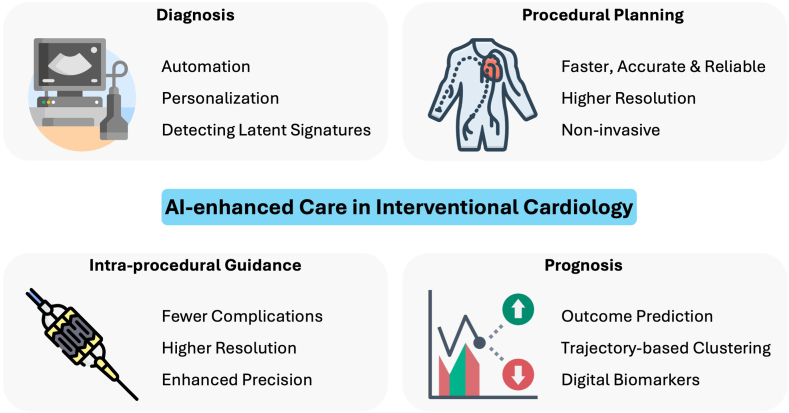
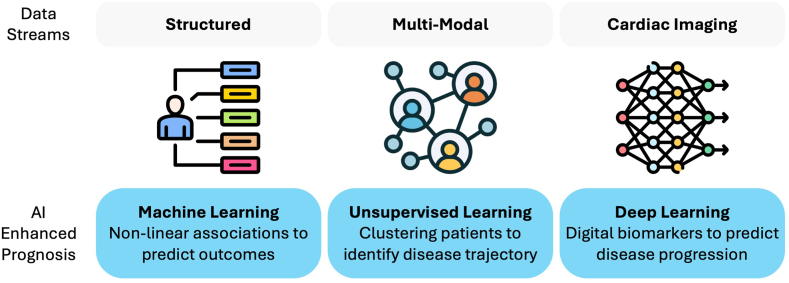
Artificial intelligence (AI) serves as a powerful tool that can revolutionize how personalized, patient-focused care is provided within interventional cardiology. Specifically, AI can augment clinical care across the spectrum for acute coronary syndrome, coronary artery disease, and valvular heart disease, with applications in coronary and structural heart interventions. This has been enabled by the potential of AI to harness various types of health data. We review how AI-driven technologies can advance diagnosis, preprocedural planning, intraprocedural guidance, and prognostication in interventional cardiology. AI automates clinical tasks, increases efficiency, improves reliability and accuracy, and individualizes clinical care, establishing its potential to transform care. Furthermore, AI-enabled, community-based screening programs are yet to be implemented to leverage the full potential of AI to improve patient outcomes. However, to transform clinical practice, AI tools require robust and transparent development processes, consistent performance across various settings and populations, positive impact on clinical and care quality outcomes, and seamless integration into clinical workflows. Once these are established, AI can reshape interventional cardiology, improving precision, efficiency, and patient outcomes.
人工智能(AI)是一种强大的工具,它可以彻底改变介入心脏病学中提供个性化、以患者为中心的护理方式。具体而言,人工智能可以增强对急性冠状动脉综合征、冠状动脉疾病和心脏瓣膜病等各种疾病的临床护理,并应用于冠状动脉和结构性心脏介入治疗。人工智能利用各种类型健康数据的潜力促成了这一点。我们回顾了人工智能驱动的技术如何在介入心脏病学中推进诊断、术前规划、术中指导和预后评估。人工智能使临床任务自动化,提高了效率,提升了可靠性和准确性,并使临床护理个性化,确立了其改变护理方式的潜力。此外,尚未实施基于社区的人工智能筛查项目以充分发挥人工智能改善患者预后的全部潜力。然而,为了改变临床实践,人工智能工具需要稳健且透明的开发过程,在各种环境和人群中保持一致的性能,对临床和护理质量结果产生积极影响,并无缝集成到临床工作流程中。一旦实现这些,人工智能可以重塑介入心脏病学,提高精准度、效率和患者预后。