Ai Gan, Peng Hao, Pan Weiye, Li Yuke, Wan Zhirui, Yin Zhiyuan, Shen Danyu, Dong Suomeng, Wang Yuanchao, Dou Daolong
College of Plant Protection, Academy for Advanced Interdisciplinary Studies, Nanjing Agricultural University, Nanjing 210095, China.
USDA-ARS, Crop Diseases, Pests and Genetics Research Unit, Parlier, CA 93648, USA.
Fundam Res. 2024 Feb 21;5(2):663-673. doi: 10.1016/j.fmre.2023.10.026. eCollection 2025 Mar.
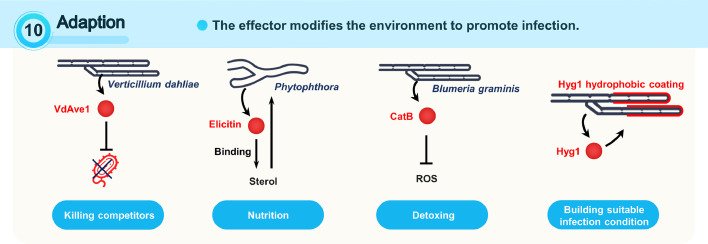
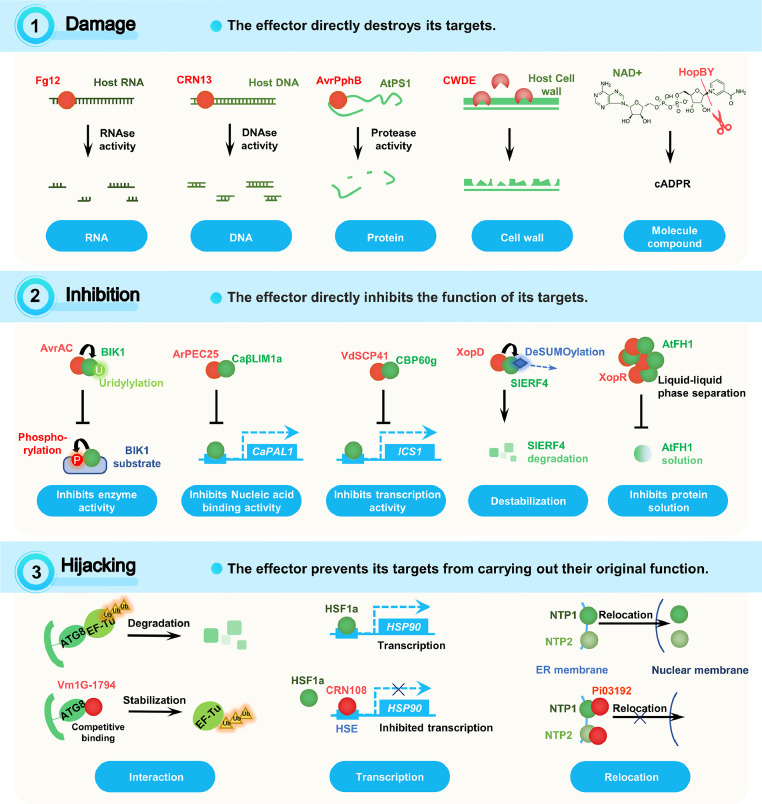
Plant diseases cause dramatic economic loss, posing a major challenge to modern agriculture. Plant pathogenic organisms secret effectors that utilize fascinating and intricate stratagems to facilitate infection. The consequences of plant-pathogen interactions are largely determined by effectors. The effector research has made great strides since its inception in the 1990s and the importance of effectors is increasingly noticed. Molecular investigation of effectors has provided critical insights into how plant pathogens manipulate their hosts to cause diseases. Thus far, numerous excellent reviews concerning effectors have focused on their targeting host pathways, recognition by host receptors, and evasion mechanisms, but few have ever summarized all known effector action modes. Here, we distinguish ten different stratagems of effector function from all types of pathogens, including damage, inhibition, hijacking, promotion, subversion, mimicry, reprogramming, evasion, decoying, and adaption. Furthermore, we discuss examples of these ten stratagems, refine the effector definition, and propose future directions of phytopathogenic effector research.
植物病害造成巨大的经济损失,对现代农业构成重大挑战。植物病原生物分泌效应子,这些效应子利用奇妙而复杂的策略来促进感染。植物与病原体相互作用的结果很大程度上由效应子决定。自20世纪90年代效应子研究开始以来,已取得了长足进展,效应子的重要性也日益受到关注。对效应子的分子研究为植物病原体如何操纵其宿主引发病害提供了关键见解。迄今为止,许多关于效应子的优秀综述都聚焦于它们靶向宿主途径、被宿主受体识别以及逃避机制,但很少有综述总结所有已知的效应子作用模式。在此,我们从所有类型的病原体中区分出十种不同的效应子功能策略,包括破坏、抑制、劫持、促进、颠覆、模拟、重编程、逃避、诱饵和适应。此外,我们讨论了这十种策略的实例,完善了效应子的定义,并提出了植物病原效应子研究的未来方向。