Lin Yun-Ping, Lee Kwo-Chen, Ma Wei-Fen, Syu Bei-Syuan, Liao Wen-Chun, Yang Hui-Ting, Lu Shu-Hua, Hong OiSaeng
School of Nursing, China Medical University, 100, Sec. 1, Jingmao Rd, Taichung, 406040, Taiwan.
Department of Nursing, China Medical University Hospital, Taichung, Taiwan.
BMC Public Health. 2025 Apr 17;25(1):1452. doi: 10.1186/s12889-025-22401-3.
Prolonged sedentary behavior in workplace settings is associated with increased health risks, including chronic diseases and reduced productivity. While various mobile health (mHealth) interventions exist, most focus on single behaviors such as physical activity (PA) or sedentary time, with limited solutions integrating diet, PA, and sedentary behavior for sedentary employees.
This study aimed to develop Simple Health, an evidence- and theory-based mHealth web app designed to promote healthy eating, increase PA, and reduce sedentary time among sedentary employees. The study also evaluated the app's usability.
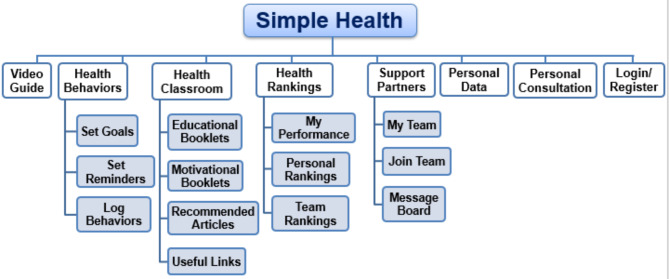
The study followed a two-phase approach. In Phase 1, Simple Health was developed by a multidisciplinary team using social cognitive theory and the ecological model as theoretical foundations. Behavior change techniques such as goal-setting, self-monitoring, and personalized feedback were incorporated. In Phase 2, usability testing was conducted with eight sedentary employees. Participants used Simple Health for five days and completed the mHealth app usability questionnaire (MAUQ) to assess ease of use, interface satisfaction, and perceived usefulness. Open-ended feedback was also collected to identify areas for improvement.
Most participants (87.5%) found Simple Health easy to use, with usability scores indicating favorable responses across ease of use (mean: 2.20/7), interface satisfaction (mean: 1.91/7), and usefulness (mean: 1.98/7). Participants valued the simplicity of behavior logging and the actionability of personalized advice. Suggestions for improvement included increasing goal-setting flexibility and refining navigation to enhance user experience.
The development and usability evaluation of Simple Health demonstrate its potential as a workplace mHealth intervention that integrates PA promotion, sedentary behavior reduction, and dietary tracking. While usability feedback was generally positive, refinements such as improved navigation and enhanced goal-setting flexibility could further optimize engagement. Future iterations should explore automatic syncing with wearable devices and expanded implementation in workplace wellness programs to assess long-term adoption and effectiveness.
工作场所长时间久坐行为与健康风险增加相关,包括慢性病和生产力下降。虽然存在各种移动健康(mHealth)干预措施,但大多数都侧重于单一行为,如身体活动(PA)或久坐时间,针对久坐员工整合饮食、PA和久坐行为的解决方案有限。
本研究旨在开发Simple Health,这是一款基于证据和理论的mHealth网络应用程序,旨在促进久坐员工的健康饮食、增加PA并减少久坐时间。该研究还评估了该应用程序的可用性。
该研究采用两阶段方法。在第一阶段,一个多学科团队以社会认知理论和生态模型为理论基础开发了Simple Health。纳入了诸如目标设定、自我监测和个性化反馈等行为改变技术。在第二阶段,对八名久坐员工进行了可用性测试。参与者使用Simple Health五天,并完成了mHealth应用程序可用性问卷(MAUQ),以评估易用性、界面满意度和感知有用性。还收集了开放式反馈以确定改进领域。
大多数参与者(87.5%)发现Simple Health易于使用,可用性得分表明在易用性(平均:2.20/7)、界面满意度(平均:1.91/7)和有用性(平均:1.98/7)方面有良好反应。参与者重视行为记录的简单性和个性化建议的可操作性。改进建议包括增加目标设定的灵活性和优化导航以增强用户体验。
Simple Health的开发和可用性评估证明了其作为工作场所mHealth干预措施的潜力,该干预措施整合了PA促进、久坐行为减少和饮食跟踪。虽然可用性反馈总体上是积极的,但诸如改进导航和增强目标设定灵活性等改进可以进一步优化参与度。未来的迭代应探索与可穿戴设备的自动同步以及在工作场所健康计划中的扩大实施,以评估长期采用情况和有效性。