Xiang Ge, Liu Zihuang, Yuan Zebin, Ying Zhongfu, Ding Yingzhe, Lin Dongtong, Qin Haihao, Dong Shanshan, Zhou Shihe, Yuan Hao, Xie Wei, Zheng Zhihong, Chen Yongqiang, Li Linpeng, Long Qi, Yang Liang, Wu Yi, Chen Keshi, Bao Feixiang, Huang Yile, Li Wei, Wang Junwei, Liu Yang, Qin Dajiang, Liu Xingguo
GMU-GIBH Joint School of Life Sciences, The Guangdong-Hong Kong-Macao Joint Laboratory for Cell Fate Regulation and Diseases, Guangzhou Medical University, Guangzhou Institutes of Biomedicine and Health, Chinese Academy of Sciences, Guangzhou, China.
GMU-GIBH Joint School of Life Sciences, The Guangdong-Hong Kong-Macao Joint Laboratory for Cell Fate Regulation and Diseases, Guangzhou Medical University, Guangzhou Institutes of Biomedicine and Health, Chinese Academy of Sciences, Guangzhou, China; Centre for Regenerative Medicine and Health, Hong Kong Institute of Science & Innovation, Chinese Academy of Sciences, Hong Kong SAR, China; Institute of Development and Regeneration, Guangdong Provincial Key Laboratory of Stem Cell and Regenerative Medicine, Guangdong-Hong Kong Joint Laboratory for Stem Cell and Regenerative Medicine, GIBH-CUHK Joint Research Laboratory on Stem Cell and Regenerative Medicine, GIBH-HKU Guangdong-Hong Kong Stem Cell and Regenerative Medicine Research Centre, China-New Zealand Joint Laboratory on Biomedicine and Health, Chinese Academy of Sciences, Guangzhou, China; University of Chinese Academy of Sciences, Beijing, China.
Stem Cell Reports. 2025 May 13;20(5):102474. doi: 10.1016/j.stemcr.2025.102474. Epub 2025 Apr 17.
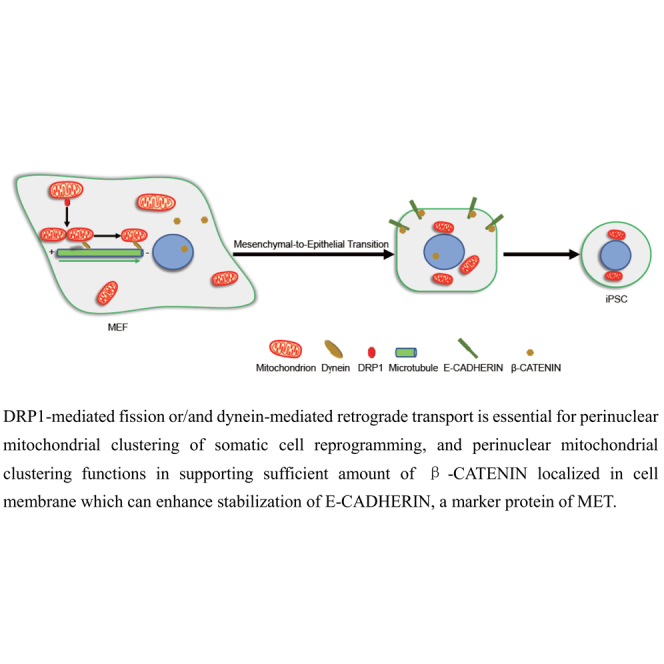
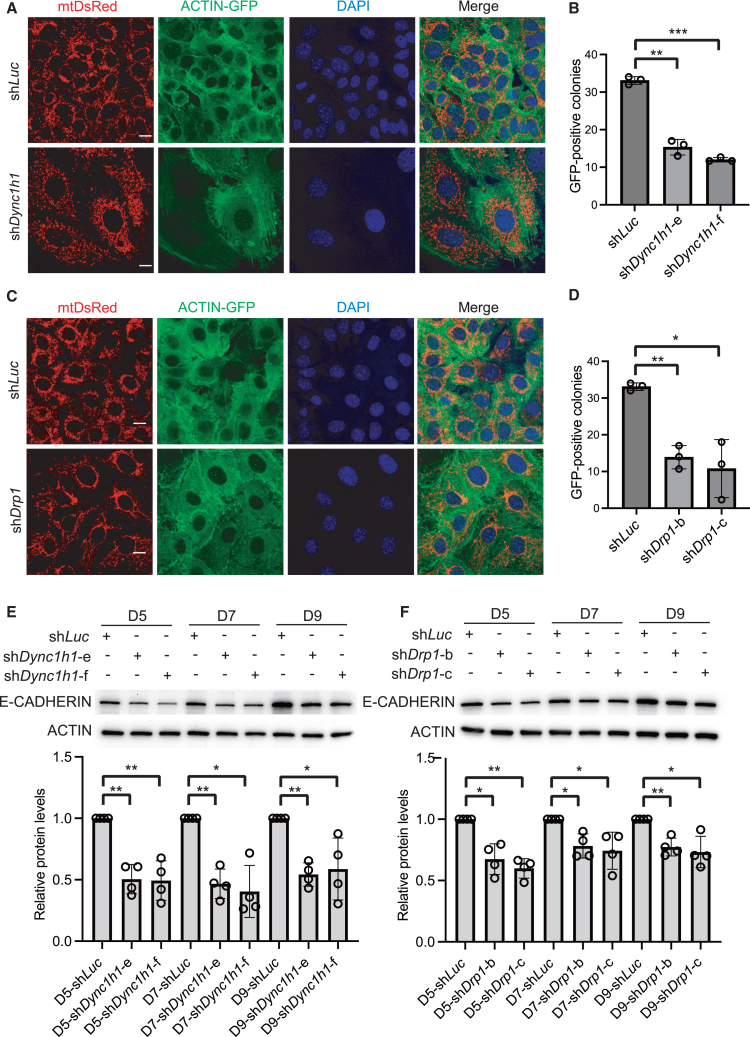
Remodeled mitochondria are characteristic of pluripotent stem cells. However, a role for mitochondrial movement and distribution in pluripotency remains unknown. Here, we show that mitochondrial retrograde transport-mediated perinuclear clustering via dynein complex occurs at the early phase of pluripotency induction. Interestingly, this mitochondrial redistribution is regulated by Yamanaka factor OCT4 but not SOX2 or KLF4. This mitochondrial redistribution, which has effect on the efficiency of somatic cell reprogramming, also depends on DRP1-mediated mitochondrial fission. Importantly, perinuclear mitochondrial clustering is required for mesenchymal-to-epithelial transition (MET), an early step in reprogramming, during which β-catenin regulates the MET process. Furthermore, sufficient amount of β-catenin plays a key role in maintaining stabilization of E-CADHERIN. Taken together, these studies show that perinuclear mitochondrial clustering is an essential organellar step for MET process of pluripotency induction, which may shed light on the subcellular relationship between mitochondrial dynamics, pluripotency, and cellular morphology.
重塑的线粒体是多能干细胞的特征。然而,线粒体的运动和分布在多能性中的作用仍然未知。在这里,我们表明,通过动力蛋白复合体介导的线粒体逆行运输导致的核周聚集发生在多能性诱导的早期阶段。有趣的是,这种线粒体重新分布受山中因子OCT4调控,而不受SOX2或KLF4调控。这种对体细胞重编程效率有影响的线粒体重新分布也依赖于DRP1介导的线粒体分裂。重要的是,核周线粒体聚集是重编程早期步骤间充质-上皮转化(MET)所必需的,在此过程中β-连环蛋白调节MET过程。此外,足够量的β-连环蛋白在维持E-钙黏蛋白的稳定性中起关键作用。综上所述,这些研究表明,核周线粒体聚集是多能性诱导的MET过程中必不可少的细胞器步骤,这可能为线粒体动力学、多能性和细胞形态之间的亚细胞关系提供线索。