Cheng Chen, Li Zheng, Su Yue, Sun Jin-Yu, Xu Chang-Hao, Kong Xiang-Qing, Sun Wei
Department of Cardiology, The First Affiliated Hospital of Nanjing Medical University, Nanjing Medical University, Nanjing, Jiangsu, China.
Cardiovascular Research Center, The Affiliated Suzhou Hospital of Nanjing Medical University, Suzhou Municipal Hospital, Gusu School, Nanjing Medical University, Suzhou, Jiangsu, China.
J Clin Hypertens (Greenwich). 2025 Apr;27(4):e70045. doi: 10.1111/jch.70045.
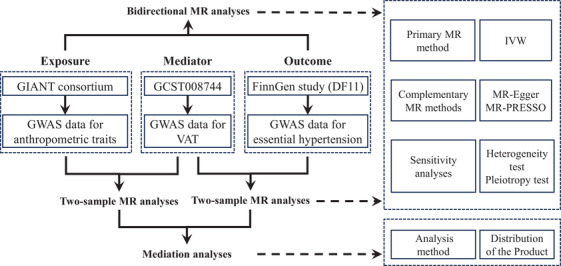
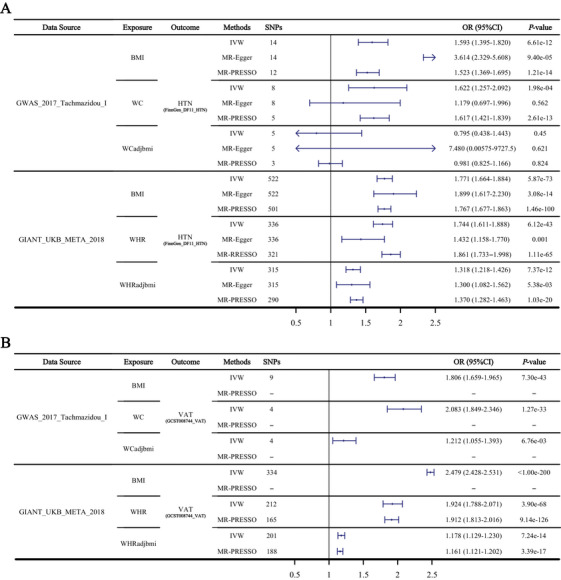
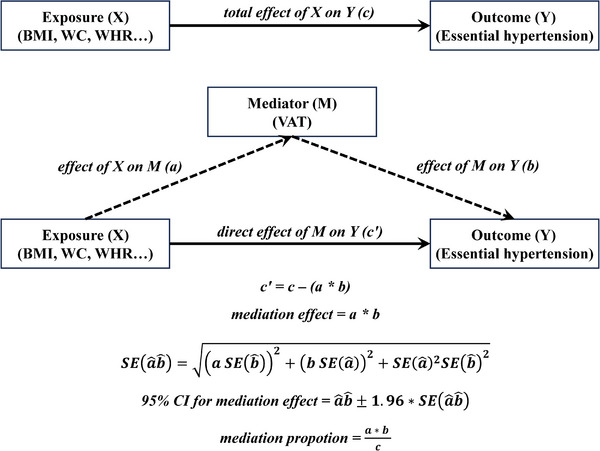
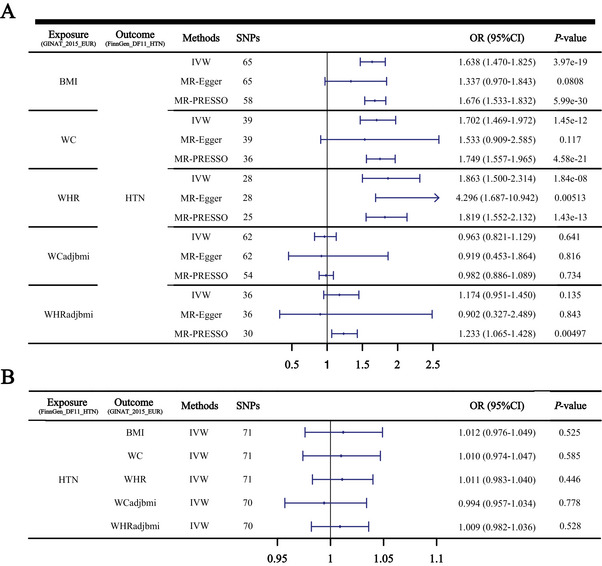
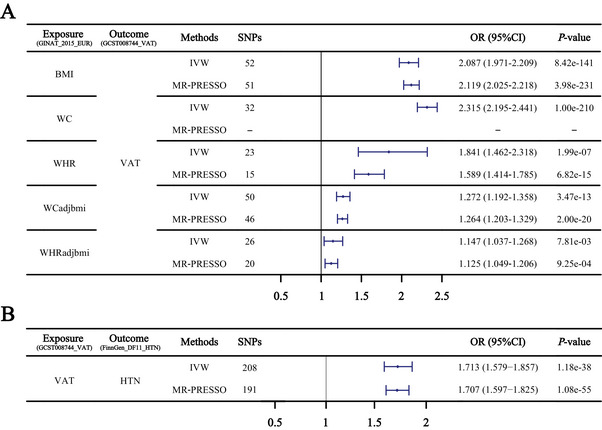
This study aims to investigate the causal relationship between obesity and essential hypertension, and evaluate the mediation effect of visceral adipose tissue (VAT) by Mendelian randomization (MR) analysis. We included body mass index (BMI), waist circumference (WC), waist-hip ratio (WHR), WC adjusted for BMI (WCadjbmi), and WHR adjusted for BMI (WHRadjbmi) as obesity-related anthropometric traits. In the bidirectional MR analyses, we found that higher BMI (OR, 1.638; p = 3.97 × 10), WC (OR, 1.702; p = 1.45 × 10), and WHR (OR, 1.863; p = 1.84 × 10) were significantly associated with increased risk of essential hypertension, while no evidence of reverse causality was observed. Then, in the two-step MR analyses, all five anthropometric traits had a positive and significant association with VAT mass, especially WC (OR, 2.315; p = 1.00 × 10). Meanwhile, higher predicted VAT mass was significantly associated with increased risk of essential hypertension (OR, 1.713; p = 1.18 × 10). Furthermore, the mediation analyses revealed that VAT had a significant mediation effect on the causal relationship between obesity-related anthropometric traits and essential hypertension, and mediated proportions in BMI, WC, and WHR were 77.8%, 80.1%, and 41.4%, respectively. Finally, the sensitivity analyses using two other datasets showed a similar result. In conclusion, our results showed that BMI, WC, and WHR have a positive and significant association with increased risk of essential hypertension. Moreover, VAT has a significant mediation effect on the causal relationship between obesity-related anthropometric traits and essential hypertension. Our study provided important statistical evidence suggesting that VAT may play a crucial meditation role in the occurrence and development of obesity-related hypertension.
本研究旨在通过孟德尔随机化(MR)分析探究肥胖与原发性高血压之间的因果关系,并评估内脏脂肪组织(VAT)的中介作用。我们纳入了体重指数(BMI)、腰围(WC)、腰臀比(WHR)、经BMI调整的腰围(WCadjbmi)以及经BMI调整的腰臀比(WHRadjbmi)作为与肥胖相关的人体测量学特征。在双向MR分析中,我们发现较高的BMI(比值比[OR],1.638;P = 3.97×10)、WC(OR,1.702;P = 1.45×10)和WHR(OR,1.863;P = 1.84×10)与原发性高血压风险增加显著相关,而未观察到反向因果关系的证据。然后,在两步MR分析中,所有五项人体测量学特征均与VAT质量呈正相关且具有显著关联,尤其是WC(OR,2.315;P = 1.00×10)。同时,较高的预测VAT质量与原发性高血压风险增加显著相关(OR,1.713;P = 1.18×10)。此外,中介分析显示VAT对与肥胖相关的人体测量学特征和原发性高血压之间的因果关系具有显著中介作用,在BMI、WC和WHR中的中介比例分别为77.8%、80.1%和41.4%。最后,使用另外两个数据集进行的敏感性分析显示了相似的结果。总之,我们的结果表明BMI、WC和WHR与原发性高血压风险增加呈正相关且具有显著关联。此外,VAT对与肥胖相关的人体测量学特征和原发性高血压之间的因果关系具有显著中介作用。我们的研究提供了重要的统计学证据,表明VAT可能在肥胖相关高血压的发生和发展中起关键的中介作用。