Rösch Sarah, Estaller Annkathrin, Oechtering Gerhard Ulrich, Neumann Stephan
Ear, Nose and Throat Unit, Small Animal Department, Leipzig University, Leipzig, Germany.
Institute of Veterinary Medicine, Clinic for Small Animals, University of Goettingen, Goettingen, Germany.
Front Vet Sci. 2025 Apr 7;12:1553551. doi: 10.3389/fvets.2025.1553551. eCollection 2025.
The most common nasal cavity disease (ND) in dogs is the malignant nasal cavity tumor. Prognosis and survival after radiation therapy are reported to correlate with tumor size, and therefore indirectly with the time to diagnosis. Diagnosis of a nasal tumor requires imaging procedures under anesthesia. Thus, diagnostic serum markers are urgently needed for early detection and for therapeutic monitoring.
This prospective, blinded study included dogs with nasal discharge that completed a comprehensive diagnostic workup for ND. Dogs were evaluated by blood testing and whole-body CT and those with concomitant diseases or with steroid pre-treatment were excluded. Serum survivin, Ki-67, and thymidine kinase 1 (TK1) concentrations were determined, and the survivin-lymphocyte ratio (SLR) calculated. Results were compared between groups of dogs with different NDs and to ten healthy controls.
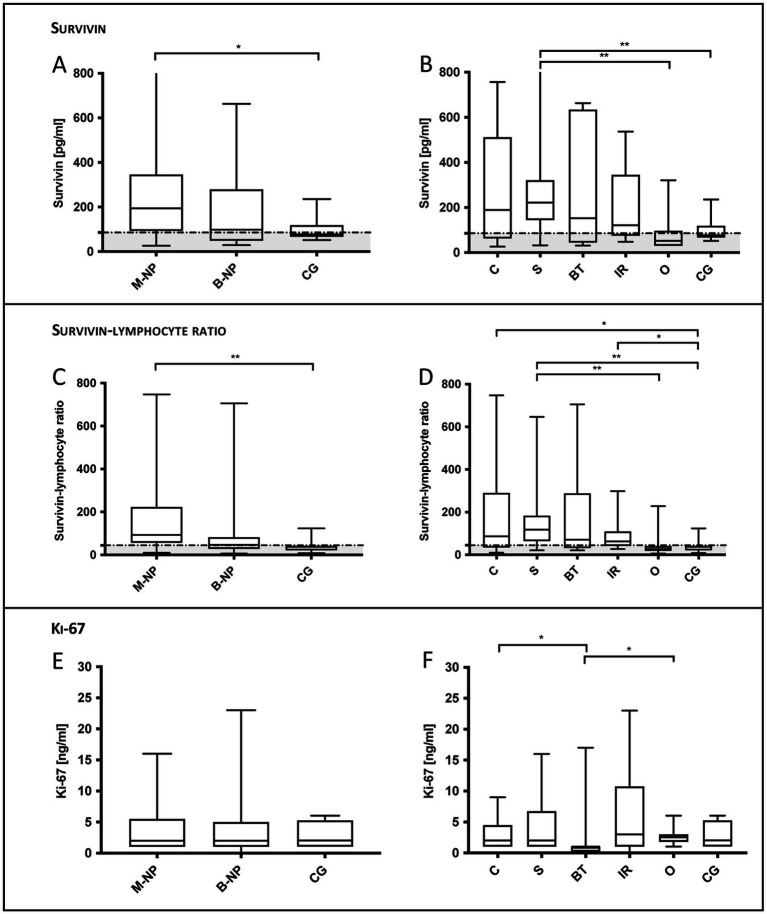
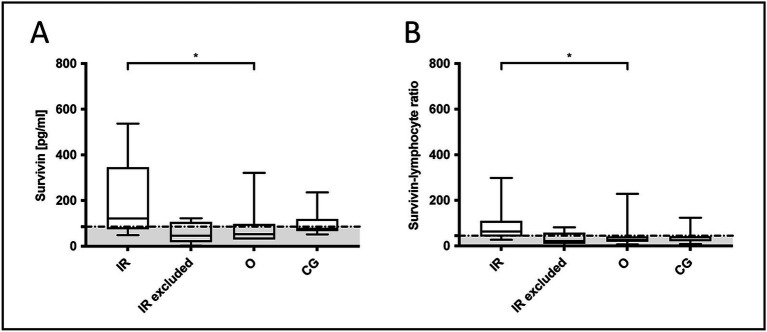
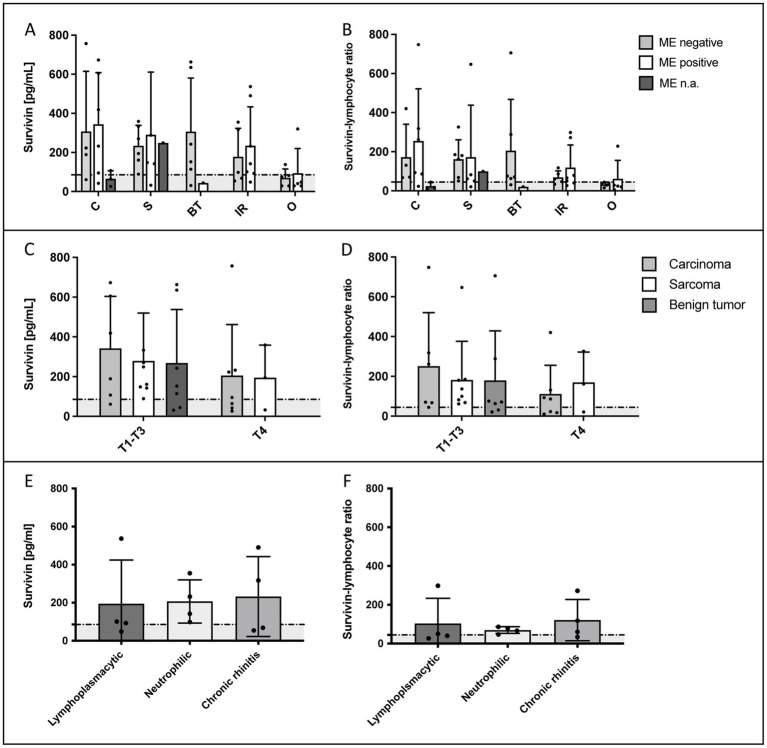
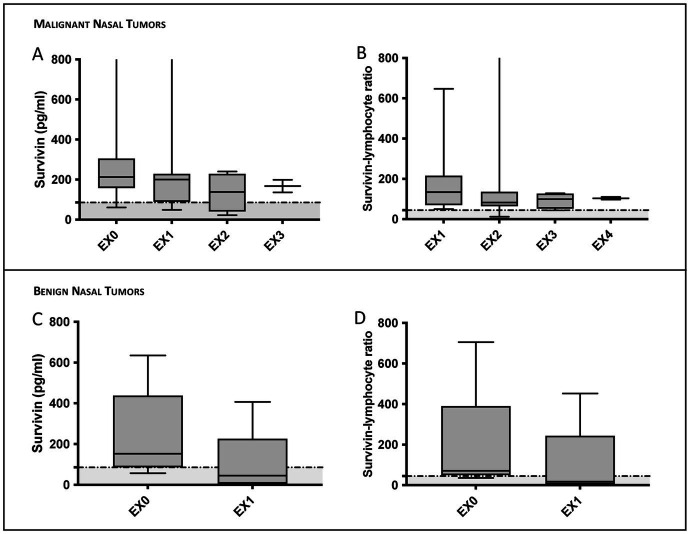
A total of 55 dogs were included, consisting of 25 with malignant ND (12 sarcomas, 13 carcinomas) and 30 with benign ND (7 benign tumors, 13 dogs with idiopathic rhinitis (IR), 10 others including dogs with dental diseases and sinonasal aspergillosis). Survivin and SLR were significantly increased in dogs with malignant ND and in subgroup comparison in sarcomas compared to controls. In addition, the SLR was significantly increased in carcinomas and IR compared to controls. In dogs with IR, no differences were observed in survivin concentrations or SLR based on microbiological or histopathological findings. Survivin concentrations or SLR in dogs with nasal tumors were not significantly different between T-categories. No significant differences were detected in TK1 concentrations among the groups, nor in Ki-67, except for significantly lower Ki-67 concentrations in benign tumors compared to carcinomas and the group others including, e.g., dental diseases.
Although not diagnostic for ND, increased survivin serum concentrations or SLR can be detected in dogs with malignant nasal tumors and IR. In malignant nasal tumors, survivin and SLR did not correlate with tumor size and therefore may be useful in the detection of even small nasal tumors. Therefore, in dogs with nasal tumors and IR, survivin and SLR could serve as a target for disease monitoring or as therapeutic target.
犬类最常见的鼻腔疾病(ND)是恶性鼻腔肿瘤。据报道,放射治疗后的预后和生存期与肿瘤大小相关,因此与诊断时间间接相关。鼻腔肿瘤的诊断需要在麻醉下进行成像检查。因此,迫切需要诊断血清标志物用于早期检测和治疗监测。
这项前瞻性、盲法研究纳入了有鼻分泌物且完成了全面鼻腔疾病诊断检查的犬只。通过血液检测和全身CT对犬只进行评估,排除患有伴随疾病或接受过类固醇预处理的犬只。测定血清生存素、Ki-67和胸苷激酶1(TK1)浓度,并计算生存素-淋巴细胞比率(SLR)。将不同鼻腔疾病犬组的结果与十只健康对照犬的结果进行比较。
共纳入55只犬,其中25只患有恶性鼻腔疾病(12只肉瘤,13只癌),30只患有良性鼻腔疾病(7只良性肿瘤,13只患有特发性鼻炎(IR)的犬,10只其他疾病犬,包括患有牙科疾病和鼻窦曲霉菌病的犬)。与对照组相比,患有恶性鼻腔疾病的犬以及肉瘤亚组比较中,生存素和SLR显著升高。此外,与对照组相比,癌和IR组的SLR显著升高。在患有IR的犬中,根据微生物学或组织病理学结果,生存素浓度或SLR未观察到差异。鼻腔肿瘤犬的生存素浓度或SLR在T分期之间无显著差异。各组间TK1浓度无显著差异,Ki-67也无显著差异,但良性肿瘤的Ki-67浓度显著低于癌和其他疾病组(如牙科疾病组)。
虽然不能用于鼻腔疾病的诊断,但在患有恶性鼻腔肿瘤和IR的犬中可检测到血清生存素浓度或SLR升高。在恶性鼻腔肿瘤中,生存素和SLR与肿瘤大小无关,因此可能有助于检测甚至小的鼻腔肿瘤。因此,在患有鼻腔肿瘤和IR的犬中,生存素和SLR可作为疾病监测的靶点或治疗靶点。