Na Hyo-Seok, Park Sang-Hi, Koo Bon-Wook, Bang Seunguk, Shin Hyun-Jung
Department of Anesthesiology and Pain Medicine, Seoul National University Bundang Hospital, Seongnam 13620, Republic of Korea.
Department of Anesthesiology and Pain Medicine, Seoul National University College of Medicine, Seoul 03080, Republic of Korea.
Medicina (Kaunas). 2025 Apr 14;61(4):726. doi: 10.3390/medicina61040726.
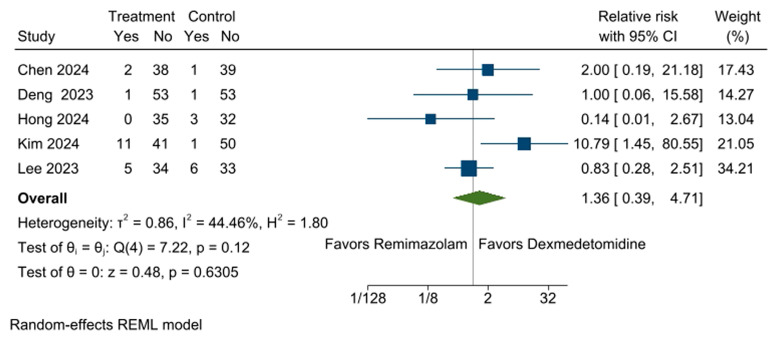
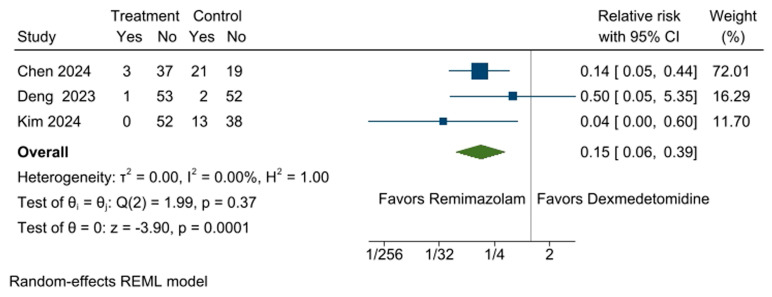
: This meta-analysis compares the safety and efficacy of remimazolam and dexmedetomidine for sedation during regional anesthesia, focusing on respiratory and hemodynamic outcomes. : A systematic search of CENTRAL, Embase, PubMed, Scopus, and Web of Science up to November 2024 identified randomized controlled trials (RCTs) comparing remimazolam with dexmedetomidine. Outcomes included respiratory depression (primary outcome), bradycardia, hypotension, hypertension, respiratory and heart rates, mean arterial pressure, sedation onset time, emergence time, and postoperative nausea and vomiting (PONV). Effect sizes were calculated as relative risks (RRs) or mean differences (MDs) using random-effects models. : Five RCTs involving 439 participants were included. Remimazolam did not significantly increase respiratory depression risk compared to dexmedetomidine (RR: 1.36, 95% CI [0.39, 4.71], = 0.6305, I = 44%). Bradycardia incidence was lower with remimazolam (RR: 0.15, 95% CI [0.06, 0.39], = 0.0001, I = 0%). Remimazolam showed faster sedation onset (MD: -6.04 min, 95% CI [-6.99, -5.09], = 0.0000, I = 68%). Both drugs demonstrated similar occurrences of hypotension and hypertension, respiratory rates, mean arterial pressures, emergence times, and incidences of PONV. : Remimazolam offers comparable safety and efficacy to dexmedetomidine, with advantages such as lower bradycardia risk and faster sedation onset. These findings support remimazolam as a viable sedative option during regional anesthesia, although further large-scale studies are warranted to confirm these results and optimize sedation practices.
本荟萃分析比较了瑞马唑仑和右美托咪定在区域麻醉期间用于镇静的安全性和有效性,重点关注呼吸和血流动力学结果。对截至2024年11月的CENTRAL、Embase、PubMed、Scopus和Web of Science进行系统检索,确定了比较瑞马唑仑和右美托咪定的随机对照试验(RCT)。结局包括呼吸抑制(主要结局)、心动过缓、低血压、高血压、呼吸和心率、平均动脉压、镇静起效时间、苏醒时间以及术后恶心呕吐(PONV)。使用随机效应模型将效应量计算为相对风险(RR)或平均差(MD)。纳入了5项涉及439名参与者的RCT。与右美托咪定相比,瑞马唑仑并未显著增加呼吸抑制风险(RR:1.36,95%CI[0.39,4.71],P = 0.6305,I² = 44%)。瑞马唑仑的心动过缓发生率较低(RR:0.15,95%CI[0.06,0.39],P = 0.0001,I² = 0%)。瑞马唑仑的镇静起效更快(MD:-6.04分钟,95%CI[-6.99,-5.09],P = 0.0000,I² = 68%)。两种药物的低血压和高血压发生率、呼吸频率、平均动脉压、苏醒时间以及PONV发生率相似。瑞马唑仑与右美托咪定的安全性和有效性相当,具有心动过缓风险较低和镇静起效更快等优势。这些发现支持瑞马唑仑作为区域麻醉期间一种可行的镇静选择,尽管需要进一步的大规模研究来证实这些结果并优化镇静实践。