Schwab Sebastian, Pörner Daniel, Boes Dominik, Hoerauf Achim, Nattermann Jacob, Strassburg Christian, Hischebeth Gunnar T R, Lutz Philipp
Department of Internal Medicine I, University of Bonn, 53127 Bonn, Germany.
Kuratorium for Dialysis, KfH Renal Center, 53127 Bonn, Germany.
J Clin Med. 2025 Apr 11;14(8):2641. doi: 10.3390/jcm14082641.
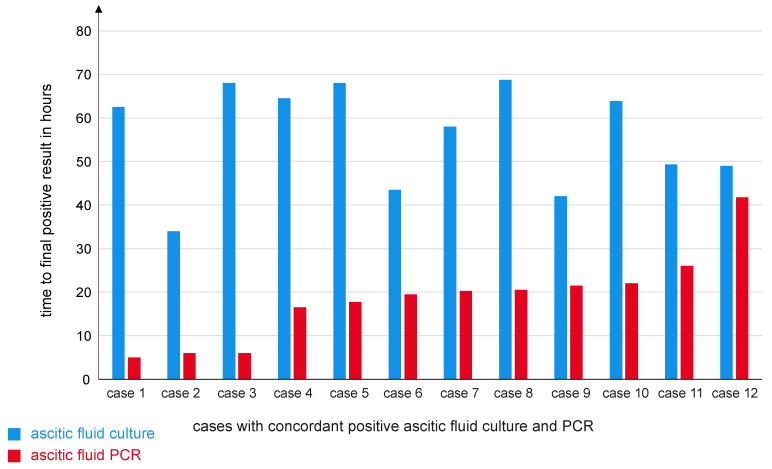
We analyzed the performance of a multiplex PCR application (Unyvero IAI) in comparison to culture in a cohort of peritonitis patients undergoing peritoneal dialysis or with liver cirrhosis. We performed a single-center study of 47 patients with clinically suspected peritonitis and compared pathogen detection rates of culture and PCR. The main outcome of interest was a comparison of accuracy and time to final positive result. In the total cohort, the pathogen detection rate in culture was 58.14% versus 34.88% in PCR ( = 0.03). Detection rates of bacteria in peritoneal dialysis patients were even higher by culture (70.83%) but comparably low by PCR (37.50%; = 0.04). The majority of discordant results were in the Gram-positive spectrum (81.82%). Differential time to final positive result was 37.39 ± 16.75 h. Time gains by using PCR diagnostic have to be weighed against lower detection rates, mainly in Gram-positive infections.
我们分析了多重PCR检测方法(Unyvero IAI)在一组接受腹膜透析或患有肝硬化的腹膜炎患者中的表现,并与培养法进行了比较。我们对47例临床怀疑患有腹膜炎的患者进行了单中心研究,比较了培养法和PCR的病原体检测率。主要关注的结果是准确性和最终获得阳性结果所需时间的比较。在整个队列中,培养法的病原体检测率为58.14%,而PCR为34.88%(P = 0.03)。腹膜透析患者中细菌的培养检测率更高(70.83%),但PCR检测率相对较低(37.50%;P = 0.04)。大多数不一致的结果出现在革兰氏阳性菌谱中(81.82%)。最终获得阳性结果的时间差异为37.39±16.75小时。使用PCR诊断所节省的时间必须与较低的检测率相权衡,尤其是在革兰氏阳性菌感染方面。