Zhu Tianyu, Tian Yixing, Wang Jinqi, Wu Zhiyuan, Xie Wenhan, Liu Haotian, Li Xia, Tao Lixin, Guo Xiuhua
Beijing Key Laboratory of Environment and Aging, School of Public Health, Capital Medical University, No. 10 Xitoutiao, Youanmen Street, Beijing 100069, China.
Department of Nutrition, Harvard T.H. Chan School of Public Health, 655 Huntington Avenue, Boston, MA 02115, USA.
Nutrients. 2025 Apr 21;17(8):1397. doi: 10.3390/nu17081397.
To investigate the association between visceral fat accumulation and the risk of cardiometabolic multimorbidity (CMM) and the potential roles of accelerated biological aging in this relationship.
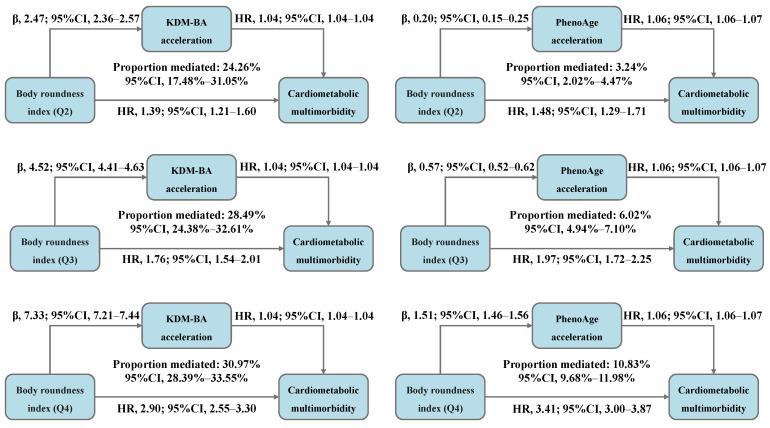
Using data from the UK Biobank, a nationwide cohort study was conducted using the available baseline body roundness index (BRI) measurement. Biological aging was assessed using the Klemera-Doubal method for biological age and the phenotypic age algorithms. The association between the BRI and CMM was estimated using the Cox proportional hazards regression model, while the roles of biological aging were examined through interaction and mediation analyses.
During a median follow-up of 14.52 years, 6156 cases of CMM were identified. A significant association was observed between the BRI and CMM. The hazard ratio (HR) for CMM was 3.72 (95% confidence interval [CI]: 3.35-4.13) for individuals in the highest quartile compared with those in the lowest quartile of the BRI. More importantly, the BRI (AUC, 0.701; 95% CI, 0.694-0.707) demonstrated superior predictive performance relative to body mass index (AUC, 0.657; 95% CI, 0.650-0.664). Furthermore, the BRI exhibited additive interactions with accelerated biological aging on the risk of CMM, and accelerated biological aging partially mediated the association between the BRI and CMM.
These findings provide evidence for the application of the BRI as a novel and readily accessible screening tool associated with CMM, suggesting that the effective management of visceral fat and biological aging deceleration may hold promise for reducing CMM risk.
探讨内脏脂肪堆积与心脏代谢多发病(CMM)风险之间的关联,以及加速生物衰老在此关系中的潜在作用。
利用英国生物银行的数据,进行了一项全国性队列研究,采用现有的基线身体圆润度指数(BRI)测量值。使用克莱梅拉 - 杜巴尔生物年龄方法和表型年龄算法评估生物衰老。使用Cox比例风险回归模型估计BRI与CMM之间的关联,同时通过交互作用和中介分析研究生物衰老的作用。
在中位随访14.52年期间,共识别出6156例CMM病例。观察到BRI与CMM之间存在显著关联。与BRI最低四分位数的个体相比,最高四分位数个体发生CMM的风险比(HR)为3.72(95%置信区间[CI]:3.35 - 4.13)。更重要的是,BRI(AUC,0.701;95% CI,0.694 - 0.707)相对于体重指数(AUC,0.657;95% CI,0.650 - 0.664)表现出更好的预测性能。此外,BRI在CMM风险方面与加速生物衰老表现出相加交互作用,并且加速生物衰老部分介导了BRI与CMM之间的关联。
这些发现为将BRI作为一种与CMM相关的新型且易于获得的筛查工具的应用提供了证据,表明有效管理内脏脂肪和减缓生物衰老可能有望降低CMM风险。