Shostak Elena S, Lang Jillian M, Quinn William K, Chervinskaya Valerie D, Fioraso Elisa, Smith Everett, Kotarsky Christopher J, DeBlauw Justin A, Lloyd Jennifer L, Ives Stephen J
Health and Human Physiological Sciences, Skidmore College, Saratoga Springs, New York, USA.
Biomedicine and Movement Science, University of Verona, Verona, Italy.
Physiol Rep. 2025 Apr;13(8):e70285. doi: 10.14814/phy2.70285.
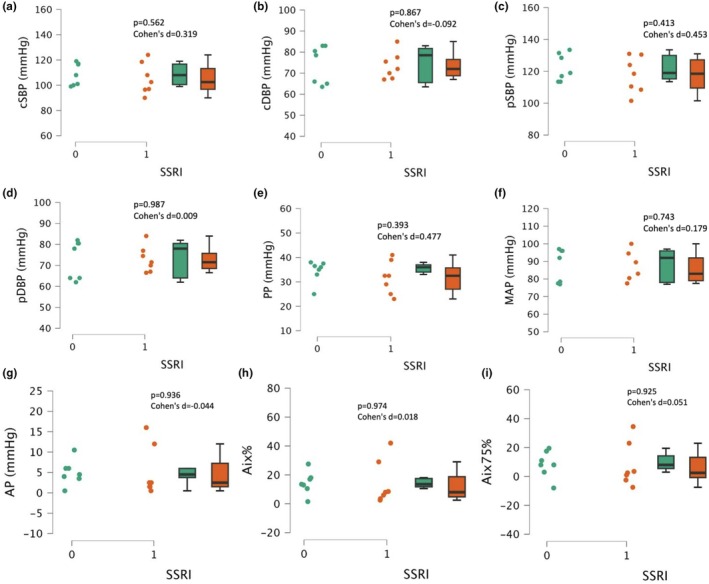
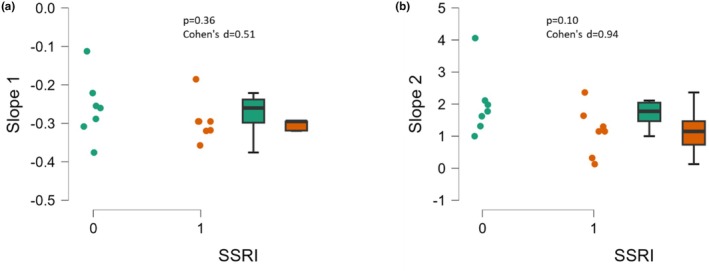
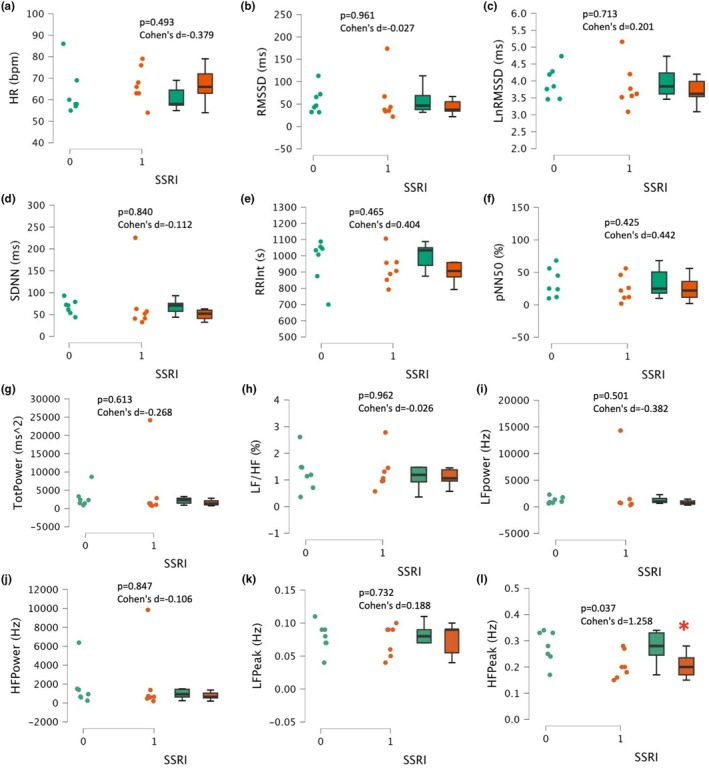
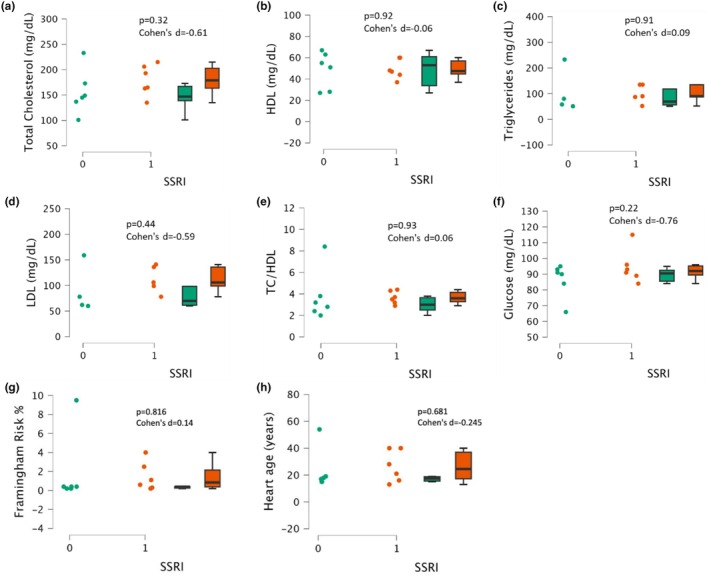
Selective serotonin reuptake inhibitors (SSRIs) are a class of drugs that are frequently used to treat psychological disorders, but the comprehensive effects on cardiometabolic health in young healthy populations are not well described. Healthy men and women using SSRIs and sex-, age-, height-, and weight-matched controls were assessed. Anthropometrics, blood pressure (BP), arterial stiffness (AS), heart rate variability (HRV), near-infrared vascular occlusion test (NIRS-VOT), and blood lipid profile were assessed, with subsequent Framingham CVD risk score calculation. There were no significant differences in central or peripheral BP or AS due to SSRI use (all, p > 0.39, Cohen's d < 0.48). HRV was not different between groups (all, p > 0.43, Cohen's d < 0.44), except for HFpeak, which was lower in SSRI users (0.20 ± 0.05 vs. 0.28 ± 0.06 Hz, p = 0.04, Cohen's d = 1.26). There were no significant differences in blood lipids (all, p > 0.22, Cohen's d < 0.09) or Framingham risk scores (both, p > 0.68, Cohen's d < 0.14) between groups. There were no significant differences in microvascular reactivity between groups, however, reperfusion slope was lower in SSRI users (1.2 ± 0.9 vs. 2.0 ± 1.1%/s, p = 0.10, Cohen's d = 0.93). SSRIs do not appear to have any significant effects on blood pressure, heart rate variability, arterial stiffness, or lipid profile in young healthy individuals but may influence microvascular function.
选择性5-羟色胺再摄取抑制剂(SSRIs)是一类常用于治疗心理障碍的药物,但对年轻健康人群心脏代谢健康的综合影响尚无详尽描述。对使用SSRIs的健康男性和女性以及性别、年龄、身高和体重匹配的对照组进行了评估。测量了人体测量指标、血压(BP)、动脉僵硬度(AS)、心率变异性(HRV)、近红外血管闭塞试验(NIRS-VOT)和血脂谱,并随后计算了弗雷明汉心血管疾病风险评分。使用SSRIs对中心或外周血压或AS无显著差异(所有p>0.39,科恩d<0.48)。除HFpeak外,各组之间的HRV无差异(所有p>0.43,科恩d<0.44),HFpeak在使用SSRIs的人群中较低(0.20±0.05 vs. 0.28±0.06Hz,p=0.04,科恩d=1.26)。两组之间血脂(所有p>0.22,科恩d<0.09)或弗雷明汉风险评分(两者p>0.68,科恩d<0.14)均无显著差异。两组之间微血管反应性无显著差异,然而,使用SSRIs的人群再灌注斜率较低(1.2±0.9 vs. 2.0±1.1%/s,p=0.10,科恩d=0.93)。SSRIs似乎对年轻健康个体的血压、心率变异性、动脉僵硬度或血脂谱没有任何显著影响,但可能会影响微血管功能。