Matias Alexs A, Albin Isabelle F, Glickman Leah, Califano Peter A, Faller Justin M, Layec Gwenael, Ives Stephen J
Department of Health and Human Physiological Sciences, Skidmore College, 815 N. Broadway, Saratoga Springs, NY, 12866, USA.
Department of Kinesiology, University of Massachusetts at Amherst, Amherst, MA, USA.
BMC Sports Sci Med Rehabil. 2023 Jul 11;15(1):83. doi: 10.1186/s13102-023-00682-8.
Heat stress during aerobic exercise training may offer an additional stimulus to improve cardiovascular function and performance in a cool-temperate environment. However, there is a paucity of information on the additive effects of high-intensity interval exercise (HIIE) and acute heat stress. We aimed to determine the effects of HIIE in combination with acute heat stress on cardiovascular function and exercise performance.
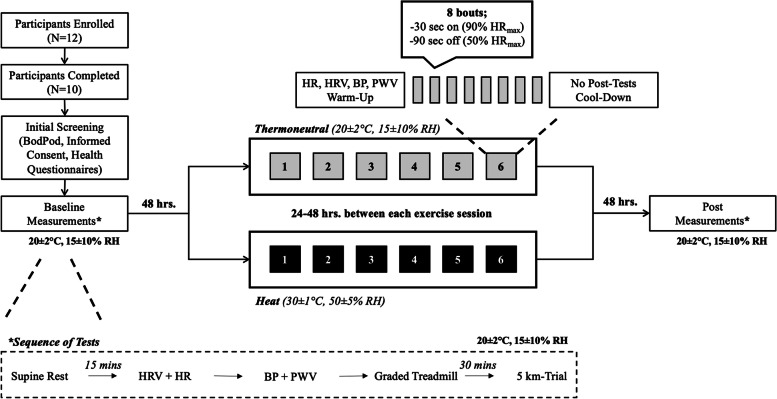
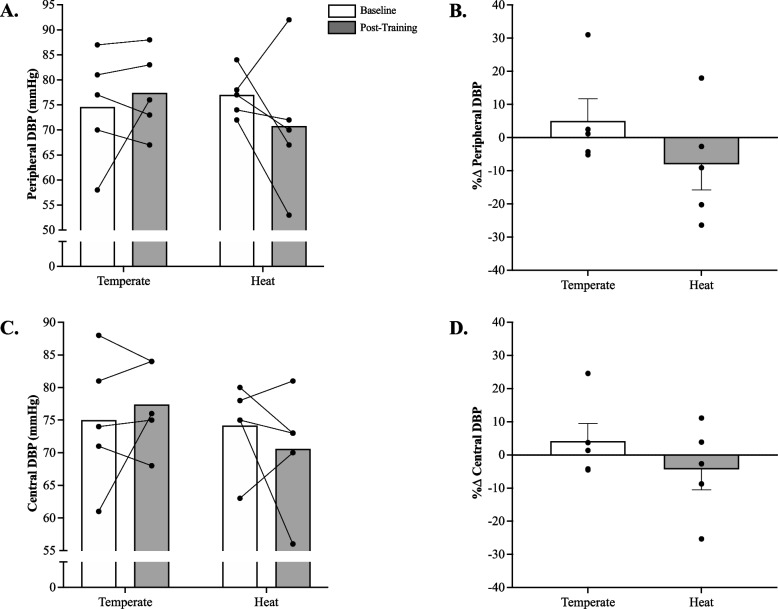
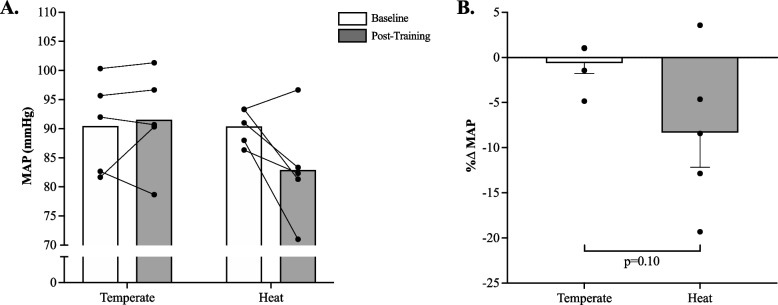
Twelve active (peak O consumption [VO]: 47 ± 8 ml·O/min/kg) young adults were counterbalanced to six sessions of HIIE in hot (HIIE-H, 30 ± 1 °C, 50 ± 5% relative humidity [RH]) or temperate conditions (HIIE-T, 20 ± 2 °C, 15 ± 10% RH). Resting heart rate (HR), HR variability (HRV), central (cBP) and peripheral blood pressure (pBP), peripheral mean arterial pressure (pMAP), pulse wave velocity (PWV), VO, and 5-km treadmill time-trial were measured pre- and post-training.
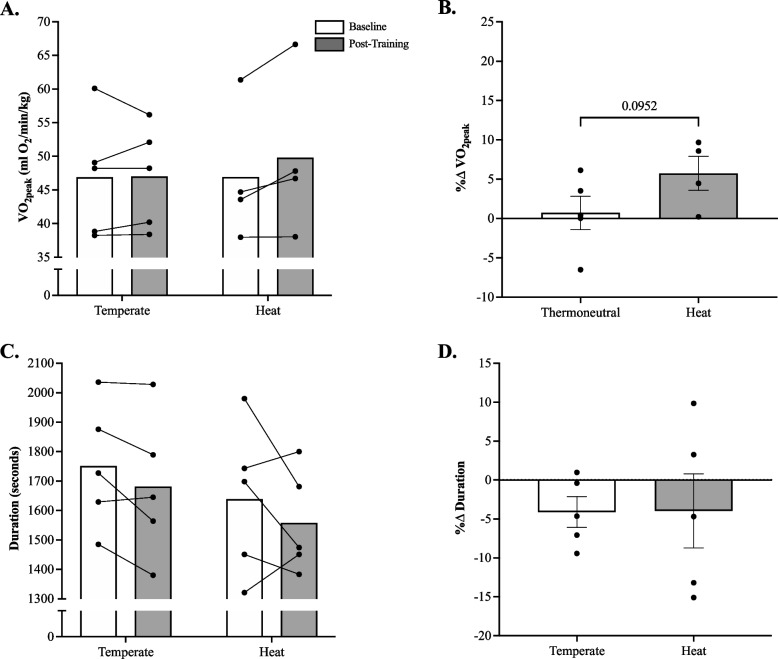
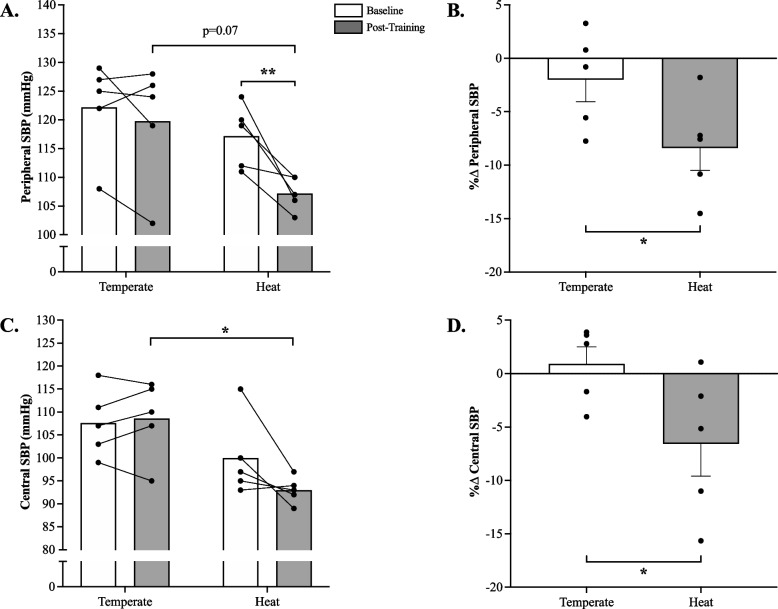
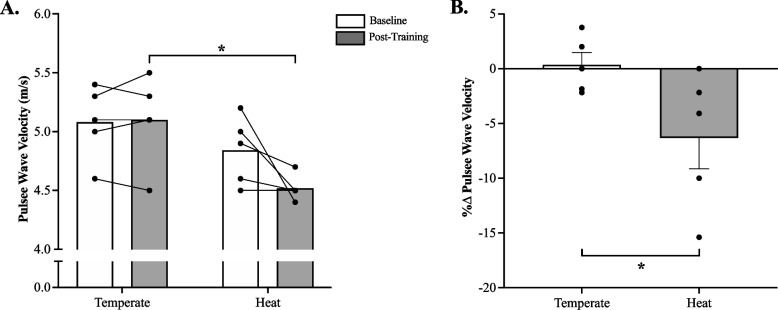
Resting HR and HRV were not significantly different between groups. However, expressed as percent change from baseline, cSBP (HIIE-T: + 0.9 ± 3.6 and HIIE-H: -6.6 ± 3.0%, p = 0.03) and pSBP (HIIE-T: -2.0 ± 4.6 and HIIE-H: -8.4 ± 4.7%, p = 0.04) were lower in the heat group. Post-training PWV was also significantly lower in the heat group (HIIE-T: + 0.4% and HIIE-H: -6.3%, p = 0.03). Time-trial performance improved with training when data from both groups were pooled, and estimated VO was not significantly different between groups (HIIE-T: 0.7% and HIIE-H: 6.0%, p = 0.10, Cohen's d = 1.4).
The addition of acute heat stress to HIIE elicited additive adaptations in only cardiovascular function compared to HIIE alone in active young adults in temperate conditions, thus providing evidence for its effectiveness as a strategy to amplify exercise-induced cardiovascular adaptations.
有氧运动训练期间的热应激可能提供额外刺激,以改善凉爽温带环境中的心血管功能和运动表现。然而,关于高强度间歇运动(HIIE)和急性热应激的叠加效应的信息匮乏。我们旨在确定HIIE与急性热应激相结合对心血管功能和运动表现的影响。
12名活跃的(峰值耗氧量[VO₂]:47±8 ml·O₂/min/kg)年轻成年人被随机分为六组,分别在炎热(HIIE-H,30±1°C,相对湿度[RH]50±5%)或温带条件(HIIE-T,20±2°C,RH 15±10%)下进行HIIE训练。在训练前后测量静息心率(HR)、心率变异性(HRV)、中心(cBP)和外周血压(pBP)、外周平均动脉压(pMAP)、脉搏波速度(PWV)、VO₂以及5公里跑步机计时赛成绩。
两组之间的静息HR和HRV无显著差异。然而,以相对于基线的百分比变化表示,热组的中心收缩压(cSBP,HIIE-T组:+0.9±3.6%,HIIE-H组:-6.6±3.0%,p = 0.03)和外周收缩压(pSBP,HIIE-T组:-2.0±4.6%,HIIE-H组:-8.4±4.7%,p = 0.04)较低。热组训练后的PWV也显著较低(HIIE-T组:+0.4%,HIIE-H组:-6.3%,p = 0.03)。当汇总两组数据时,计时赛成绩随训练而提高,且两组之间的估计VO₂无显著差异(HIIE-T组:0.7%,HIIE-H组:6.0%,p = 0.10,Cohen's d = 1.4)。
在温带条件下,与单独进行HIIE相比,在HIIE中添加急性热应激仅在心血管功能方面引发了叠加适应性变化,从而为其作为增强运动诱导的心血管适应性的策略的有效性提供了证据。