Liu Xiaoqiang, Liu Xiaobo, Huang Yingxuan, Lin Chanchan, Chen Xinqi, Li Yingyi, Huang Yisen, Wang Yubin
Department of Gastroenterology, First Hospital of Quanzhou Affiliated to Fujian Medical University, Quanzhou, China.
McConnell Brain Imaging Centre, Montreal Neurological Institute, McGill University, Montreal, QC, Canada.
Front Nutr. 2025 Apr 11;12:1566314. doi: 10.3389/fnut.2025.1566314. eCollection 2025.
Growing attention has been paid to the relationship between the gut microbiota and diarrhea. A recently proposed Dietary Index for Gut Microbiota (DI-GM) reflects the overall dietary quality as it pertains to gut microbiota diversity. However, evidence regarding the association between DI-GM and diarrhea is still lacking. This study aims to investigate the association between DI-GM and the risk of diarrhea.
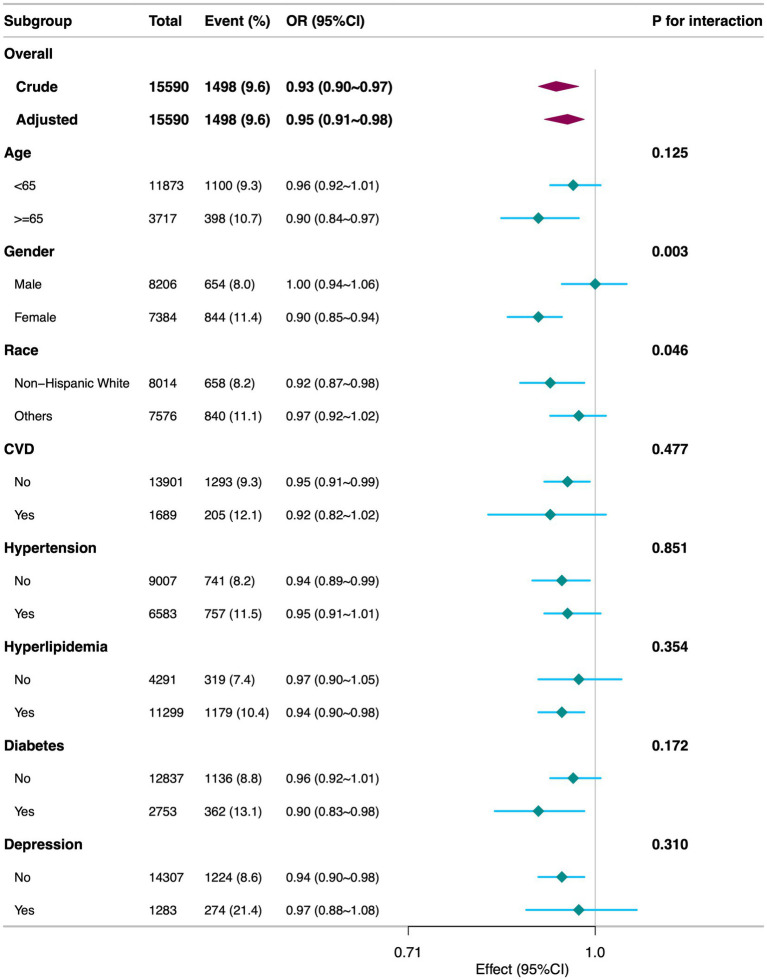
A total of 15,590 adults (≥20 years old) from National Health and Nutrition Examination Survey (NHANES) 2005-2010 were included in this analysis. Diarrhea was defined by self-reported common Bristol Stool Form Scale (BSFS) type 6 or 7, or more than three bowel movements per day. DI-GM comprises 14 food/nutrient components known to be associated with gut microbiota. A higher score indicates a more favorable diet for the gut microbiota. Multivariable logistic regression was used to evaluate the association between DI-GM and diarrhea, with subgroup and sensitivity analyses performed to confirm robustness.
After adjusting for age, gender, race, physical activity, chronic diseases, and other confounders, each 1-point increase in DI-GM was associated with a 5% reduction in diarrhea risk (adjusted OR = 0.95, 95% CI: 0.91-0.98, = 0.005). Compared with those who had a DI-GM score of 0-3, individuals with a DI-GM score ≥ 6 demonstrated a significantly lower risk of diarrhea (OR = 0.77, 95% CI: 0.65-0.91, = 0.002). Subgroup and sensitivity analyses further supported this negative association. Notably, the "beneficial component" was found to have a more pronounced effect on reducing diarrhea risk.
Based on a large representative population, our findings suggest that a higher DI-GM score is significantly associated with a lower risk of diarrhea, underscoring the importance of overall dietary patterns in maintaining gut function and homeostasis.
肠道微生物群与腹泻之间的关系日益受到关注。最近提出的肠道微生物群饮食指数(DI-GM)反映了与肠道微生物群多样性相关的整体饮食质量。然而,关于DI-GM与腹泻之间关联的证据仍然不足。本研究旨在调查DI-GM与腹泻风险之间的关联。
本分析纳入了2005 - 2010年美国国家健康与营养检查调查(NHANES)中的15590名成年人(≥20岁)。腹泻定义为自我报告的布里斯托大便分类法(BSFS)6型或7型,或每天排便超过三次。DI-GM包括14种已知与肠道微生物群相关的食物/营养成分。分数越高表明对肠道微生物群越有益的饮食。采用多变量逻辑回归评估DI-GM与腹泻之间的关联,并进行亚组分析和敏感性分析以确认结果的稳健性。
在调整年龄、性别、种族、身体活动、慢性病和其他混杂因素后,DI-GM每增加1分,腹泻风险降低5%(调整后的OR = 0.95,95% CI:0.91 - 0.98,P = 0.005)。与DI-GM评分为0 - 3的人相比,DI-GM评分≥6的个体腹泻风险显著降低(OR = 0.77,95% CI:0.65 - 0.91,P = 0.002)。亚组分析和敏感性分析进一步支持了这种负相关关系。值得注意的是,“有益成分”对降低腹泻风险的作用更为显著。
基于大量具有代表性的人群,我们的研究结果表明,较高的DI-GM评分与较低的腹泻风险显著相关,强调了整体饮食模式在维持肠道功能和内环境稳定中的重要性。