
ARM-Net:一种用于高光谱图像压缩的三相集成网络。
ARM-Net: A Tri-Phase Integrated Network for Hyperspectral Image Compression.
作者信息
Fang Qizhi, Wang Zixuan, Wang Jingang, Zhang Lili
机构信息
Liaoning General Aviation Academy, Shenyang 110136, China.
School of Electronical and Information Engineering, Shenyang Aerospace University, Shenyang 110136, China.
出版信息
Sensors (Basel). 2025 Mar 16;25(6):1843. doi: 10.3390/s25061843.
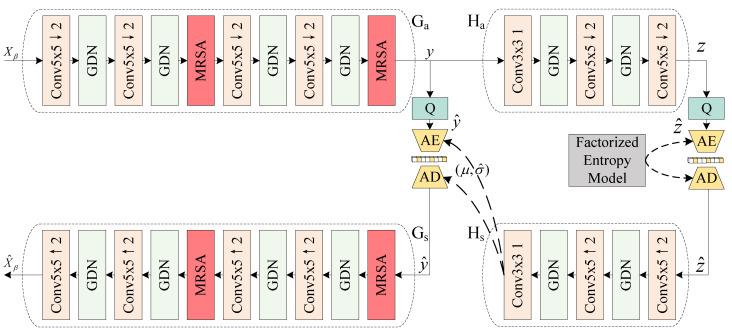
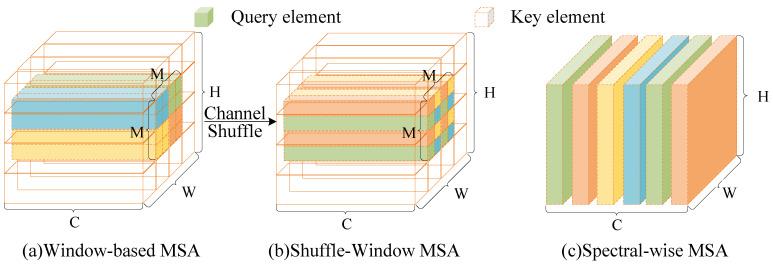
Most current hyperspectral image compression methods rely on well-designed modules to capture image structural information and long-range dependencies. However, these modules tend to increase computational complexity exponentially with the number of bands, which limits their performance under constrained resources. To address these challenges, this paper proposes a novel triple-phase hybrid framework for hyperspectral image compression. The first stage utilizes an adaptive band selection technique to sample the raw hyperspectral image, which mitigates the computational burden. The second stage concentrates on high-fidelity compression, efficiently encoding both spatial and spectral information within the sampled band clusters. In the final stage, a reconstruction network compensates for sampling-induced losses to precisely restore the original spectral details. The proposed framework, known as ARM-Net, is evaluated on seven mixed hyperspectral datasets. Compared to state-of-the-art methods, ARM-Net achieves an overall improvement of approximately 1-2 dB in both the peak signal-to-noise ratio and multiscale structural similarity index measure, as well as a reduction in the average spectral angle mapper of approximately 0.1.
当前大多数高光谱图像压缩方法依赖精心设计的模块来捕捉图像结构信息和长距离依赖性。然而,这些模块往往会随着波段数量呈指数级增加计算复杂度,这限制了它们在资源受限情况下的性能。为应对这些挑战,本文提出了一种用于高光谱图像压缩的新型三相混合框架。第一阶段利用自适应波段选择技术对原始高光谱图像进行采样,从而减轻计算负担。第二阶段专注于高保真压缩,在采样波段簇内高效编码空间和光谱信息。在最后阶段,一个重建网络补偿采样引起的损失,以精确恢复原始光谱细节。所提出的框架称为ARM-Net,在七个混合高光谱数据集上进行了评估。与现有方法相比,ARM-Net在峰值信噪比和多尺度结构相似性指数测量方面总体提高了约1-2 dB,并且平均光谱角映射器降低了约0.1。






 Zotero 插件