Yadav Chandra Shekhar, Krishna Atul, Singh Suriya Pratap, Kishan Jai, Chopra Sidharth, Srivastava Kajal, Guha Rajdeep, Lohani Minaxi B, Ahmad Varish, Alghamdi Anwar A, Khan Abdul Rahman, Azad Iqbal
Department of Chemistry, Integral University, Lucknow, India.
Department of Laboratory Animal Facility, CSIR-CDRI, Lucknow, India.
Sci Rep. 2025 Apr 28;15(1):14752. doi: 10.1038/s41598-025-98645-1.
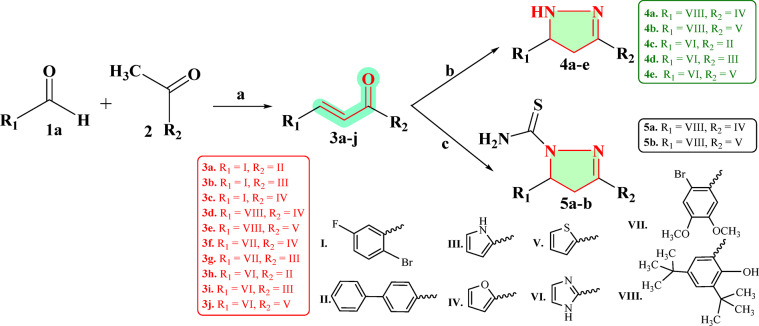
In this study, a series of novel α, β-unsaturated carbonyl compounds (3a-j) and their pyrazoline derivatives (4a-e and 5a-b) were designed and successfully synthesized. All synthesized compounds were characterized using various spectroscopic techniques, including H NMR, C NMR, and mass spectrometry. The biological activity of these compounds was evaluated against five bacterial strains (Pseudomonas aeruginosa, Klebsiella pneumoniae, Escherichia coli, Staphylococcus aureus, and Acinetobacter baumannii) and three fungal strains (Candida tropicalis, Candida parapsilosis, and Candida albicans). The results revealed that compound (4c) exhibited potent antifungal activity with a minimum inhibitory concentration (MIC) of 6.25 µg/mL across all tested strains and zone of inhibition (ZOI) against Candida albicans is 27 mm. Furthermore, time kill kinetics of Candida albicans and haemolysis assays also perform in support of their antifungal activity. Additionally, all synthesized compounds were subjected to computational analysis using molecular descriptors, ADMET, molecular docking, and molecular dynamics to find protein-ligand interactions. Molecular docking studies indicated that the most effective antifungal compounds (3h and 4c) exhibited binding energies of -8.76 and -8.44 kcal/mol for DHFR and -7.96 and -8.24 kcal/mol for NMT1, respectively. The obtained results revealed that these compounds exhibit potential interactions with antifungal targets as dual inhibitors. As a result, this study finds an important approach to synthesized compounds with potential antifungal activity.
在本研究中,设计并成功合成了一系列新型α,β-不饱和羰基化合物(3a-j)及其吡唑啉衍生物(4a-e和5a-b)。所有合成的化合物均采用多种光谱技术进行表征,包括氢核磁共振(¹H NMR)、碳核磁共振(¹³C NMR)和质谱分析。评估了这些化合物对五种细菌菌株(铜绿假单胞菌、肺炎克雷伯菌、大肠杆菌、金黄色葡萄球菌和鲍曼不动杆菌)和三种真菌菌株(热带念珠菌、近平滑念珠菌和白色念珠菌)的生物活性。结果表明,化合物(4c)表现出强效抗真菌活性,在所有测试菌株中的最低抑菌浓度(MIC)为6.25 μg/mL,对白色念珠菌的抑菌圈(ZOI)为27 mm。此外,还进行了白色念珠菌的时间杀菌动力学和溶血试验,以支持其抗真菌活性。此外,所有合成的化合物都使用分子描述符、ADMET、分子对接和分子动力学进行了计算分析,以寻找蛋白质-配体相互作用。分子对接研究表明,最有效的抗真菌化合物(3h和4c)对二氢叶酸还原酶(DHFR)的结合能分别为-8.76和-8.44 kcal/mol,对N-甲基转移酶1(NMT1)的结合能分别为-7.96和-8.24 kcal/mol。所得结果表明,这些化合物作为双重抑制剂与抗真菌靶点表现出潜在的相互作用。因此,本研究为合成具有潜在抗真菌活性的化合物找到了一种重要方法。