Ljungholm Linda, Klinga Charlotte, Ekstedt Mirjam, Edin-Liljegren Anette, Forsgärde Elin-Sofie
Department of Health and Caring Sciences, Linnaeus University, Kalmar, Växjö, SE-391 82, Sweden.
Academic Primary Healthcare Centre, Stockholm Health Care Services, Stockholm, Sweden.
BMC Health Serv Res. 2025 Apr 28;25(1):614. doi: 10.1186/s12913-025-12649-1.
This study, conducted across three distinct geographical regions in Sweden, highlights the diverse conditions and challenges in healthcare provision. The study focuses on the sparsely populated northern regions of Sweden, the capital city of Stockholm, and the southeast rural area of Sweden. Each location presents unique obstacles to continuity of care, influenced by factors such as population density and geographical disparities. By examining the experiences of patients with complex care needs, their family carers, and healthcare personnel, this study aims to describe the conditions for and identify potential solutions associated with the delivery of continuity in care in different geographical regions of Sweden, with differing population densities.
Secondary analysis was conducted using qualitative content analysis on interview data from two studies, consisting of 53 transcripts from individual, pair, and focus group interviews held between August 2018 and November 2019. The potential solutions identified from participants' experiences were categorized into region-specific and common themes. Three personas-Vera, Bo, and Inga-were developed, each representing a scenario based on the region-specific analyses.
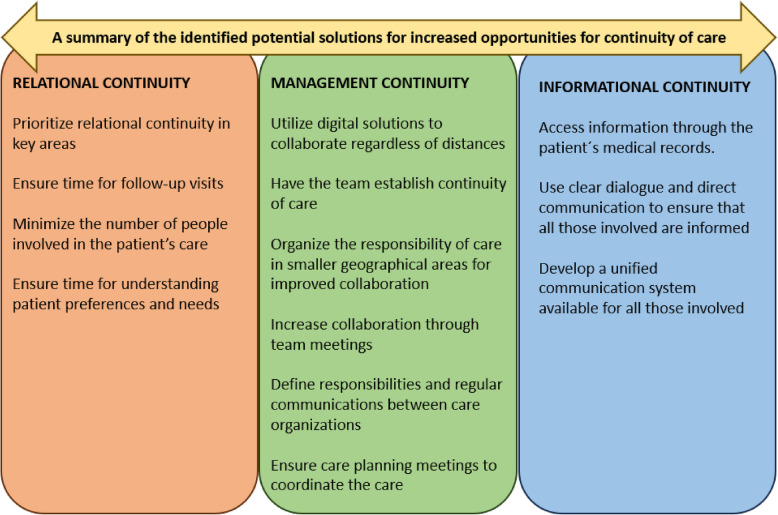
Despite regional differences, universal solutions to common challenges were identified focusing on relational, management, and informational aspects. Common key obstacles to continuity of care included resource shortages, insufficient information transfer, and privacy regulations. Possible solutions for overcoming these challenges include prioritizing relational continuity, streamlining processes, and advocating for a unified communication system. By collaborating, building trust, understanding patient preferences, and ensuring clear communication, healthcare personnel can effectively promote continuity of care.
Building a stable workforce while prioritizing relational continuity, along with patients' preferences and needs, is essential for ensuring continuity of care from multiple providers. Digital solutions can enhance collaboration across distances, while coordinating responsibilities within smaller geographical areas can strengthen partnerships among healthcare organizations. Direct dialogue, along with ensuring that everyone has access to relevant information through a unified communication system, is vital for management continuity. By integrating these universal and transferable solutions to the obstacles associated with continuity of care, we can create a cohesive care experience for patients, regardless of geographical and demographic conditions.
这项在瑞典三个不同地理区域开展的研究,凸显了医疗服务提供方面的多样状况和挑战。该研究聚焦于瑞典人口稀少的北部地区、首都斯德哥尔摩以及瑞典东南部农村地区。每个地点在医疗连续性方面都存在独特障碍,这些障碍受到人口密度和地理差异等因素的影响。通过考察有复杂护理需求的患者、其家庭护理人员以及医护人员的经历,本研究旨在描述瑞典不同人口密度的不同地理区域提供连续性护理的条件,并确定与之相关的潜在解决方案。
对两项研究的访谈数据进行定性内容分析,开展二次分析。这些数据包括2018年8月至2019年11月期间进行的个人、双人及焦点小组访谈的53份文字记录。从参与者经历中确定的潜在解决方案被归类为特定区域主题和共同主题。开发了三个角色——薇拉、博和英加,每个角色都代表基于特定区域分析的一种情景。
尽管存在区域差异,但针对共同挑战确定了侧重于关系、管理和信息方面的通用解决方案。护理连续性的常见关键障碍包括资源短缺、信息传递不足和隐私法规。克服这些挑战的可能解决方案包括优先考虑关系连续性、简化流程以及倡导统一的沟通系统。通过协作、建立信任、了解患者偏好并确保清晰沟通,医护人员能够有效促进护理连续性。
在优先考虑关系连续性以及患者偏好和需求的同时,建立稳定的 workforce 对于确保来自多个提供者的护理连续性至关重要。数字解决方案可以加强远距离协作,而在较小地理区域内协调职责可以加强医疗组织之间的伙伴关系。直接对话以及确保每个人都能通过统一的沟通系统获取相关信息对于管理连续性至关重要。通过将这些通用且可转移的解决方案应用于与护理连续性相关的障碍,我们可以为患者创造一个连贯的护理体验,无论地理和人口状况如何。