Rudin Lucille, Kneubühler Julien, Dubey Badri Nath, Ahmad Sabahuddin, Bornstein Michael M, Shyp Viktoriya
Department Research, University Center for Dental Medicine Basel UZB, University of Basel, Basel, Switzerland.
CSSB Centre for Structural Systems Biology, Deutsches Elektronen-Synchrotron DESY, Hamburg, Germany.
Microbiol Spectr. 2025 Jun 3;13(6):e0284824. doi: 10.1128/spectrum.02848-24. Epub 2025 Apr 30.
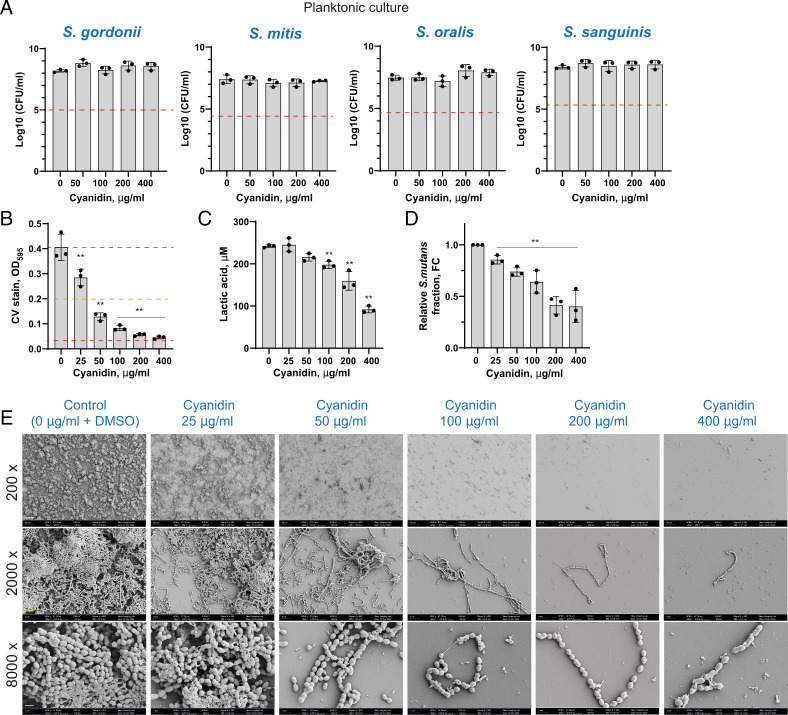
As primary colonizers of the tooth surface, oral streptococci play a crucial role in dental caries development. Numerous natural compounds, including flavonoids, are emerging as promising agents for inhibiting dental biofilm formation without compromising bacterial viability, underscoring their potential in non-bactericidal antibiofilm strategies. This study investigated the effects and mechanism of action of the unmodified plant flavonoid cyanidin on the growth and sucrose-dependent biofilm formation of oral streptococci, with a particular focus on the cariogenic pathogen . At concentrations above 100 µg/mL, cyanidin significantly inhibited biofilm formation by without impacting bacterial viability. The flavonoid reduced the biomass of surface-associated bacteria and exopolysaccharides (EPS), particularly by inhibiting water-insoluble glucan (WIG) production mediated by the glucosyltransferases GtfB and GtfC. While cyanidin did not exhibit a bactericidal effect on early colonizer streptococci, such as , , , and , it showed a significant inhibitory effect on bacterial acidogenicity and mixed-species streptococcal biofilms in the presence of . Remarkably, cyanidin gradually reduced the proportion of in the mixed biofilm, suggesting a selective impact that may promote a more commensal-dominant community by disrupting glucan production and biofilm competitiveness.
The identification of compounds with potent antibiofilm effects that do not compromise bacterial viability presents a promising strategy for oral health management. By preventing biofilm formation and keeping bacteria in a planktonic state, such agents could enhance bacterial susceptibility to targeted therapies, including probiotics or phage-based treatments. Cyanidin, which exhibits strong antibiofilm activity against oral streptococcal biofilms, reduces bacterial acidogenicity and may promote a more commensal-dominant biofilm , potentially hindering the maturation of cariogenic biofilms.
作为牙面的主要定植菌,口腔链球菌在龋齿发展中起关键作用。包括黄酮类化合物在内的众多天然化合物正成为有前景的抑制牙菌斑生物膜形成的药物,且不影响细菌活力,凸显了它们在非杀菌性抗生物膜策略中的潜力。本研究调查了未修饰的植物黄酮花青素对口腔链球菌生长和蔗糖依赖性生物膜形成的影响及作用机制,特别关注致龋病原体。在浓度高于100μg/mL时,花青素显著抑制生物膜形成,且不影响细菌活力。该黄酮类化合物减少了表面相关细菌和胞外多糖(EPS)的生物量,尤其是通过抑制由葡糖基转移酶GtfB和GtfC介导的水不溶性葡聚糖(WIG)的产生。虽然花青素对早期定植菌链球菌(如 、 、 和 )没有杀菌作用,但在 存在的情况下,它对细菌产酸能力和混合菌种链球菌生物膜有显著抑制作用。值得注意的是,花青素逐渐降低了混合生物膜中 的比例,这表明其具有选择性影响,可能通过破坏 葡聚糖的产生和生物膜竞争力来促进更以共生菌为主导的群落。
鉴定出具有强大抗生物膜作用且不影响细菌活力的化合物,为口腔健康管理提供了一种有前景的策略。通过防止生物膜形成并使细菌保持浮游状态,此类药物可增强细菌对靶向治疗的敏感性,包括益生菌或基于噬菌体的治疗。花青素对口腔链球菌生物膜表现出强大的抗生物膜活性,降低细菌产酸能力,并可能促进更以共生菌为主导的生物膜 ,潜在地阻碍致龋生物膜的成熟。