Richards Andrew J, Malekzadeh Rohin, Elghobashy Mohamed E, Laham Robert, Power Geoffrey A, Paris Michael T, Cheng Arthur J
Muscle Health Research Centre, School of Kinesiology and Health Science, Faculty of Health, York University, Toronto, Ontario, Canada.
Department of Medicine, University of Toronto, Toronto, Ontario, Canada.
Scand J Med Sci Sports. 2025 May;35(5):e70061. doi: 10.1111/sms.70061.
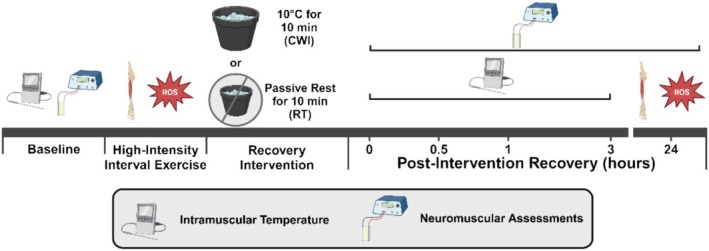
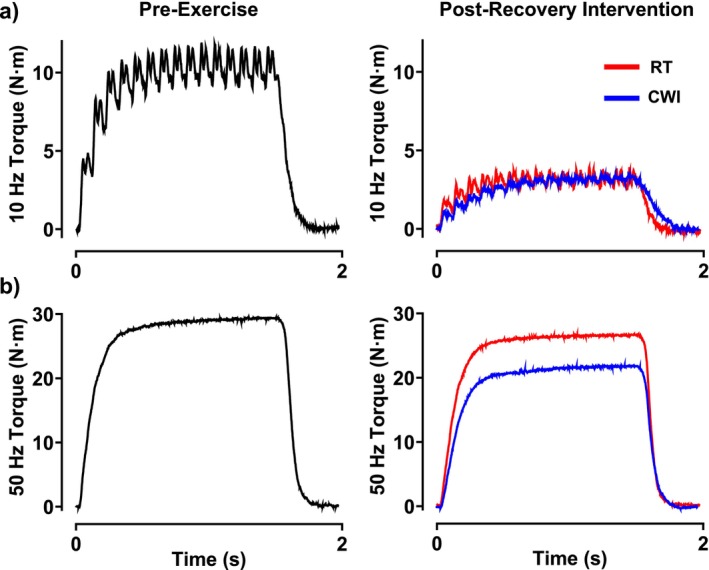
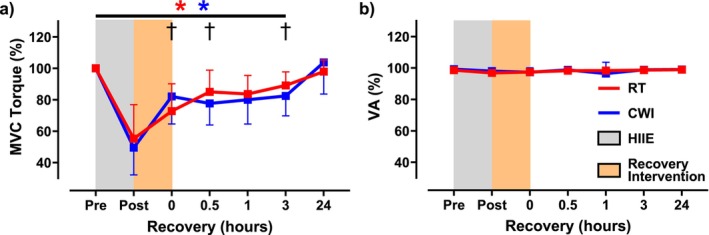
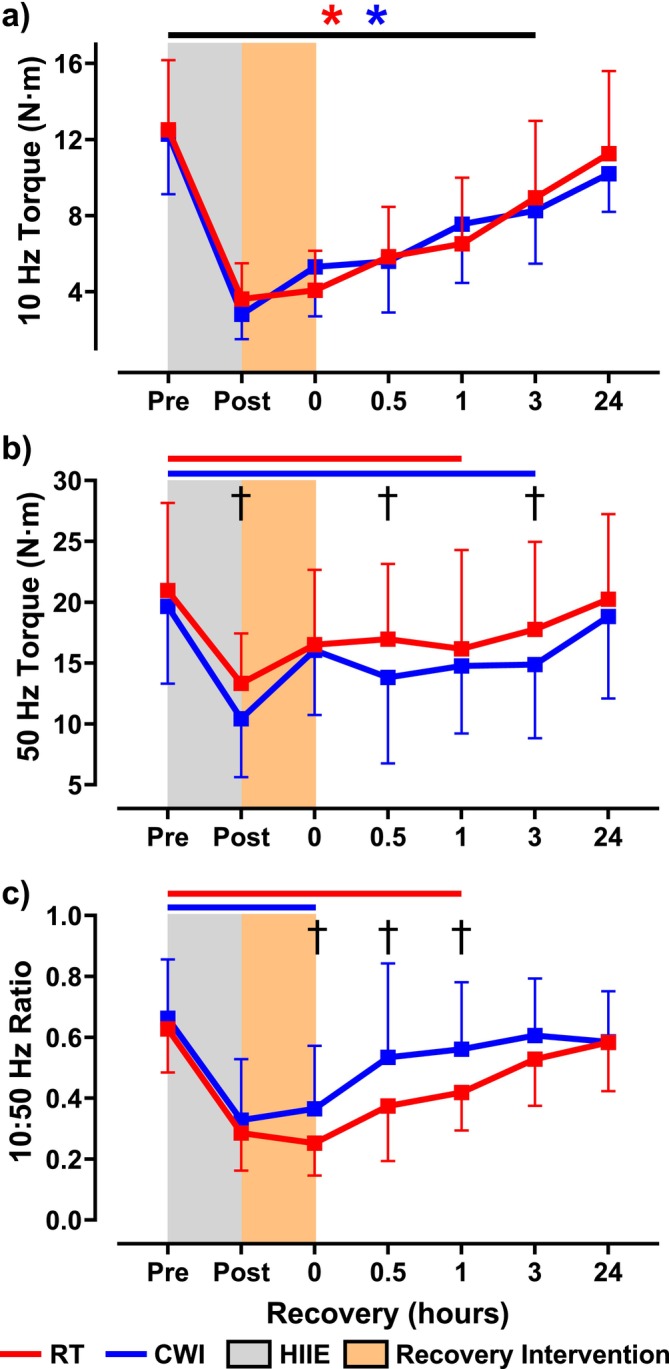
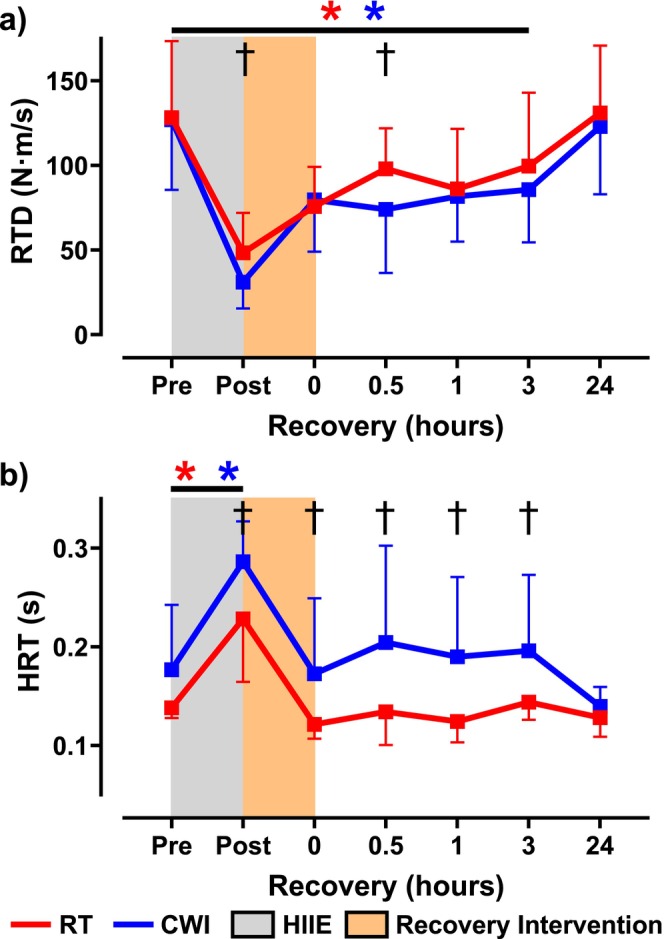
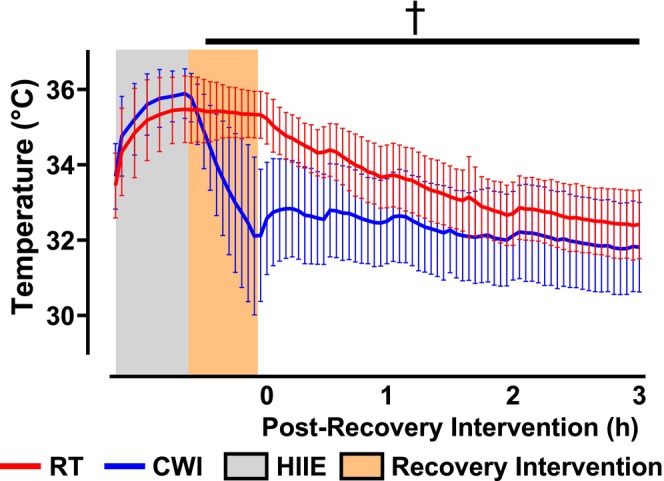
Cold-water immersion (CWI) has become a widely adopted method for post-exercise recovery. However, its effectiveness in restoring neuromuscular function remains inconclusive. This study examined the impact of CWI on recovery following high-intensity interval exercise (HIIE). Twelve young, recreationally active individuals (10 males, 2 females) participated in a randomized crossover study. Each session included six sets of 30-s all-out isokinetic concentric contractions of the ankle dorsiflexor and plantar flexor muscles, followed by 10 min of room temperature rest (RT) or CWI at 10°C. Neuromuscular function and intramuscular temperature were evaluated periodically over 24 h, as well as next-day fatigue resistance of the dorsiflexors. In both conditions, maximal voluntary contraction torque remained impaired for up to 3 h without significant changes in voluntary activation (p > 0.05). Electrically stimulated torque showed no difference in the fatigue-induced decline or recovery of 10 Hz torque, which also remained impaired for up to 3 h. However, 50 Hz torque recovered within 1 h following RT, whereas it remained slightly reduced for up to 3 h following CWI. The 10:50 Hz torque ratio showed immediate recovery with CWI, whereas RT recovery was delayed for up to 1 h. Notably, the ratio was significantly lower with RT at 0-, 0.5-, and 1-h post-intervention. Despite these differences, HIIE performance during a repeat bout conducted 24 h later remained similar. In conclusion, 10 min of CWI at 10°C does not enhance post-exercise recovery or next-day exercise performance following HIIE.
冷水浸泡(CWI)已成为一种广泛采用的运动后恢复方法。然而,其在恢复神经肌肉功能方面的有效性仍尚无定论。本研究考察了CWI对高强度间歇运动(HIIE)后恢复的影响。12名年轻的、有运动习惯的个体(10名男性,2名女性)参与了一项随机交叉研究。每个训练单元包括六组踝关节背屈肌和跖屈肌的30秒全力等速向心收缩,随后进行10分钟的室温休息(RT)或10°C的CWI。在24小时内定期评估神经肌肉功能和肌肉内温度,以及次日背屈肌的抗疲劳能力。在两种情况下,最大自主收缩扭矩在长达3小时内均受损,而自主激活无显著变化(p>0.05)。电刺激扭矩在疲劳诱导的10Hz扭矩下降或恢复方面无差异,其在长达3小时内也仍受损。然而,50Hz扭矩在RT后1小时内恢复,而在CWI后长达3小时内仍略有下降。10:50Hz扭矩比在CWI后立即恢复,而RT恢复延迟长达1小时。值得注意的是,在干预后0小时、0.5小时和1小时,RT时该比值显著较低。尽管存在这些差异,但在24小时后进行的重复训练中,HIIE表现仍相似。总之,10°C下10分钟的CWI并不能增强HIIE后的运动后恢复或次日运动表现。