Karvelsson Sigurður T, Besnier Emmanuel, Vilhjálmsson Arnar Ingi, Molkhou Camille, Jóhannsson Freyr, Lepretre Perrine, Poisson Étienne Ljóni, Tamion Fabienne, Bellien Jérémy, Rolfsson Óttar, de Lomana Adrián López García, Duflot Thomas
Center for Systems Biology, University of Iceland, Reykjavík, Iceland.
Department of Anesthesiology and Critical Care, University of Rouen Normandy, INSERM EnVI UMR 1096, CHU Rouen, Rouen, F-76000, France.
Sci Rep. 2025 May 3;15(1):15498. doi: 10.1038/s41598-025-00373-z.
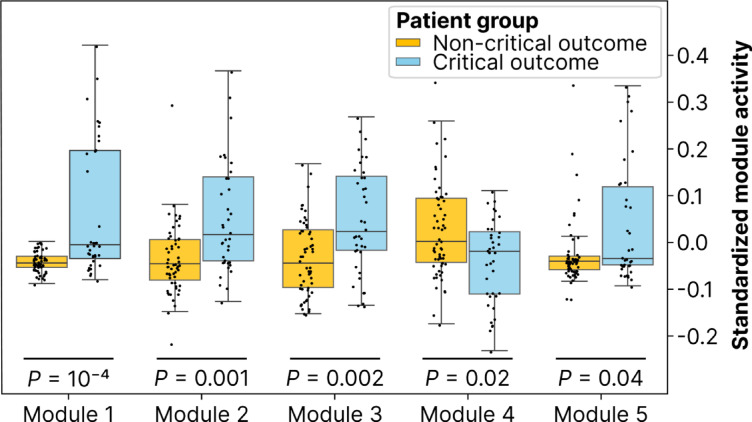
SARS-CoV-2 significantly impacts the human metabolome. This study aims to evaluate the predictive capability of a comprehensive module clustering approach in plasma metabolomics for identifying the risk of critical complications in COVID-19 patients admitted to intensive care units (ICUs). We conducted a prospective monocenter study, gathering blood samples within 24 h of ICU admission, alongside clinical, biological, and demographic patient characteristics. Subsequently, we quantified patients' plasma metabolome using a comprehensive untargeted metabolomics approach. First, we stratified patients based on a composite outcome score indicating critical status. Analysis of potential predictors revealed that older patients with higher severity scores and pronounced alterations in key biological parameters are more likely to experience critical complications. Next, we identified 6,667 metabolic features clustered into 57 annotated metabolic modules across all patients by employing an integrative metabolomics approach. Furthermore, we identified the most differentially expressed metabolic modules related to patients' outcomes. Moreover, we defined the top five most predictive metabolites of critical status: homoserine, urobilinogen, methionine, xanthine and pipecolic acid. These five predictors alone demonstrated similar or superior performance compared to clinical and demographic variables in predicting patients' outcomes. This innovative metabolic module inference approach offers a valuable framework for identifying patients prone to complications upon ICU admission for COVID-19. Its potential applications extend to enhancing patient management across diverse clinical settings.
严重急性呼吸综合征冠状病毒2型(SARS-CoV-2)对人类代谢组有重大影响。本研究旨在评估血浆代谢组学中一种综合模块聚类方法在识别入住重症监护病房(ICU)的新冠肺炎患者发生严重并发症风险方面的预测能力。我们开展了一项前瞻性单中心研究,在患者入住ICU后24小时内采集血样,同时收集患者的临床、生物学和人口统计学特征。随后,我们采用全面的非靶向代谢组学方法对患者的血浆代谢组进行定量分析。首先,我们根据表示危急状态的综合结局评分对患者进行分层。对潜在预测因素的分析表明,病情严重程度评分较高且关键生物学参数有明显改变的老年患者更有可能发生严重并发症。接下来,我们采用综合代谢组学方法,在所有患者中识别出6667个代谢特征,并将其聚类为57个注释代谢模块。此外,我们确定了与患者结局最相关的差异表达代谢模块。此外,我们定义了危急状态的前五个最具预测性的代谢物:高丝氨酸、尿胆原、蛋氨酸、黄嘌呤和哌啶酸。仅这五个预测因素在预测患者结局方面就表现出与临床和人口统计学变量相似或更优的性能。这种创新的代谢模块推断方法为识别入住ICU的新冠肺炎患者中易发生并发症的患者提供了一个有价值的框架。其潜在应用扩展到改善不同临床环境中的患者管理。