Arbelaez Ossa Laura, Rost Michael, Bont Nathalie, Lorenzini Giorgia, Shaw David, Elger Bernice Simone
Institute for Biomedical Ethics, University of Basel, Basel, Switzerland.
Care and Public Health Research Institute, Maastricht University, Maastricht, The Netherlands.
JMIR AI. 2025 May 5;4:e50781. doi: 10.2196/50781.
The introduction of artificial intelligence (AI) into health care has sparked discussions about its potential impact. Patients, as key stakeholders, will be at the forefront of interacting with and being impacted by AI. Given the ethical importance of patient-centered health care, patients must navigate how they engage with AI. However, integrating AI into clinical practice brings potential challenges, particularly in shared decision-making and ensuring patients remain active participants in their care. Whether AI-supported interventions empower or undermine patient participation depends largely on how these technologies are envisioned and integrated into practice.
This study explores how patients and medical AI professionals perceive the patient's role and the factors shaping participation in AI-supported care.
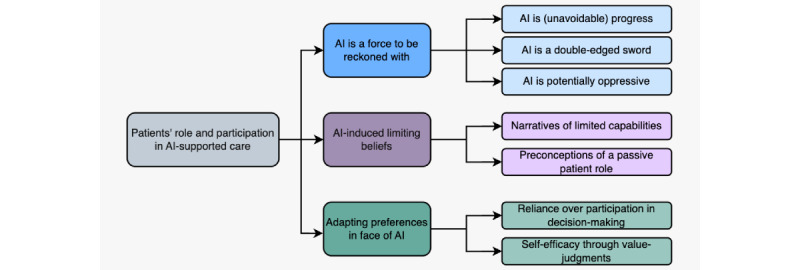
We conducted qualitative semistructured interviews with 21 patients and 21 medical AI professionals from different disciplinary backgrounds. Data were analyzed using reflexive thematic analysis. We identified 3 themes to describe how patients and professionals describe factors that shape participation in AI-supported care.
The first theme explored the vision of AI as an unavoidable and potentially harmful force of change in health care. The second theme highlights how patients perceive limitations in their capabilities that may prevent them from meaningfully participating in AI-supported care. The third theme describes patients' adaptive responses, such as relying on experts or making value judgments leading to acceptance or rejection of AI-supported care.
Both external and internal preconceptions influence how patients and medical AI professionals perceive patient participation. Patients often internalize AI's complexity and inevitability as an obstacle to their active participation, leading them to feel they have little influence over its development. While some patients rely on doctors or see AI as something to accept or reject, these strategies risk placing them in a disempowering role as passive recipients of care. Without adequate education on their rights and possibilities, these responses may not be enough to position patients at the center of their care.
将人工智能(AI)引入医疗保健领域引发了关于其潜在影响的讨论。患者作为关键利益相关者,将处于与AI交互并受其影响的前沿位置。鉴于以患者为中心的医疗保健的伦理重要性,患者必须应对他们如何与AI互动的问题。然而,将AI整合到临床实践中带来了潜在挑战,特别是在共同决策以及确保患者在其护理中保持积极参与者方面。AI支持的干预措施增强还是削弱患者参与度在很大程度上取决于这些技术如何被设想并整合到实践中。
本研究探讨患者和医学AI专业人员如何看待患者的角色以及影响参与AI支持的护理的因素。
我们对来自不同学科背景的21名患者和21名医学AI专业人员进行了定性半结构化访谈。使用反思性主题分析对数据进行分析。我们确定了3个主题来描述患者和专业人员如何描述影响参与AI支持的护理的因素。
第一个主题探讨了将AI视为医疗保健中不可避免且可能有害的变革力量的观点。第二个主题强调患者如何看待自身能力的局限性,这些局限性可能阻止他们有意义地参与AI支持的护理。第三个主题描述了患者的适应性反应,例如依赖专家或做出价值判断以接受或拒绝AI支持的护理。
外部和内部的先入之见都会影响患者和医学AI专业人员对患者参与的看法。患者常常将AI的复杂性和必然性内化,将其视为积极参与的障碍,导致他们觉得自己对其发展几乎没有影响力。虽然一些患者依赖医生或将AI视为可接受或拒绝的事物,但这些策略有可能使他们处于无权的被动护理接受者角色。如果没有关于他们权利和可能性的充分教育,这些反应可能不足以让患者处于其护理的中心位置。