Whatley Mary C, Murayama Kou, Sakaki Michiko, Castel Alan D
Department of Psychology, University of California, Los Angeles.
Department of Psychology, Western Carolina University, Cullowhee, North Carolina, United States.
PLoS One. 2025 May 7;20(5):e0320600. doi: 10.1371/journal.pone.0320600. eCollection 2025.
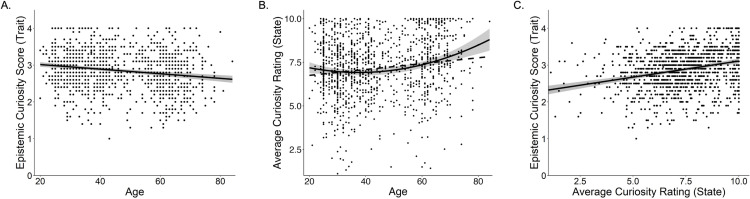
Maintaining curiosity in older age may be a key predictor of successful aging, but prior research on the relationship between curiosity and age is mixed, with mounting evidence showing that curiosity declines with age. However, there is evidence suggesting that state curiosity - a situational feeling of curiosity in response to information - may increase with age. Prior work has largely not adequately differentiated state and trait curiosity when examining its relationship with age. In a large lifespan sample (pilot study N = 193; preregistered main study N = 1,218), we assess trait curiosity and state curiosity (using a trivia rating task) to examine the relationship between each construct and age. The results show that, in line with prior work, trait curiosity shows a negative relationship with age, but state curiosity shows a positive relationship with age, while controlling for demographic variables. The results suggest that curiosity may have a more complex relationship with age than previously considered, which can have implications for engagement in cognitive activities in everyday life.
在老年时期保持好奇心可能是成功衰老的一个关键预测因素,但先前关于好奇心与年龄之间关系的研究结果不一,越来越多的证据表明好奇心会随着年龄的增长而下降。然而,有证据表明,状态好奇心——一种因信息而产生的情境性好奇感——可能会随着年龄的增长而增加。先前的研究在考察好奇心与年龄的关系时,在很大程度上没有充分区分状态好奇心和特质好奇心。在一个大规模的全生命周期样本中(试点研究N = 193;预先注册的主要研究N = 1218),我们评估特质好奇心和状态好奇心(使用一个琐事评分任务),以检验每种构念与年龄之间的关系。结果表明,与先前的研究一致,在控制人口统计学变量的情况下,特质好奇心与年龄呈负相关,而状态好奇心与年龄呈正相关。研究结果表明,好奇心与年龄的关系可能比之前认为的更为复杂,这可能会对日常生活中的认知活动参与度产生影响。