Wang Yinqing, Zhao Liangjun, Hu Yueming, Dai Hui, Zhang Yuanyang
Sichuan University of Science and Engineering, Yibin, 644000, China.
Sichuan Key Provincial Research Base of Intelligent Tourism, Yibin, 644000, China.
Sci Rep. 2025 May 8;15(1):16003. doi: 10.1038/s41598-025-00750-8.
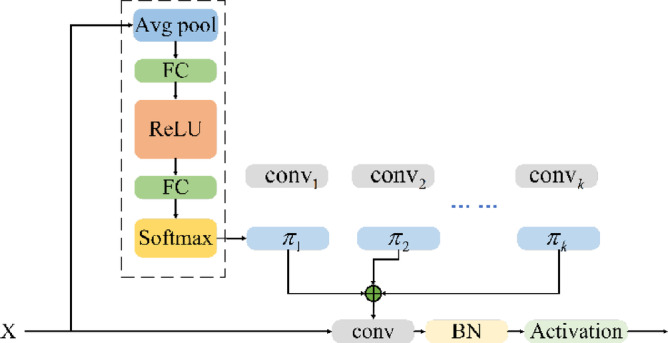
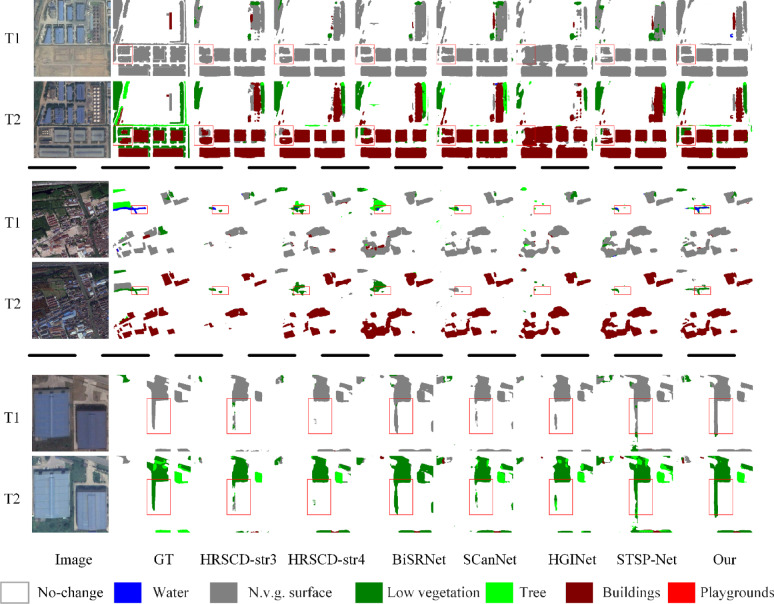
Semantic Change Detection (SCD) aims to accurately identify the change areas and their categories in dual-time images, which is more complex and challenging than traditional binary change detection tasks. Accurately capturing the change information of land cover types is crucial for remote sensing image analysis and subsequent decision-making applications. However, existing SCD methods often neglect the spatial details and temporal dependencies of dual-time images, leading to problems such as change category imbalance and limited detection accuracy, especially in capturing small target changes. To address this issue, this study proposes a network that guides multitask semantic change detection through spatiotemporal semantic interaction (STGNet). STGNet enhances the ability to capture spatial details by introducing a Detail-Aware Path (DAP) and designs a Bidirectional Guidance Module for Spatial Detail and Semantic Information for adaptive feature selection, improving feature extraction capabilities in complex scenes. Furthermore, to resolve the inconsistency between semantic information and change areas, this paper designs a Cross-Temporal Refinement Interaction Module (CTIM), which enables cross-time scale feature fusion and interaction, constraining the consistency of detection results and improving the recognition accuracy of unchanged areas. To further enhance detection performance, a dynamic depthwise separable convolution is designed in the CTIM module, which can adaptively adjust convolution kernels to more precisely capture change features in different regions of the image. Experimental results on three SCD datasets show that the proposed method outperforms other existing methods in various evaluation metrics. In particular, on the Landsat-SCD dataset, the F1 score (F1) reaches 91.64%, and the separation Kappa coefficient improves by 17.68%. These experimental results fully demonstrate the significant advantages of STGNet in improving semantic change detection accuracy, robustness, and generalization capability.
语义变化检测(SCD)旨在准确识别双时相图像中的变化区域及其类别,这比传统的二值变化检测任务更为复杂且具有挑战性。准确捕捉土地覆盖类型的变化信息对于遥感图像分析及后续决策应用至关重要。然而,现有的SCD方法常常忽略双时相图像的空间细节和时间依赖性,导致诸如变化类别不平衡和检测精度受限等问题,尤其是在捕捉小目标变化方面。为解决这一问题,本研究提出了一种通过时空语义交互来引导多任务语义变化检测的网络(STGNet)。STGNet通过引入细节感知路径(DAP)增强了捕捉空间细节的能力,并设计了一个用于空间细节和语义信息的双向引导模块以进行自适应特征选择,从而提高复杂场景中的特征提取能力。此外,为解决语义信息与变化区域之间的不一致性,本文设计了一个跨时间细化交互模块(CTIM),它能够实现跨时间尺度的特征融合与交互,约束检测结果的一致性并提高未变化区域的识别精度。为进一步提升检测性能,在CTIM模块中设计了动态深度可分离卷积,其能够自适应调整卷积核以更精确地捕捉图像不同区域的变化特征。在三个SCD数据集上的实验结果表明,所提方法在各项评估指标上均优于其他现有方法。特别是在Landsat-SCD数据集上,F1分数(F1)达到91.64%,分离Kappa系数提高了17.68%。这些实验结果充分证明了STGNet在提高语义变化检测精度、鲁棒性和泛化能力方面的显著优势。