Tsang Tim K, Rojas Diana P, Xu Fei, Xu Yanfang, Zhu Xiaolin, Halloran M Elizabeth, Longini Ira M, Yang Yang
World Health Organization Collaborating Centre for Infectious Disease Epidemiology and Control, School of Public Health, Li Ka Shing Faculty of Medicine, The University of Hong Kong, Hong Kong Special Administrative Region, China.
Department of Biostatistics, University of Florida, Gainesville, FL, USA.
Nat Commun. 2025 May 8;16(1):4299. doi: 10.1038/s41467-025-59655-9.
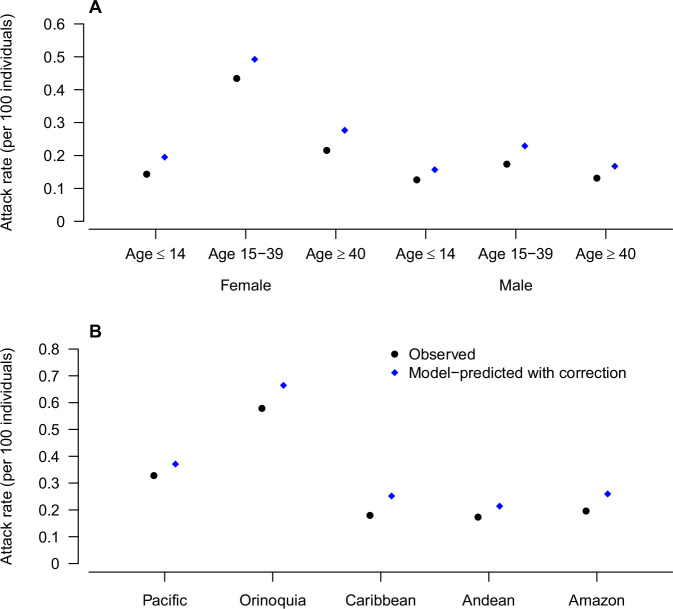
The 2015-2016 Zika virus outbreak in the Americas presented significant challenges in understanding the transmission dynamics due to substantial reporting biases, as women of reproductive age (15-39 years) were disproportionately represented in the surveillance data when public awareness of relationship between Zika and microcephaly increased. Using national surveillance data from Colombia during July 27, 2015-November 21, 2016, we developed a Bayesian hierarchical modeling framework to reconstruct the true numbers of symptomatic cases and estimate transmission parameters while accounting for differential reporting across age-sex groups. Our model revealed that the detection rate of symptomatic cases among women of reproductive age was 99% (95% CI: 98.7-100), compared to 85.4% (95% CI: 84.7-86.1) in other demographic groups. After correcting for these biases, our results showed that females aged 15-39 years remained 82.8% (95% CI: 80.2-85.2%) more susceptible to Zika symptomatic infection than males of the same age, independent of differential reporting areas. Departments with medium-high altitude, medium-high population density, low coverage of forest, or high dengue incidence from 2011-2015 exhibited greater Zika risk. This study underscores the importance of accounting for surveillance biases in epidemiological studies to better understand factors influencing Zika transmission and to inform disease control and prevention.
2015 - 2016年寨卡病毒在美洲爆发,由于存在大量报告偏差,在了解传播动态方面面临重大挑战,因为随着公众对寨卡病毒与小头畸形之间关系的认识提高,育龄妇女(15 - 39岁)在监测数据中的占比过高。利用哥伦比亚2015年7月27日至2016年11月21日的国家监测数据,我们开发了一个贝叶斯分层建模框架,以重建有症状病例的真实数量,并在考虑不同年龄 - 性别组报告差异的情况下估计传播参数。我们的模型显示,育龄妇女中有症状病例的检出率为99%(95%置信区间:98.7 - 100),而其他人口群体为85.4%(95%置信区间:84.7 - 86.1)。校正这些偏差后,我们的结果表明,15 - 39岁的女性比同年龄男性感染寨卡病毒有症状感染的易感性仍高82.8%(95%置信区间:80.2 - 85.2%),与报告差异地区无关。海拔中高、人口密度中高、森林覆盖率低或2011 - 2015年登革热发病率高的部门,寨卡病毒风险更大。本研究强调了在流行病学研究中考虑监测偏差对于更好地理解影响寨卡病毒传播的因素以及为疾病控制和预防提供信息的重要性。