• 文献检索
  • 文档翻译
  • 深度研究
  • 学术资讯
  • Suppr Zotero 插件Zotero 插件
  • 邀请有礼
  • 套餐&价格
  • 历史记录
应用&插件
Suppr Zotero 插件Zotero 插件浏览器插件Mac 客户端Windows 客户端微信小程序
定价
高级版会员购买积分包购买API积分包
服务
文献检索文档翻译深度研究API 文档MCP 服务
关于我们
关于 Suppr公司介绍联系我们用户协议隐私条款
关注我们

Suppr 超能文献

核心技术专利:CN118964589B侵权必究
粤ICP备2023148730 号-1Suppr @ 2026

文献检索

告别复杂PubMed语法,用中文像聊天一样搜索,搜遍4000万医学文献。AI智能推荐,让科研检索更轻松。

立即免费搜索

文件翻译

保留排版,准确专业,支持PDF/Word/PPT等文件格式,支持 12+语言互译。

免费翻译文档

深度研究

AI帮你快速写综述,25分钟生成高质量综述,智能提取关键信息,辅助科研写作。

立即免费体验

2015-2016 年哥伦比亚登革热和寨卡病毒感染相对风险的联合估计。

Joint Estimation of Relative Risk for Dengue and Zika Infections, Colombia, 2015-2016.

出版信息

Emerg Infect Dis. 2019 Jun;25(6):1118-1126. doi: 10.3201/eid2506.180392.

DOI:10.3201/eid2506.180392
PMID:31107226
原文链接:https://pmc.ncbi.nlm.nih.gov/articles/PMC6537708/
Abstract

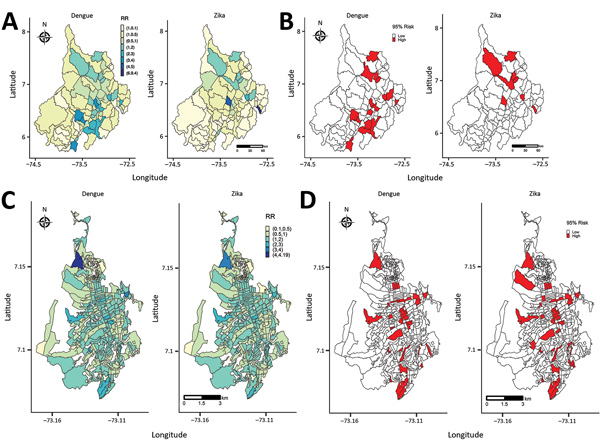
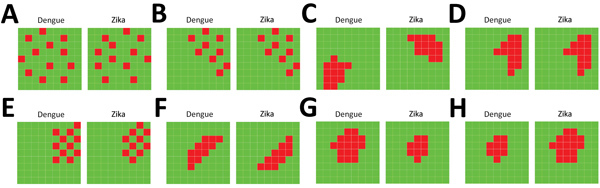
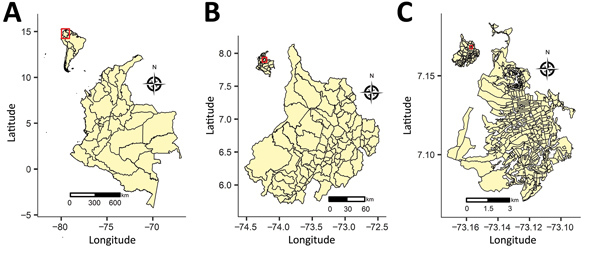
We jointly estimated relative risk for dengue and Zika virus disease (Zika) in Colombia, establishing the spatial association between them at the department and city levels for October 2015-December 2016. Cases of dengue and Zika were allocated to the 87 municipalities of 1 department and the 293 census sections of 1 city in Colombia. We fitted 8 hierarchical Bayesian Poisson joint models of relative risk for dengue and Zika, including area- and disease-specific random effects accounting for several spatial patterns of disease risk (clustered or uncorrelated heterogeneity) within and between both diseases. Most of the dengue and Zika high-risk municipalities varied in their risk distribution; those for Zika were in the northern part of the department and dengue in the southern to northeastern parts. At city level, spatially clustered patterns of dengue high-risk census sections indicated Zika high-risk areas. This information can be used to inform public health decision making.

摘要

我们联合估计了哥伦比亚登革热和寨卡病毒病(Zika)的相对风险,并在部门和城市级别上建立了它们在 2015 年 10 月至 2016 年 12 月之间的空间关联。将登革热和寨卡病例分配给哥伦比亚 1 个部门的 87 个城市和 1 个城市的 293 个普查区。我们拟合了 8 个登革热和寨卡相对风险的分层贝叶斯泊松联合模型,包括针对疾病风险的区域和疾病特异性随机效应,这些效应考虑了两种疾病内和疾病间的多种疾病风险空间模式(聚类或不相关的异质性)。大多数登革热和寨卡高风险城市在风险分布上有所不同;寨卡病毒的高风险城市位于该省北部,而登革热的高风险城市位于南部至东北部。在城市层面,登革热高风险普查区的空间聚类模式表明寨卡病毒高风险地区。这些信息可用于为公共卫生决策提供信息。
https://cdn.ncbi.nlm.nih.gov/pmc/blobs/2955/6537708/c0885346d5aa/18-0392-F5.jpg
https://cdn.ncbi.nlm.nih.gov/pmc/blobs/2955/6537708/c5a46496a164/18-0392-F1.jpg
https://cdn.ncbi.nlm.nih.gov/pmc/blobs/2955/6537708/f6e687fbb756/18-0392-F2.jpg
https://cdn.ncbi.nlm.nih.gov/pmc/blobs/2955/6537708/aa40ea6a88ae/18-0392-F3.jpg
https://cdn.ncbi.nlm.nih.gov/pmc/blobs/2955/6537708/1361a1cdf715/18-0392-F4.jpg
https://cdn.ncbi.nlm.nih.gov/pmc/blobs/2955/6537708/c0885346d5aa/18-0392-F5.jpg
https://cdn.ncbi.nlm.nih.gov/pmc/blobs/2955/6537708/c5a46496a164/18-0392-F1.jpg
https://cdn.ncbi.nlm.nih.gov/pmc/blobs/2955/6537708/f6e687fbb756/18-0392-F2.jpg
https://cdn.ncbi.nlm.nih.gov/pmc/blobs/2955/6537708/aa40ea6a88ae/18-0392-F3.jpg
https://cdn.ncbi.nlm.nih.gov/pmc/blobs/2955/6537708/1361a1cdf715/18-0392-F4.jpg
https://cdn.ncbi.nlm.nih.gov/pmc/blobs/2955/6537708/c0885346d5aa/18-0392-F5.jpg

相似文献

1
Joint Estimation of Relative Risk for Dengue and Zika Infections, Colombia, 2015-2016.2015-2016 年哥伦比亚登革热和寨卡病毒感染相对风险的联合估计。
Emerg Infect Dis. 2019 Jun;25(6):1118-1126. doi: 10.3201/eid2506.180392.
2
Co-circulation and simultaneous co-infection of dengue, chikungunya, and zika viruses in patients with febrile syndrome at the Colombian-Venezuelan border.登革热、基孔肯雅热和寨卡病毒在哥伦比亚-委内瑞拉边境发热综合征患者中的共同传播及同时合并感染
BMC Infect Dis. 2018 Jan 30;18(1):61. doi: 10.1186/s12879-018-2976-1.
3
Spatiotemporal distribution and socioeconomic disparities of dengue, chikungunya and Zika in two Latin American cities from 2007 to 2017.2007 年至 2017 年拉丁美洲两个城市登革热、基孔肯雅热和寨卡病毒的时空分布及社会经济差异。
Trop Med Int Health. 2021 Mar;26(3):301-315. doi: 10.1111/tmi.13530. Epub 2020 Dec 13.
4
Cross-Protection of Dengue Virus Infection against Congenital Zika Syndrome, Northeastern Brazil.巴西东北部登革热病毒感染对先天性寨卡综合征的交叉保护作用。
Emerg Infect Dis. 2019 Aug;25(8):1485-1493. doi: 10.3201/eid2508.190113. Epub 2019 Aug 17.
5
Entomological characterization of Aedes mosquitoes and arbovirus detection in Ibagué, a Colombian city with co-circulation of Zika, dengue and chikungunya viruses.伊瓦格市埃及伊蚊的昆虫学特征及虫媒病毒检测,该市为哥伦比亚城市,寨卡、登革热和基孔肯雅热病毒共同流行。
Parasit Vectors. 2021 Sep 6;14(1):446. doi: 10.1186/s13071-021-04908-x.
6
Community context and sub-neighborhood scale detail to explain dengue, chikungunya and Zika patterns in Cali, Colombia.社区背景和邻里尺度细节,以解释哥伦比亚卡利市登革热、基孔肯雅热和寨卡病毒的流行模式。
PLoS One. 2017 Aug 2;12(8):e0181208. doi: 10.1371/journal.pone.0181208. eCollection 2017.
7
Dengue, chikungunya and zika virus coinfection: results of the national surveillance during the zika epidemic in Colombia.登革热、基孔肯雅热和寨卡病毒合并感染:哥伦比亚寨卡疫情期间全国监测结果。
Epidemiol Infect. 2019 Jan;147:e77. doi: 10.1017/S095026881800359X.
8
Spatio-Temporal Modeling of Zika and Dengue Infections within Colombia.哥伦比亚境内寨卡和登革热感染的时空建模。
Int J Environ Res Public Health. 2018 Jun 30;15(7):1376. doi: 10.3390/ijerph15071376.
9
Climatic and socio-economic factors supporting the co-circulation of dengue, Zika and chikungunya in three different ecosystems in Colombia.支持登革热、寨卡和基孔肯雅热在哥伦比亚三个不同生态系统中共同流行的气候和社会经济因素。
PLoS Negl Trop Dis. 2021 Mar 11;15(3):e0009259. doi: 10.1371/journal.pntd.0009259. eCollection 2021 Mar.
10
A comprehensive analysis and immunobiology of autoimmune neurological syndromes during the Zika virus outbreak in Cúcuta, Colombia.哥伦比亚库库塔寨卡病毒爆发期间自身免疫性神经综合征的全面分析和免疫生物学研究。
J Autoimmun. 2017 Feb;77:123-138. doi: 10.1016/j.jaut.2016.12.007. Epub 2017 Jan 3.

引用本文的文献

1
Zika emergence, persistence, and transmission rate in Colombia: a nationwide application of a space-time Markov switching model.哥伦比亚寨卡病毒的出现、持续和传播速度:时空马尔可夫转换模型的全国性应用。
Sci Rep. 2024 May 1;14(1):10003. doi: 10.1038/s41598-024-59976-7.
2
Zika, chikungunya and co-occurrence in Brazil: space-time clusters and associated environmental-socioeconomic factors.寨卡、基孔肯雅热与巴西的共同流行:时空聚集及相关环境-社会经济因素。
Sci Rep. 2023 Oct 21;13(1):18026. doi: 10.1038/s41598-023-42930-4.
3
Dengue, chikungunya, and Zika virus infections in Latin America and the Caribbean: a systematic review.

本文引用的文献

1
Spatial analysis of probable cases of dengue fever, chikungunya fever and zika virus infections in Maranhao State, Brazil.巴西马拉尼昂州登革热、基孔肯雅热和寨卡病毒感染疑似病例的空间分析。
Rev Inst Med Trop Sao Paulo. 2018 Oct 25;60:e62. doi: 10.1590/S1678-9946201860062.
2
Zika might not be acting alone: Using an ecological study approach to investigate potential co-acting risk factors for an unusual pattern of microcephaly in Brazil.寨卡可能不是单独起作用的:采用生态研究方法来调查巴西一种不寻常小头畸形模式的潜在共同作用风险因素。
PLoS One. 2018 Aug 15;13(8):e0201452. doi: 10.1371/journal.pone.0201452. eCollection 2018.
3
拉丁美洲和加勒比地区的登革热、基孔肯雅热和寨卡病毒感染:一项系统综述
Rev Panam Salud Publica. 2023 Feb 10;47:e34. doi: 10.26633/RPSP.2023.34. eCollection 2023.
4
Spatial connectivity in mosquito-borne disease models: a systematic review of methods and assumptions.蚊媒传染病模型中的空间连通性:方法和假设的系统评价。
J R Soc Interface. 2021 May;18(178):20210096. doi: 10.1098/rsif.2021.0096. Epub 2021 May 26.
5
Assessing the reporting of Dengue, Chikungunya and Zika to the National Surveillance System in Colombia from 2014-2017: A Capture-recapture analysis accounting for misclassification of arboviral diagnostics.评估2014年至2017年哥伦比亚向国家监测系统报告的登革热、基孔肯雅热和寨卡病毒情况:一项考虑虫媒病毒诊断错误分类的捕获再捕获分析。
PLoS Negl Trop Dis. 2021 Feb 4;15(2):e0009014. doi: 10.1371/journal.pntd.0009014. eCollection 2021 Feb.
Spatio-Temporal Modeling of Zika and Dengue Infections within Colombia.
哥伦比亚境内寨卡和登革热感染的时空建模。
Int J Environ Res Public Health. 2018 Jun 30;15(7):1376. doi: 10.3390/ijerph15071376.
4
Risk factors for arbovirus infections in a low-income community of Rio de Janeiro, Brazil, 2015-2016.2015-2016 年巴西里约热内卢低收入社区虫媒病毒感染的危险因素。
PLoS One. 2018 Jun 7;13(6):e0198357. doi: 10.1371/journal.pone.0198357. eCollection 2018.
5
Spatiotemporal incidence of Zika and associated environmental drivers for the 2015-2016 epidemic in Colombia.哥伦比亚 2015-2016 年寨卡疫情的时空分布及相关环境驱动因素。
Sci Data. 2018 Apr 24;5:180073. doi: 10.1038/sdata.2018.73.
6
Surveillance on the endemic of Zika virus infection by meteorological factors in Colombia: a population-based spatial and temporal study.哥伦比亚气象因素与寨卡病毒感染地方性流行的监测:基于人群的时空研究。
BMC Infect Dis. 2018 Apr 17;18(1):180. doi: 10.1186/s12879-018-3085-x.
7
Potential risks of Zika and chikungunya outbreaks in Brazil: A modeling study.巴西寨卡和基孔肯雅热疫情爆发的潜在风险:建模研究。
Int J Infect Dis. 2018 May;70:20-29. doi: 10.1016/j.ijid.2018.02.007. Epub 2018 Feb 14.
8
Spatial distribution of Zika virus infection in Northeastern Colombia.哥伦比亚东北部寨卡病毒感染的空间分布。
Infez Med. 2017 Sep 1;25(3):241-246.
9
Zika Virus: What Have We Learnt Since the Start of the Recent Epidemic?寨卡病毒:自近期疫情开始以来我们了解到了什么?
Front Microbiol. 2017 Aug 22;8:1554. doi: 10.3389/fmicb.2017.01554. eCollection 2017.
10
Relative risk estimation of dengue disease at small spatial scale.小空间尺度下登革热疾病的相对风险估计。
Int J Health Geogr. 2017 Aug 15;16(1):31. doi: 10.1186/s12942-017-0104-x.