López-Cámara Claudia-Francisca, Schleich Sabrina, Davoglio Estradioto Juliana, Fortugno Paolo, Sheikh Mohammed-Ali, Landers Joachim, Salamon Soma, Wende Heiko, Wiggers Hartmut
Institute for Energy and Materials Processes - Reactive Fluids, University of Duisburg-Essen 47057 Duisburg Germany.
Center for Nanointegration Duisburg-Essen (CENIDE), University of Duisburg-Essen 47057 Duisburg Germany.
RSC Adv. 2025 May 8;15(19):15121-15130. doi: 10.1039/d5ra00808e. eCollection 2025 May 6.
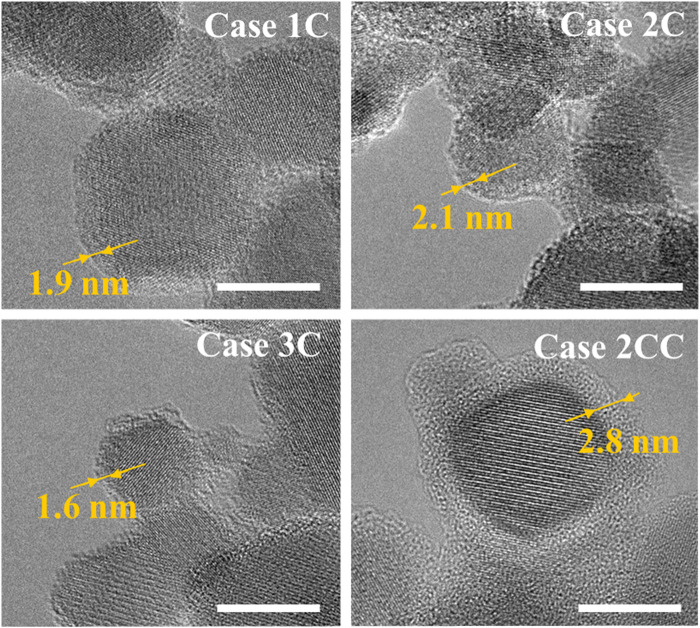
Superparamagnetic iron oxide nanoparticles (IONPs) have a large range of applications, such as pollutant removal and inductive heating. Some of these applications benefit from coating the IONPs with silica (SiO) to conserve their properties and/or prevent their aggregation; yet, the habitual synthesis methodologies require several steps, which limit their industrial scalability. In this work, we explore the capability to synthesize and stabilize oxidation-sensitive phases of IONPs gas-phase flame synthesis as an alternative methodology that enables continuous operation. The addition of an inline quench gas nozzle-to avoid aggregation/agglomeration-and a coating nozzle is investigated to clarify their roles in contributing to the properties of the resultant coated IONPs. Three different quench and coating configuration heights above burner (HAB) are studied. The resultant synthesized Fe O |SiO core-shell nanoparticles are characterized using (scanning) transmission electron microscopy ((S)TEM), X-ray diffraction (XRD), Fourier-transform infrared spectroscopy (FTIR), elemental analysis, dynamic light scattering (DLS), Mössbauer spectroscopy, magnetometry, and energy-dispersive X-ray spectroscopy (EDX) from scanning electron microscopy (SEM). Results show that the synthesized nanoparticles presented a mixture of oxidation states-mainly magnetite (FeO) and maghemite (γ-FeO) phases-and a narrow primary particle size distribution. Quenching the IONPs early decreased the nanoparticle agglomeration/aggregation up to one order of magnitude. Moreover, homogeneous coating was achieved in all cases. Increasing the coating thickness helped reduce oxygen diffusion to the iron oxide core of the coated IONPs, conserving more magnetite phase in the coated IONP cores. These insights allowed us to conclude that targeted coated IONPs can be successfully produced through gas-phase synthesis using a flame reactor. In the near future, the long-term stability of IONP properties will be explored using this inline coating.
超顺磁性氧化铁纳米颗粒(IONPs)有广泛的应用,如污染物去除和感应加热。其中一些应用受益于用二氧化硅(SiO)包覆IONPs以保持其性质和/或防止其聚集;然而,传统的合成方法需要几个步骤,这限制了它们的工业可扩展性。在这项工作中,我们探索了通过气相火焰合成来合成和稳定IONPs氧化敏感相的能力,这是一种能够实现连续操作的替代方法。研究了添加在线淬火气体喷嘴以避免聚集/团聚以及一个包覆喷嘴,以阐明它们在影响所得包覆IONPs性质方面的作用。研究了燃烧器上方三种不同的淬火和包覆配置高度(HAB)。使用(扫描)透射电子显微镜((S)TEM)、X射线衍射(XRD)、傅里叶变换红外光谱(FTIR)、元素分析、动态光散射(DLS)、穆斯堡尔光谱、磁强计以及扫描电子显微镜(SEM)中的能量色散X射线光谱(EDX)对所得合成的Fe₃O₄|SiO核壳纳米颗粒进行了表征。结果表明,合成的纳米颗粒呈现出氧化态的混合物——主要是磁铁矿(Fe₃O₄)和磁赤铁矿(γ-Fe₂O₃)相——并且初级粒径分布狭窄。早期对IONPs进行淬火可将纳米颗粒的团聚/聚集减少多达一个数量级。此外,在所有情况下都实现了均匀包覆。增加包覆厚度有助于减少氧气向包覆IONPs的氧化铁核心扩散,在包覆IONP核心中保留更多的磁铁矿相。这些见解使我们得出结论,通过使用火焰反应器进行气相合成可以成功生产出目标包覆的IONPs。在不久的将来,将使用这种在线包覆来探索IONP性质的长期稳定性。