Ajinkya Nene, Yu Xuefeng, Kaithal Poonam, Luo Hongrong, Somani Prakash, Ramakrishna Seeram
Materials and Interfaces Center, Shenzhen Institutes of Advanced Technology, Chinese Academy of Sciences, Shenzhen 518055, China.
Department of Molecular and Cellular Engineering, Jacob Institute of Biotechnology and Bioengineering, SHUATS, Allahabad 211007, India.
Materials (Basel). 2020 Oct 18;13(20):4644. doi: 10.3390/ma13204644.
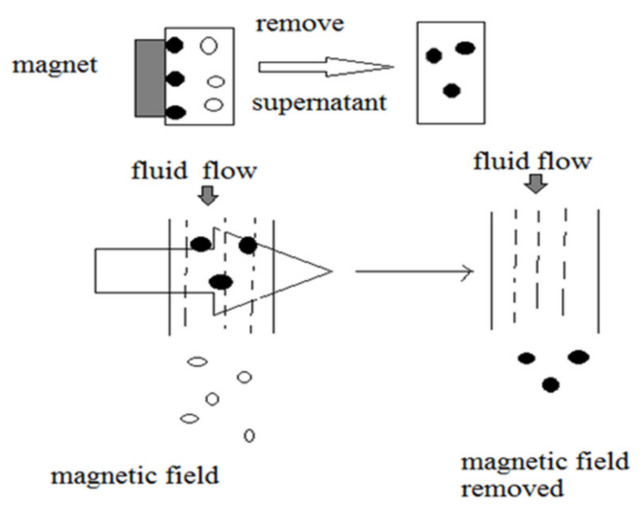
Iron oxides are chemical compounds which have different polymorphic forms, including γ-FeO (maghemite), FeO (magnetite), and FeO (wustite). Among them, the most studied are γ-FeO and FeO, as they possess extraordinary properties at the nanoscale (such as super paramagnetism, high specific surface area, biocompatible etc.), because at this size scale, the quantum effects affect matter behavior and optical, electrical and magnetic properties. Therefore, in the nanoscale, these materials become ideal for surface functionalization and modification in various applications such as separation techniques, magnetic sorting (cells and other biomolecules etc.), drug delivery, cancer hyperthermia, sensing etc., and also for increased surface area-to-volume ratio, which allows for excellent dispersibility in the solution form. The current methods used are partially and passively mixed reactants, and, thus, every reaction has a different proportion of all factors which causes further difficulties in reproducibility. Direct active and complete mixing and automated approaches could be solutions to this size- and shape-controlled synthesis, playing a key role in its exploitation for scientific or technological purposes. An ideal synthesis method should be able to allow reliable adjustment of parameters and control over the following: fluctuation in temperature; pH, stirring rate; particle distribution; size control; concentration; and control over nanoparticle shape and composition i.e., crystallinity, purity, and rapid screening. Iron oxide nanoparticle (IONP)-based available clinical applications are RNA/DNA extraction and detection of infectious bacteria and viruses. Such technologies are important at POC (point of care) diagnosis. IONPs can play a key role in these perspectives. Although there are various methods for synthesis of IONPs, one of the most crucial goals is to control size and properties with high reproducibility to accomplish successful applications. Using multiple characterization techniques to identify and confirm the oxide phase of iron can provide better characterization capability. It is very important to understand the in-depth IONP formation mechanism, enabling better control over parameters and overall reaction and, by extension, properties of IONPs. This work provides an in-depth overview of different properties, synthesis methods, and mechanisms of iron oxide nanoparticles (IONPs) formation, and the diverse range of their applications. Different characterization factors and strategies to confirm phase purity in the IONP synthesis field are reviewed. First, properties of IONPs and various synthesis routes with their merits and demerits are described. We also describe different synthesis strategies and formation mechanisms for IONPs such as for: wustite (FeO), hematite (α-FeO), maghemite (ɤ-FeO) and magnetite (FeO). We also describe characterization of these nanoparticles and various applications in detail. In conclusion, we present a detailed overview on the properties, size-controlled synthesis, formation mechanisms and applications of IONPs.
氧化铁是具有不同多晶型形式的化合物,包括γ-FeO(磁赤铁矿)、FeO(磁铁矿)和FeO(方铁矿)。其中,研究最多的是γ-FeO和FeO,因为它们在纳米尺度上具有非凡的性质(如超顺磁性、高比表面积、生物相容性等),这是由于在这个尺寸尺度下,量子效应会影响物质行为以及光学、电学和磁学性质。因此,在纳米尺度上,这些材料成为各种应用(如分离技术、磁分选(细胞和其他生物分子等)、药物递送、癌症热疗、传感等)中表面功能化和修饰的理想选择,同时也因其高的表面积与体积比而在溶液形式中具有出色的分散性。目前使用的方法是部分和被动混合反应物,因此,每个反应中所有因素的比例都不同,这给可重复性带来了进一步的困难。直接主动和完全混合以及自动化方法可能是解决这种尺寸和形状控制合成的方法,在其用于科学或技术目的方面发挥关键作用。理想的合成方法应该能够可靠地调整参数并控制以下方面:温度波动;pH值、搅拌速率;颗粒分布;尺寸控制;浓度;以及控制纳米颗粒的形状和组成,即结晶度、纯度和快速筛选。基于氧化铁纳米颗粒(IONP)的现有临床应用是RNA/DNA提取以及检测传染性细菌和病毒。此类技术在即时检测(POC)诊断中很重要。IONP在这些方面可以发挥关键作用。尽管有多种合成IONP的方法,但最关键的目标之一是高可重复性地控制尺寸和性质以实现成功应用。使用多种表征技术来识别和确认铁的氧化物相可以提供更好的表征能力。深入了解IONP的形成机制非常重要,这有助于更好地控制参数和整个反应,进而控制IONP的性质。这项工作深入概述了氧化铁纳米颗粒(IONP)的不同性质、合成方法和形成机制,以及它们广泛的应用。综述了IONP合成领域中不同的表征因素和确认相纯度的策略。首先,描述了IONP的性质以及各种合成路线及其优缺点。我们还描述了IONP的不同合成策略和形成机制,例如对于:方铁矿(FeO)、赤铁矿(α-FeO)、磁赤铁矿(ɤ-FeO)和磁铁矿(FeO)。我们还详细描述了这些纳米颗粒的表征和各种应用。总之,我们对IONP的性质、尺寸控制合成、形成机制和应用进行了详细概述。