Yue Xinghai, Wang Chenchen, Zhang Xixu
The Second Clinical College, Liaoning University of Traditional Chinese Medicine, Shenyang, Liaoning, China.
Department of Endocrinology, The Second Affiliated Hospital of Liaoning University of Traditional Chinese Medicine, Shenyang, Liaoning, China.
Lipids Health Dis. 2025 May 10;24(1):172. doi: 10.1186/s12944-025-02581-y.
The relationship between eosinophil number and overweight status (or obesity) remains a subject of debate. While animal studies suggest a negative correlation between the two, most clinical studies indicate a positive correlation. Therefore, we hypothesize that a nonlinear relationship may exist between eosinophil number and overweight status. This study aims to investigate the association between eosinophil number and overweight status (as well as related indicators) using data from the National Health and Nutrition Examination Survey (NHANES).
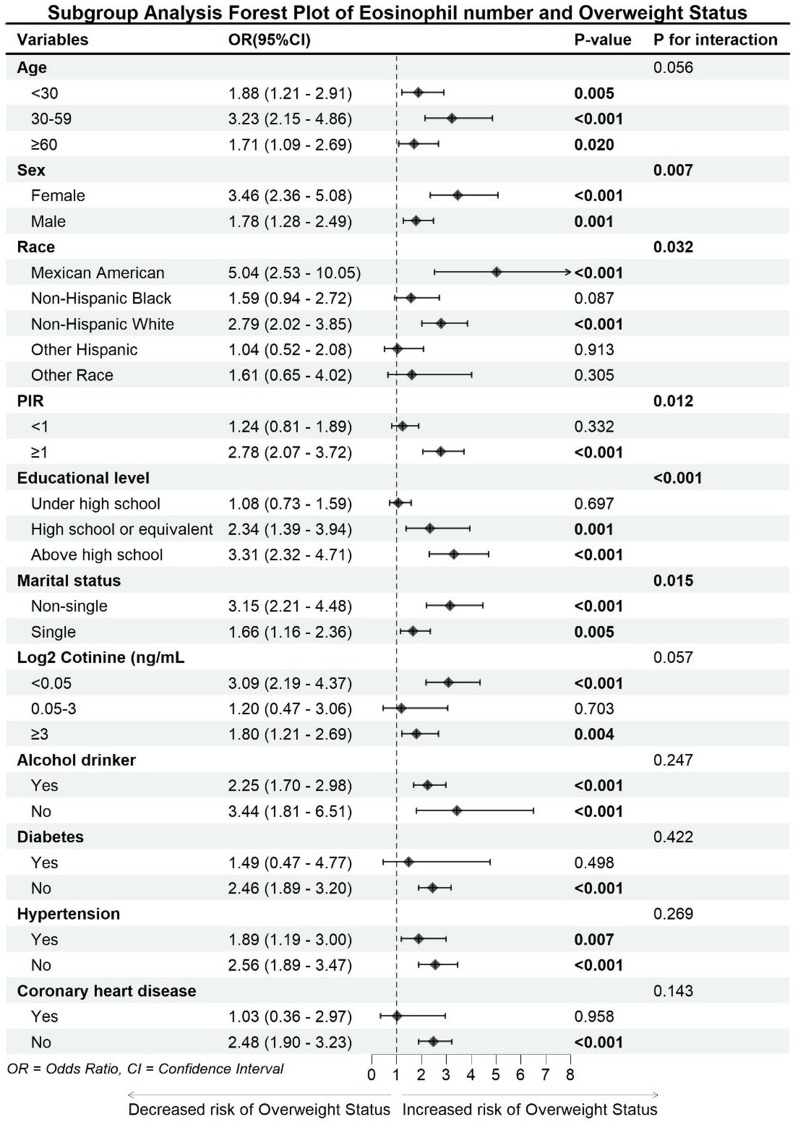
We utilized data from NHANES 1999-2018, where eosinophil number was obtained from laboratory tests. Overweight status was defined as a body mass index (BMI) ≥ 25. We then applied weighted logistic regression/linear regression, subgroup analysis, and restricted cubic splines (RCS) analysis to investigate the association between eosinophil number and overweight status (as well as related indicators).
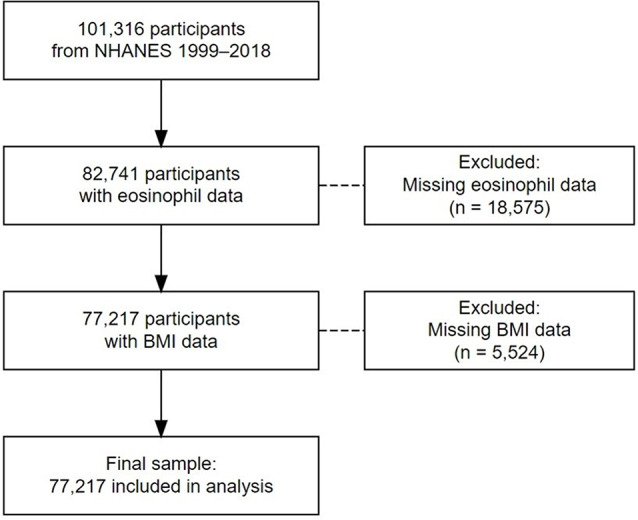
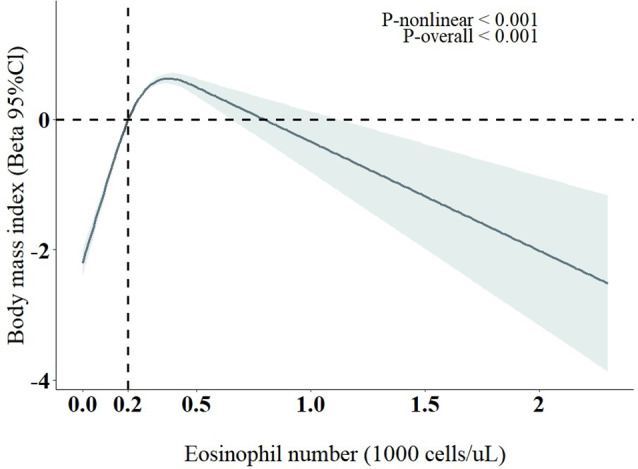
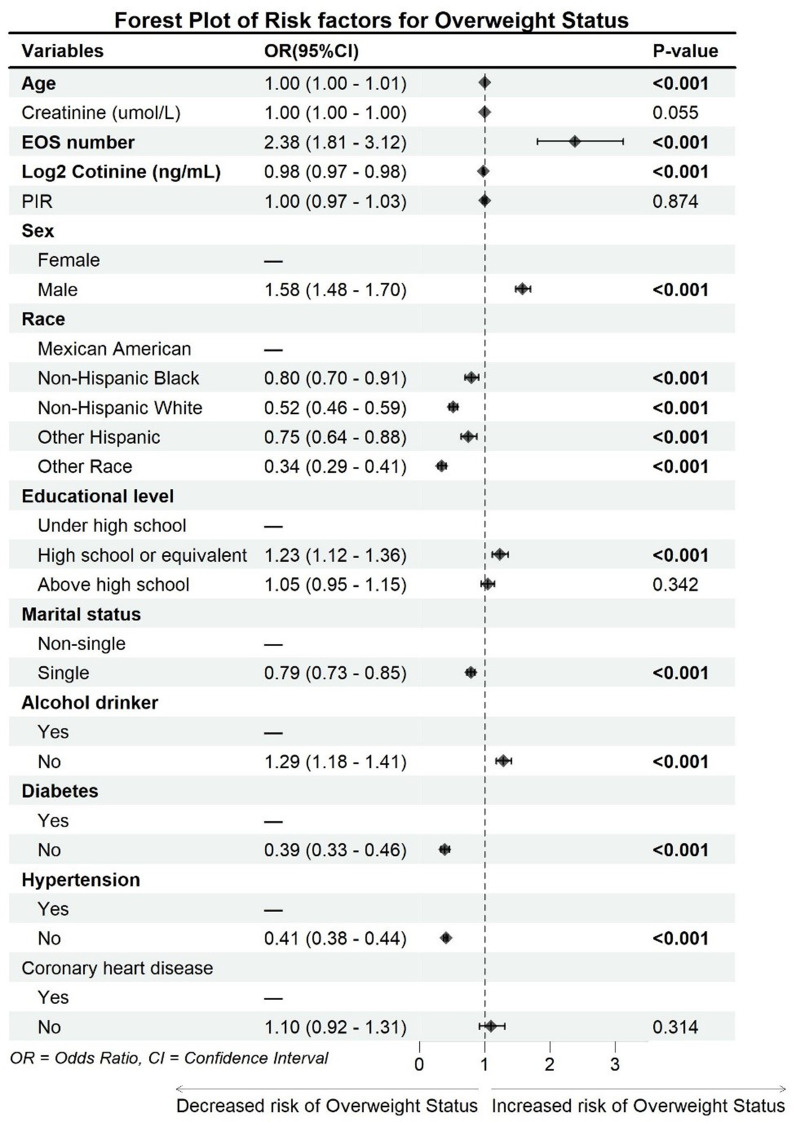
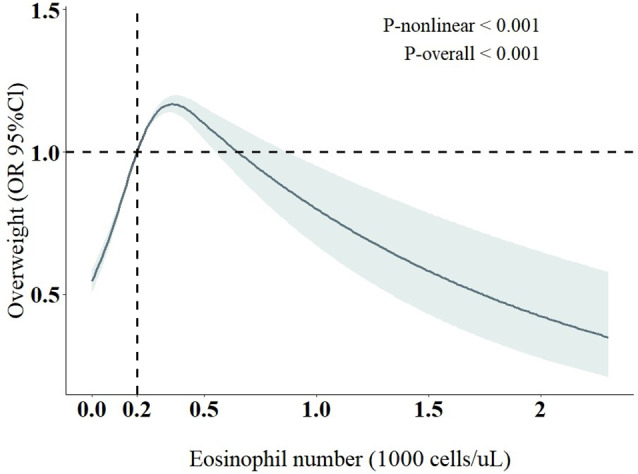
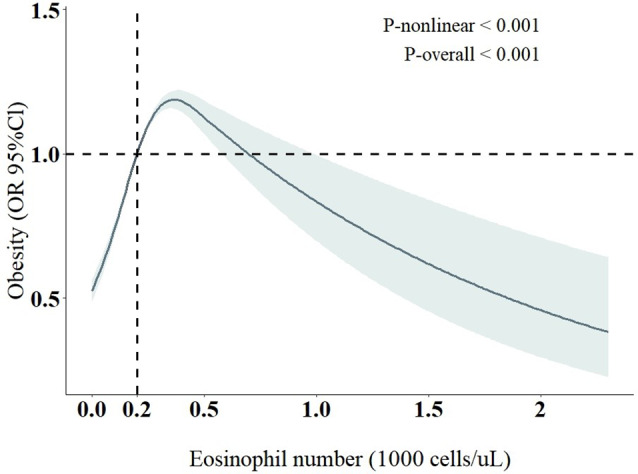
A total of 77,217 individuals were included in this study, with 38,106 individuals in the non-overweight group (BMI < 25) and 39,111 individuals in the overweight group (overweight and obesity, BMI ≥ 25). The logistic regression analysis revealed a significant association between eosinophil number and overweight status (OR: 2.38, 95% CI: 1.81-3.12, P < 0.001). Additionally, eosinophil number was significantly positively correlated with obesity/BMI/triglycerides and negatively correlated with High-Density Lipoprotein (HDL). Finally, the nonlinear regression results indicated an inverted U-shaped relationship between eosinophil number and overweight status/obesity/BMI.
Our study demonstrates an inverted U-shaped relationship between eosinophil number and overweight status/obesity/BMI. Eosinophil number is also significantly associated with HDL and triglycerides. These findings suggest that eosinophils may play a role in overweight (or obesity) and provide valuable insights for exploring the underlying immune mechanisms of overweight status.
嗜酸性粒细胞数量与超重状态(或肥胖)之间的关系仍是一个有争议的话题。虽然动物研究表明两者呈负相关,但大多数临床研究表明呈正相关。因此,我们假设嗜酸性粒细胞数量与超重状态之间可能存在非线性关系。本研究旨在利用国家健康与营养检查调查(NHANES)的数据,调查嗜酸性粒细胞数量与超重状态(以及相关指标)之间的关联。
我们使用了1999 - 2018年NHANES的数据,其中嗜酸性粒细胞数量通过实验室检测获得。超重状态定义为体重指数(BMI)≥25。然后,我们应用加权逻辑回归/线性回归、亚组分析和受限立方样条(RCS)分析来研究嗜酸性粒细胞数量与超重状态(以及相关指标)之间的关联。
本研究共纳入77217名个体,其中非超重组(BMI < 25)有38106名个体,超重组(超重和肥胖,BMI≥25)有39111名个体。逻辑回归分析显示嗜酸性粒细胞数量与超重状态之间存在显著关联(OR:2.38,95%CI:1.81 - 3.12,P < 0.001)。此外,嗜酸性粒细胞数量与肥胖/BMI/甘油三酯显著正相关,与高密度脂蛋白(HDL)负相关。最后,非线性回归结果表明嗜酸性粒细胞数量与超重状态/肥胖/BMI之间呈倒U形关系。
我们的研究表明嗜酸性粒细胞数量与超重状态/肥胖/BMI之间呈倒U形关系。嗜酸性粒细胞数量也与HDL和甘油三酯显著相关。这些发现表明嗜酸性粒细胞可能在超重(或肥胖)中起作用,并为探索超重状态的潜在免疫机制提供有价值的见解。