Todorova Boryana, Steyrl David, Hornsey Matthew J, Pearson Samuel, Brick Cameron, Lange Florian, Van Bavel Jay J, Vlasceanu Madalina, Lamm Claus, Doell Kimberly C
Department of Cognition, Emotion, and Methods in Psychology, Faculty of Psychology, University of Vienna, Vienna, Austria.
Business School, University of Queensland, Brisbane, Australia.
NPJ Clim Action. 2025;4(1):46. doi: 10.1038/s44168-025-00251-4. Epub 2025 May 8.
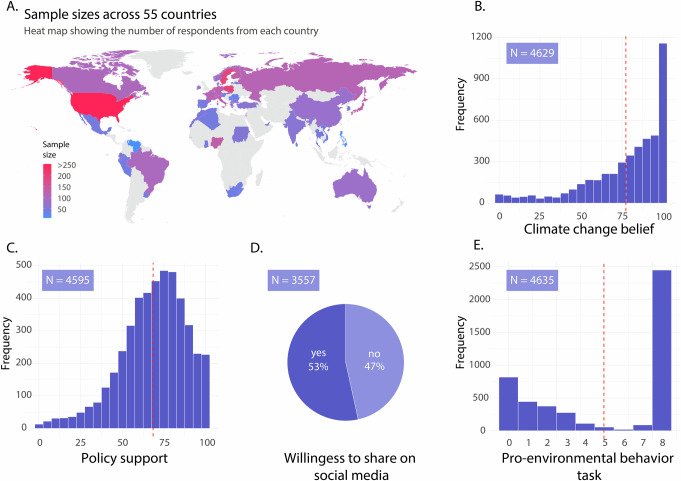
While numerous studies have examined factors associated with climate-friendly beliefs and behaviors, a systematic, cross-national ranking of their key correlates is lacking. We use interpretable machine learning to quantify the extent to which different climate-relevant outcomes (climate change belief, policy support, willingness to share information on social media, and a pro-environmental behavioral task) are predictable and to rank 19 individual- and nation-level predictors in terms of their importance across 55 countries ( = 4635). We find notable differences in explained variance for the outcomes (e.g., 57% for climate change belief vs. 10% for pro-environmental behavior). Four predictors had consistent effects across all outcomes: environmentalist identity, trust in climate science, internal environmental motivation, and the Human Development Index. However, most of the predictors show divergent patterns, predicting some but not all outcomes or even having opposite effects. To better capture this complexity, future models should include multi-level factors and consider the different contexts (e.g., public vs private) in which climate-related cognition and action emerge.
虽然众多研究探讨了与气候友好型信念和行为相关的因素,但缺乏对其关键相关因素进行系统的跨国排名。我们使用可解释的机器学习来量化不同气候相关结果(气候变化信念、政策支持、在社交媒体上分享信息的意愿以及一项亲环境行为任务)的可预测程度,并在55个国家(n = 4635)中,根据19个个人层面和国家层面的预测因素的重要性对它们进行排名。我们发现不同结果的解释方差存在显著差异(例如,气候变化信念的解释方差为57%,而亲环境行为的解释方差为10%)。四个预测因素在所有结果中都有一致的影响:环保主义者身份认同、对气候科学的信任、内在环境动机以及人类发展指数。然而,大多数预测因素呈现出不同的模式,只预测部分而非全部结果,甚至产生相反的影响。为了更好地把握这种复杂性,未来的模型应纳入多层次因素,并考虑气候相关认知和行动出现的不同背景(例如,公共背景与私人背景)。