Tang Huimiao, Li Wenxin, Xu Yidan, Zhou Yanjun, Hamblin Michael R, Wen Xiang
Department of Dermatology, West China Hospital, Sichuan University, Chengdu, China.
Laboratory of Dermatology, Clinical Institute of Inflammation and Immunology, Frontiers Science Center for Disease-related Molecular Network, West China Hospital, Sichuan University, Chengdu, China.
Front Microbiol. 2025 Apr 28;16:1549895. doi: 10.3389/fmicb.2025.1549895. eCollection 2025.
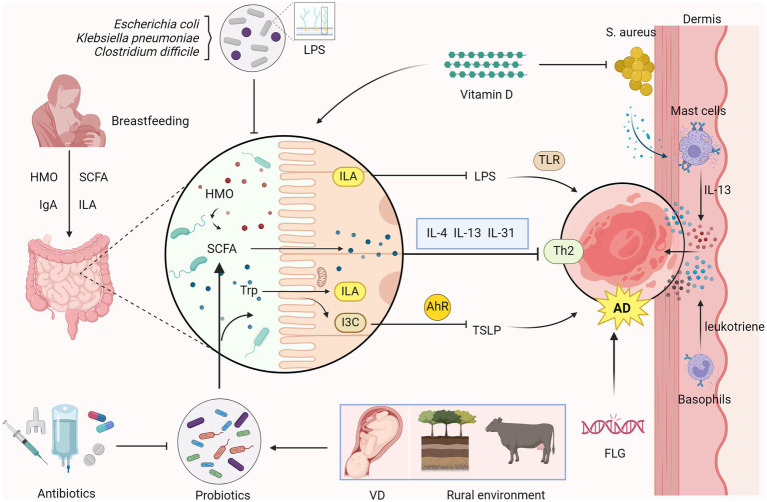
Atopic dermatitis is a chronic inflammatory skin condition with a higher incidence rate among children. In recent years, the role of the gut microbiota in the pathogenesis of atopic dermatitis has garnered increasing attention. This review systematically delineates the research advancements in the structural characteristics of the gut microbiota in children with atopic dermatitis and its influencing factors. Studies have revealed significant differences in the gut microbiota structure between children with atopic dermatitis and healthy controls, characterized by a reduction in microbial diversity, a decrease in beneficial bacteria, and an increase in harmful bacteria. Dietary patterns, environmental factors, birth patterns, antibiotic use, and gestational diabetes mellitus are factors could impact the gut microbiota hence influencing the susceptibility of children to atopic dermatitis. Moreover, this review explores the interplay between the gut microbiota and the immune system in atopic dermatitis, with the potential to inform more effective probiotic treatment strategies for children with atopic dermatitis.
特应性皮炎是一种慢性炎症性皮肤病,在儿童中发病率较高。近年来,肠道微生物群在特应性皮炎发病机制中的作用越来越受到关注。这篇综述系统地阐述了特应性皮炎患儿肠道微生物群的结构特征及其影响因素的研究进展。研究表明,特应性皮炎患儿与健康对照者的肠道微生物群结构存在显著差异,其特征为微生物多样性降低、有益菌减少和有害菌增加。饮食模式、环境因素、出生方式、抗生素使用和妊娠期糖尿病是可能影响肠道微生物群从而影响儿童患特应性皮炎易感性的因素。此外,本综述探讨了特应性皮炎中肠道微生物群与免疫系统之间的相互作用,有望为特应性皮炎患儿制定更有效的益生菌治疗策略提供依据。