Li Jing, Mo Daize, Hu Jinyuan, Wang Shichao, Gong Jun, Huang Yujing, Li Zheng, Yuan Zhen, Xu Mengze
Faculty of Arts and Sciences, Beijing Normal University, Zhuhai, 519087, China.
School of Systems Science, Beijing Normal University, Beijing, 100875, China.
Microsyst Nanoeng. 2025 May 13;11(1):87. doi: 10.1038/s41378-025-00948-w.
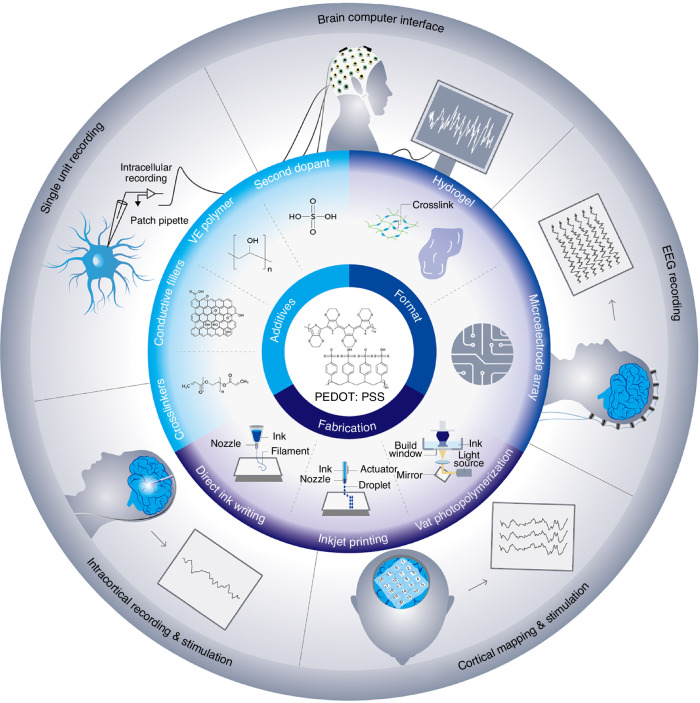
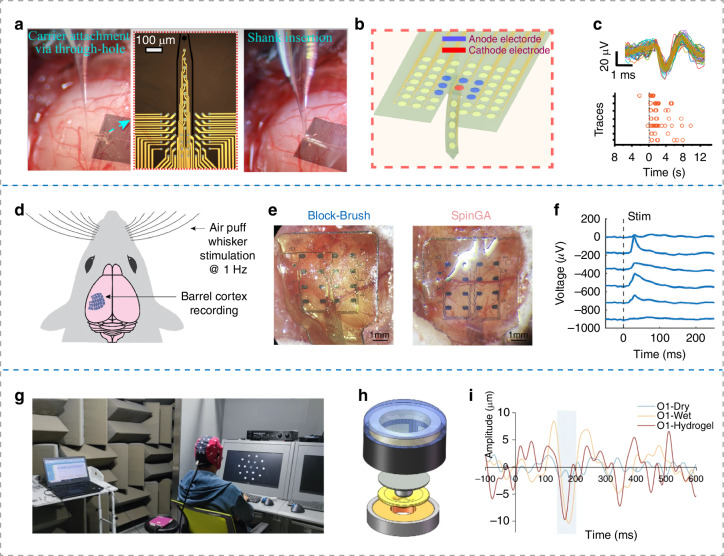
The growing demand for advanced neural interfaces that enable precise brain monitoring and modulation has catalyzed significant research into flexible, biocompatible, and highly conductive materials. PEDOT:PSS-based bioelectronic materials exhibit high conductivity, mechanical flexibility, and biocompatibility, making them particularly suitable for integration into neural devices for brain science research. These materials facilitate high-resolution neural activity monitoring and provide precise electrical stimulation across diverse modalities. This review comprehensively examines recent advances in the development of PEDOT:PSS-based bioelectrodes for brain monitoring and modulation, with a focus on strategies to enhance their conductivity, biocompatibility, and long-term stability. Furthermore, it highlights the integration of multifunctional neural interfaces that enable synchronous stimulation-recording architectures, hybrid electro-optical stimulation modalities, and multimodal brain activity monitoring. These integrations enable fundamentally advancing the precision and clinical translatability of brain-computer interfaces. By addressing critical challenges related to efficacy, integration, safety, and clinical translation, this review identifies key opportunities for advancing next-generation neural devices. The insights presented are vital for guiding future research directions in the field and fostering the development of cutting-edge bioelectronic technologies for neuroscience and clinical applications.
对能够实现精确脑监测和调控的先进神经接口的需求不断增长,推动了对柔性、生物相容性和高导电性材料的大量研究。基于聚(3,4-乙撑二氧噻吩):聚苯乙烯磺酸盐(PEDOT:PSS)的生物电子材料具有高导电性、机械柔韧性和生物相容性,使其特别适合集成到用于脑科学研究的神经装置中。这些材料有助于高分辨率神经活动监测,并提供跨多种模式的精确电刺激。本文综述全面研究了基于PEDOT:PSS的用于脑监测和调控的生物电极的最新进展,重点关注提高其导电性、生物相容性和长期稳定性的策略。此外,还强调了多功能神经接口的集成,这些接口能够实现同步刺激-记录架构、混合电光刺激模式和多模态脑活动监测。这些集成从根本上提高了脑机接口的精度和临床可转化性。通过应对与功效、集成、安全性和临床转化相关的关键挑战,本综述确定了推进下一代神经装置的关键机遇。所提出的见解对于指导该领域未来的研究方向以及促进用于神经科学和临床应用的前沿生物电子技术的发展至关重要。