Xue Jing, Jiang Xianzhang, Li Anjing, Li Jiaxin, Su Xiaoyun, Huang Jianzhong, Qin Lina
National Joint Engineering Research Center of Industrial Microbiology and Fermentation Technology, College of Life Sciences, Fujian Normal University, Fuzhou 350117, China.
State Key Laboratory of Animal Nutrition and Feeding, Institute of Animal Sciences, Chinese Academy of Agricultural Sciences, Beijing 100193, China.
Int J Mol Sci. 2025 Apr 24;26(9):4024. doi: 10.3390/ijms26094024.
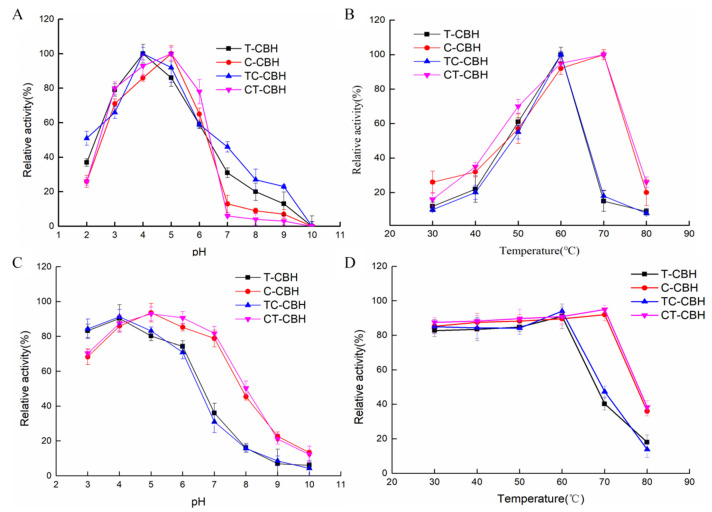
Understanding the molecular mechanisms of cellobiohydrolase I (CBHI), a key enzyme in cellulase complexes, is crucial for developing efficient enzymes for the degradation of lignocellulosic biomasses (LCB). Building on our previous discovery that CBHI (C-CBH) exhibits significantly higher specific activity than CBHI (T-CBH), systematic domain-swapping experiments were conducted to elucidate the structural determinants of catalytic efficiency in CBHI. Herein, the carbohydrate-binding modules (CBM) of the CBHIs from (T-CBH) and (C-CBH) were interchanged and to obtain two chimeric mutants TC-CBH and CT-CBH. These four CBHs were expressed in , and the enzyme properties were analyzed. Comparative characterization revealed that while module exchange preserved native temperature/pH adaptability, it significantly altered substrate specificity and catalytic performance. The CT-CBH variant was identified as the most efficient biocatalyst, exhibiting four key advantages over T-CBH: (1) protein expression levels that far exceed those of T-CBH, (2) specific activity enhanced by 2.6-fold (734.5 U/μM vs. 282.5 U/μM on MU-cellobiose), (3) superior degradation capacities for filter paper (1.6-fold) and xylan, and (4) improved binding affinity for crystalline cellulose. These findings establish cross-species domain engineering as a viable strategy for creating high-performance cellulases, providing both mechanistic insights and practical solutions for lignocellulose degradation.
了解纤维二糖水解酶I(CBHI)的分子机制对于开发高效降解木质纤维素生物质(LCB)的酶至关重要,CBHI是纤维素酶复合物中的关键酶。基于我们之前的发现,即CBHI(C-CBH)比CBHI(T-CBH)表现出显著更高的比活性,我们进行了系统的结构域交换实验,以阐明CBHI催化效率的结构决定因素。在此,将(T-CBH)和(C-CBH)的纤维二糖水解酶的碳水化合物结合模块(CBM)进行交换,得到两个嵌合突变体TC-CBH和CT-CBH。这四种CBH在中表达,并分析了酶的性质。比较表征表明,虽然模块交换保留了天然的温度/pH适应性,但它显著改变了底物特异性和催化性能。CT-CBH变体被确定为最有效的生物催化剂,与T-CBH相比具有四个关键优势:(1)蛋白质表达水平远远超过T-CBH,(2)比活性提高了2.6倍(在MU-纤维二糖上为734.5 U/μM对282.5 U/μM),(3)对滤纸(1.6倍)和木聚糖具有更高的降解能力,(4)对结晶纤维素的结合亲和力提高。这些发现确立了跨物种结构域工程作为创建高性能纤维素酶的可行策略,为木质纤维素降解提供了机制见解和实际解决方案。