Cerami Chiara, Boccardi Marina, Meli Claudia, Panzavolta Andrea, Funghi Giulia, Festari Cristina, Cappa Stefano F, Chatzikostopoulos Thanos, Chicherio Christian, Clarens Florencia, de Oliveira Fabricio Ferreira, Di Lorenzo Francesco, Filardi Marco, Ibanez Agustin, Girtler Nicola, Lebouvier Thibaud, Logroscino Giancarlo, Luca Antonella, MacPherson Sarah E, Matias-Guiu Jordi A, Piccoli Tommaso, Piguet Olivier, Pomati Simone, Russo Mirella, Sacco Leonardo, Schild Ann-Katrin, Sensi Stefano L, Shirk Steven D, Sollberger Marc, Tábuas-Pereira Miguel, Tsolaki Magda, van den Berg Esther, Bertoux Maxime, Kumfor Fiona, Van den Stock Jan, Welsh-Bohmer Kathleen A, Dodich Alessandra
IUSS Cognitive Neuroscience ICoN Center, Scuola Universitaria Superiore IUSS di Pavia, Pavia, Italy.
Brain e-Health Aging (BeA) Laboratory, Department of Neurorehabilitation, Istituti Clinici Scientifici Maugeri IRCCS, Milan, Italy.
J Neuropsychol. 2025 Sep;19(3):603-618. doi: 10.1111/jnp.12431. Epub 2025 May 14.
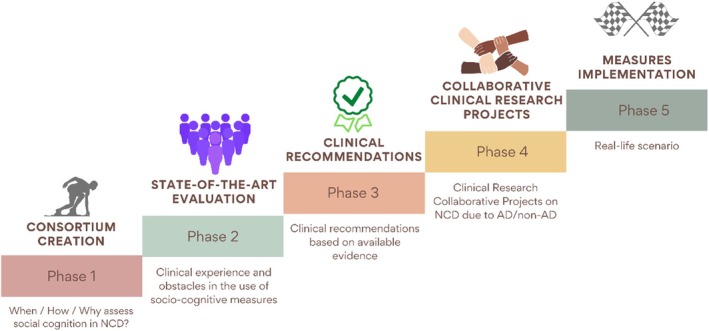
Harmonized neuropsychological assessment for neurocognitive disorders (NCDs) is an urgent priority in clinics. Neuropsychology assessments in NCDs seldom include tests exploring social cognitive skills. In 2022, we launched the SIGNATURE initiative to optimize socio-cognitive assessment in NCDs. Here, we report findings from the first initiative phase, including consortium creation and evaluation of the state of the art in socio-cognitive assessment in memory clinics. We developed an ad hoc online survey to explore practices and measures, relevance, and obstacles preventing the use of socio-cognitive testing in clinics. The survey was distributed within the SIGNATURE network. National coordinators were identified to disseminate the survey to local collaborators and scientific societies active in the field of dementia and/or neuropsychology. Data were analysed in aggregate form and stratified by geographical area and variables of interest. Four hundred and thirteen (413) responses from 10 European and Latin American geographical regions were recorded. Responders were balanced between physicians and psychologists. Seventy-eight (78) % of respondents reported no/limited experience with socio-cognitive measures; more than 85% agreed on their relevance in clinics. Ekman-60 faces was the most well-known and/or used task, followed by the Faux-Pas and Reading-the-Mind-in-the-Eyes tests. Lack of clinical measures, assessment time, guidelines, and education/training were reported as main obstacles. Real-life barriers prevent the adoption of socio-cognitive testing in clinics. Bidirectional collaboration between clinicians and researchers is required to address clinical needs and constraints and facilitate consistent socio-cognitive assessment.
对神经认知障碍(NCDs)进行统一的神经心理学评估是临床工作的当务之急。NCDs的神经心理学评估很少包括探索社会认知技能的测试。2022年,我们发起了SIGNATURE倡议,以优化NCDs的社会认知评估。在此,我们报告该倡议第一阶段的结果,包括联盟的创建以及对记忆诊所社会认知评估的现有技术水平的评估。我们开展了一项专门的在线调查,以探索实践与措施、相关性以及阻碍社会认知测试在诊所应用的障碍。该调查在SIGNATURE网络内进行分发。确定了国家协调员,将调查分发给在痴呆症和/或神经心理学领域活跃的当地合作者和科学协会。数据以汇总形式进行分析,并按地理区域和感兴趣的变量进行分层。记录了来自10个欧洲和拉丁美洲地理区域的413份回复。回复者在医生和心理学家之间保持平衡。78%的受访者表示没有/仅有有限的社会认知测量经验;超过85%的人认同其在诊所中的相关性。埃克曼60表情测试是最广为人知和/或使用的任务,其次是失礼测试和读心测试。缺乏临床测量方法、评估时间、指南以及教育/培训被报告为主要障碍。现实生活中的障碍阻碍了社会认知测试在诊所中的采用。临床医生和研究人员之间需要进行双向合作,以满足临床需求和限制,并促进一致的社会认知评估。