Heo Hokwan, Nguyen-Dinh Thanh, Jung Man-Young, Greening Chris, Yoon Sukhwan
Department of Civil and Environmental Engineering, Korea Advanced Institute of Science and Technology (KAIST), Daejeon 34141, Republic of Korea.
Department of Microbiology, Biomedicine Discovery Institute, Monash University, Clayton, Victoria 3800, Australia.
ISME J. 2025 Jan 2;19(1). doi: 10.1093/ismejo/wraf092.
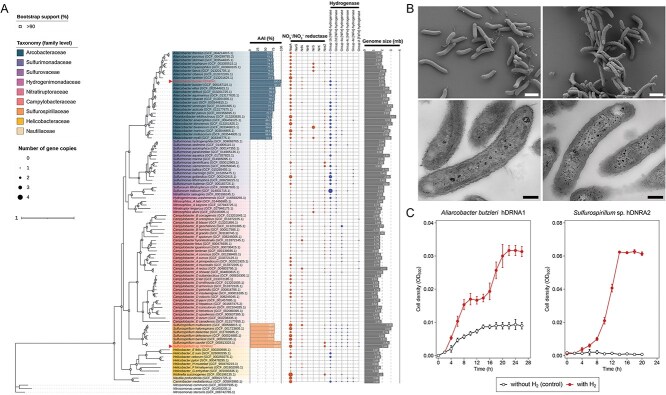
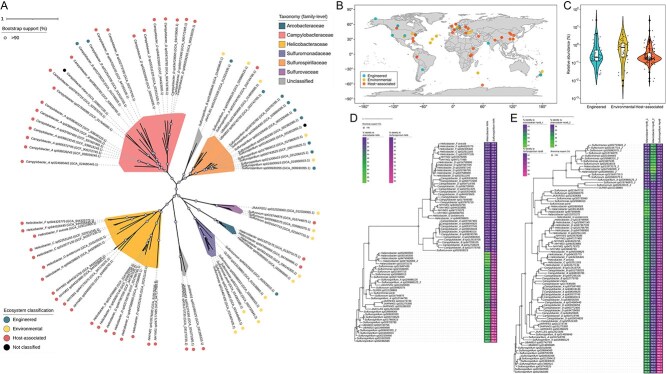
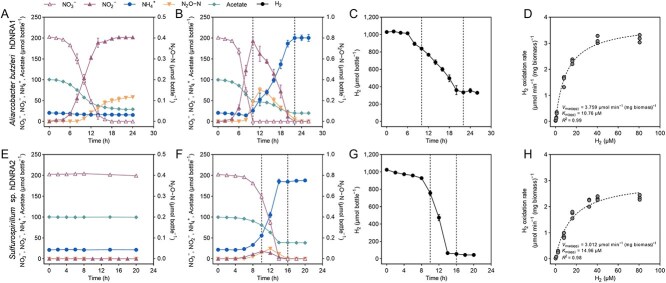
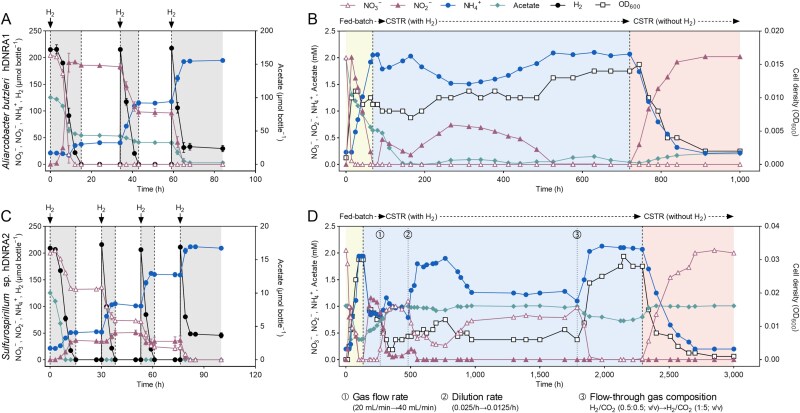
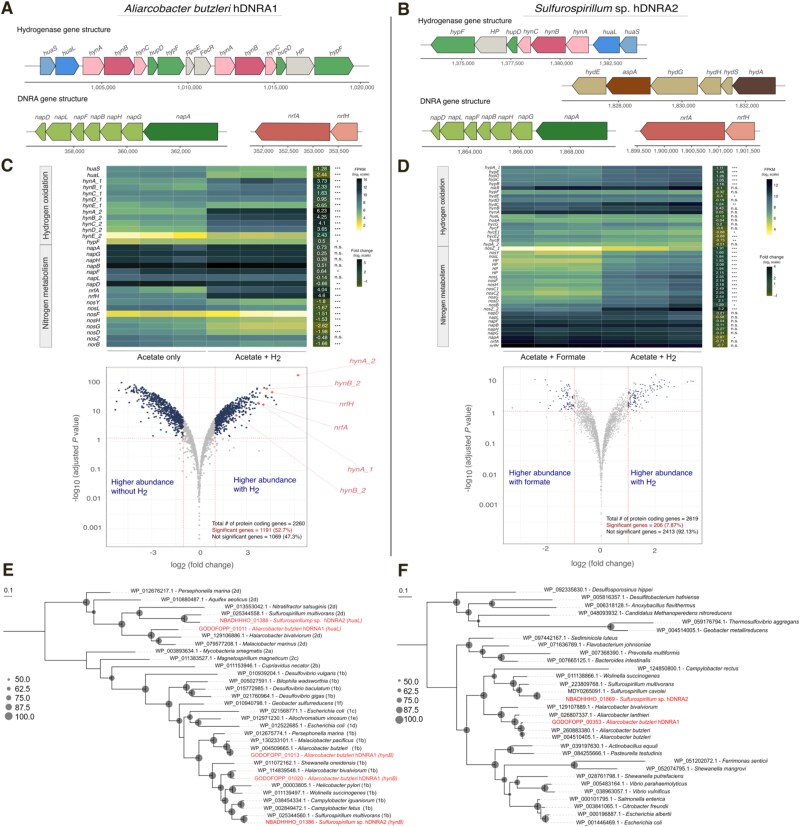
Dissimilatory nitrate reduction to ammonium (DNRA) is a key process used by diverse microorganisms in the global nitrogen cycle. For long, DNRA has been considered primarily as an organotrophic reaction, despite evidence that oxidation of inorganic electron donors also supports DNRA. Evidence of DNRA coupling with molecular hydrogen (H2) oxidation has been reported for several microbial isolates; however, the underlying physiology of the microbial process remains understudied. In this study, we report the isolation of two Campylobacterota strains, Aliarcobacter butzleri hDNRA1 and Sulfurospirillum sp. hDNRA2, which grow using H2 as the sole electron donor for DNRA, and physiological insights gained from a close examination of hydrogenotrophic DNRA in these isolates. In both batch and continuous cultures, DNRA sensu stricto (i.e. NO3- reduction that includes stoichiometric NO2--to-NH4+ reduction) was strictly dependent on the presence of H2 and exhibited stoichiometric coupling with H2 oxidation, indicating that electrons required for NO2- reduction were unequivocally derived from H2. Successful chemostat incubation further demonstrated that hydrogenotrophic DNRA is viable under NO3--limiting, H2-excess conditions. Genomic and transcriptomic analyses identified group 1b [NiFe]-hydrogenase and cytochrome c552 nitrite reductase as the key enzymes catalyzing hydrogenotrophic DNRA. In addition, metagenomic surveys revealed that bacteria capable of hydrogenotrophic DNRA are taxonomically diverse and abundant in various ecosystems, particularly in the vicinity of deep-sea hydrothermal vents. These findings, integrating physiological, genomic, and transcriptomic analyses, clarify that H2 can solely serve as a growth-supporting electron donor for DNRA and suggest potential significance of this microbial process in nitrogen- and hydrogen-related environmental biogeochemical cycles.
异化硝酸盐还原为铵(DNRA)是全球氮循环中多种微生物所利用的关键过程。长期以来,DNRA主要被视为一种有机营养反应,尽管有证据表明无机电子供体的氧化也支持DNRA。已有报道称,几种微生物分离株存在DNRA与分子氢(H2)氧化耦合的证据;然而,该微生物过程的潜在生理学仍未得到充分研究。在本研究中,我们报告了两株弯曲杆菌属菌株的分离,即布氏嗜盐弧菌hDNRA1和硫螺旋菌属hDNRA2,它们利用H2作为DNRA的唯一电子供体生长,并通过对这些分离株中氢营养型DNRA的仔细研究获得了生理学见解。在分批培养和连续培养中,严格意义上的DNRA(即包括化学计量的NO2-到NH4+还原的NO3-还原)严格依赖于H2的存在,并与H2氧化表现出化学计量耦合,这表明NO2-还原所需的电子明确来自H2。成功的恒化器培养进一步证明,氢营养型DNRA在NO3-限制、H2过量的条件下是可行的。基因组和转录组分析确定1b组[NiFe] - 氢化酶和细胞色素c552亚硝酸还原酶是催化氢营养型DNRA的关键酶。此外,宏基因组调查显示,能够进行氢营养型DNRA的细菌在分类学上具有多样性,并且在各种生态系统中都很丰富,特别是在深海热液喷口附近。这些结合了生理学、基因组学和转录组学分析的发现,阐明了H2可以单独作为DNRA的生长支持电子供体,并暗示了这一微生物过程在与氮和氢相关的环境生物地球化学循环中的潜在意义。