Lyu Jian, Liu Fumei, Chai Yan, Wang Xiting, Liu Yi, Xie Yanming
NMPA Key Laboratory for Clinical Research and Evaluation of Traditional Chinese Medicine & National Clinical Research Center for Chinese Medicine Cardiology, XiYuan Hospital, China Academy of Chinese Medical Sciences, No.1 Xiyuan playground Road, Haidian District, Beijing, 100091, PR China.
Institute of Basic Research in Clinical Medicine, China Academy of Chinese Medical Sciences, No.16 Nanxiaojie, Inner Dongzhimen, Dongcheng District, Beijing, 100700, PR China.
Sci Rep. 2025 May 14;15(1):16789. doi: 10.1038/s41598-025-01329-z.
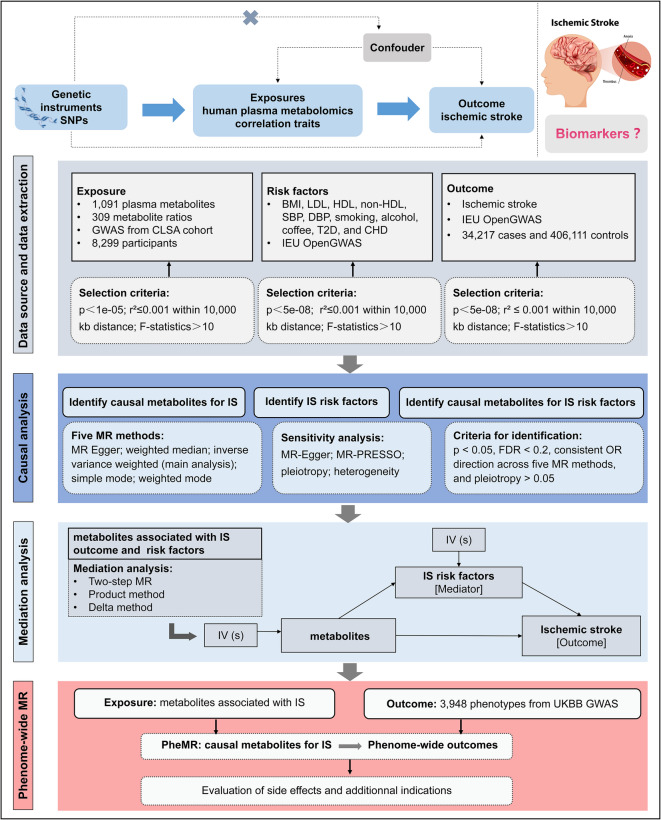
The Global Burden of Disease Study 2021 reports that stroke remains a leading cause of death, with ischemic stroke (IS) presenting significant challenges in screening, prevention, and treatment. We explored the causal effects of 1,400 plasma metabolites on IS outcomes using a two-sample Mendelian randomization (MR) framework. We assessed causal relationships between IS and 11 common clinical risk factors and further examined these relationships for metabolites. Mediation analysis identified mechanisms for metabolites affecting both IS and its risk factors. Finally, a phenome-wide association study (PheWAS) MR analysis evaluated the side effects and additional indications of IS-associated metabolites across 3,948 phenotypes from the UKBB GWAS. Nineteen metabolites showed a causal relationship with IS. MR analysis confirmed body mass index (BMI), high-density lipoprotein (HDL), systolic blood pressure (SBP), diastolic blood pressure (DBP), and type 2 diabetes (T2D) as risk factors for IS. Among 136 metabolites associated with at least one IS risk factor, 132 were linked to risk factors but not directly to IS. BMI, DBP, and coffee intake mediated the causal relationship between IS and the levels of 1-stearoyl-GPG (18:0), 1-oleoyl-2-linoleoyl-GPE (18:1/18:2), Octadecadienedioate (C18:2-DC), and X-24,951. Phe-MR analysis indicated that these metabolites were protective and affected other indications similarly to IS. Our findings reveal causal pathways and identify four potential biomarkers for IS, providing new insights for its screening, prevention, and treatment.
《2021年全球疾病负担研究》报告称,中风仍是主要死因,缺血性中风(IS)在筛查、预防和治疗方面面临重大挑战。我们使用两样本孟德尔随机化(MR)框架探讨了1400种血浆代谢物对IS结局的因果效应。我们评估了IS与11种常见临床风险因素之间的因果关系,并进一步研究了这些因素与代谢物之间的关系。中介分析确定了代谢物影响IS及其风险因素的机制。最后,一项全表型关联研究(PheWAS)MR分析评估了来自英国生物银行全基因组关联研究(UKBB GWAS)的3948种表型中与IS相关代谢物的副作用和其他适应症。19种代谢物与IS存在因果关系。MR分析证实体重指数(BMI)、高密度脂蛋白(HDL)、收缩压(SBP)、舒张压(DBP)和2型糖尿病(T2D)是IS的风险因素。在与至少一种IS风险因素相关的136种代谢物中,有132种与风险因素相关,但与IS无直接关联。BMI、DBP和咖啡摄入量介导了IS与1-硬脂酰甘油磷酸(18:0)、1-油酰基-2-亚油酰基甘油磷酸乙醇胺(18:1/18:2)、十八碳二烯二酸(C18:2-DC)和X-24,951水平之间的因果关系。Phe-MR分析表明,这些代谢物具有保护作用,并且与IS类似地影响其他适应症。我们的研究结果揭示了因果途径,并确定了四种IS潜在生物标志物,为其筛查、预防和治疗提供了新见解。