Chhun Nok, Mangale Dorothy I, Agot Kawango, Owade Winnie A, Kadima Julie, Badia Jacinta, Kibugi James K, Kohler Pamela K, John-Stewart Grace, Beima-Sofie Kristin
Department of Global Health, University of Washington, 3980 15th Ave NE, Seattle, WA, 98195, USA.
Department of Oncology, Washington University, St. Louis, MO, USA.
BMC Health Serv Res. 2025 May 15;25(1):702. doi: 10.1186/s12913-025-12875-7.
Differentiation of HIV services, a client-centered strategy, may improve care outcomes among adolescents and youth living with HIV (AYLHIV). Understanding health provider perceptions of barriers and facilitators that influence implementation can optimize adoption and sustainment of health systems interventions.
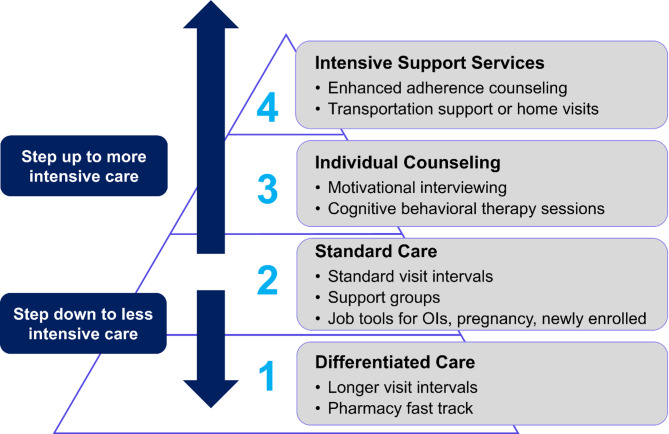
The Data-informed Stepped Care (DiSC) study was a cluster randomized controlled trial of a stepped care intervention in 24 HIV care facilities in Kenya. At each visit, providers used an assessment tool to allocate AYLHIV to services according to level of need. Stable clients were allocated to differentiated service delivery (DSD) with less frequent visits. Intensified services, including behavioral counseling, were provided for those with greater likelihood of loss to follow-up, mental health issues, or viral non-suppression. We conducted focus group discussions (FGDs) with providers across 12 intervention sites between January-February 2023. FGDs used a semi-structured interview guide, grounded in the Consolidated Framework for Implementation Research, which were audio-recorded and transcribed. Transcripts were analyzed using a team-based rapid turnaround approach to characterize key determinants influencing adoption, reach, and fidelity.
Providers were enthusiastic about, and quick to adopt, the DiSC intervention. They found the DiSC tool easy to use and felt it provided a relative advantage by improving service delivery efficiency and prioritizing time with higher need AYLHIV. Providers noted the importance of tool flexibility to align with changing national guidelines. They expressed concerns about compatibility with existing workflows at facilities exclusively using electronic medical record (EMR) systems, suggesting EMR integration will be needed for intervention sustainment. AYLHIV eligible for DSD benefited from clinic visit intervals that aligned with the school calendar, which posed a challenge for reaching AYLHIV in more intensive steps. Provider collective efficacy was important in consistent implementation of DiSC and was facilitated by continuous quality improvement meetings, access to knowledge and information, and perceived intervention effectiveness. Supportive leadership was an important driver of implementation success, through availing space for mental health counseling sessions and time for client-provider interactions outside standard operating hours.
Consideration of alignment with national policy, integration into clinic workflows, school schedules, and leadership engagement, will be important for sustained use of differentiated care interventions.
ClinicalTrials.gov, NCT05007717. Registration date: July 13, 2021.
以客户为中心的艾滋病病毒服务差异化策略,可能会改善感染艾滋病病毒的青少年和青年(AYLHIV)的护理结果。了解医疗服务提供者对影响实施的障碍和促进因素的看法,可以优化卫生系统干预措施的采用和维持。
数据驱动的阶梯式护理(DiSC)研究是在肯尼亚24个艾滋病病毒护理机构进行的阶梯式护理干预的整群随机对照试验。每次就诊时,医疗服务提供者使用评估工具根据需求水平为AYLHIV分配服务。病情稳定的患者被分配到差异化服务提供(DSD)组,就诊频率较低。为那些失访可能性较大、有心理健康问题或病毒抑制不佳的患者提供强化服务,包括行为咨询。2023年1月至2月期间,我们在12个干预地点与医疗服务提供者进行了焦点小组讨论(FGD)。FGD使用了基于实施研究综合框架的半结构化访谈指南,并进行了录音和转录。使用基于团队的快速周转方法对转录本进行分析,以确定影响采用、覆盖范围和保真度的关键决定因素。
医疗服务提供者对DiSC干预充满热情,并迅速采用。他们发现DiSC工具易于使用,并认为它通过提高服务提供效率和优先安排与需求较高的AYLHIV相处的时间而具有相对优势。医疗服务提供者指出了工具灵活性以符合不断变化的国家指南的重要性。他们对仅使用电子病历(EMR)系统的机构中与现有工作流程的兼容性表示担忧,表明干预措施的维持需要EMR整合。符合DSD条件的AYLHIV受益于与学校日历一致的门诊间隔时间,这对以更密集的步骤接触AYLHIV构成了挑战。医疗服务提供者的集体效能在DiSC的一致实施中很重要,持续质量改进会议、获取知识和信息以及感知到的干预效果促进了这一点。支持性领导是实施成功的重要驱动力,通过为心理健康咨询会议提供空间以及在标准工作时间之外为医患互动提供时间。
考虑与国家政策的一致性、融入诊所工作流程、学校时间表以及领导参与度,对于持续使用差异化护理干预措施很重要。
ClinicalTrials.gov,NCT05007717。注册日期:2021年7月13日。