Conceição Caio César Souza, Martins Camila Marinelli, Medeiros Silva Mayck, Neto Hugo Caire de Castro Faria, Chiumello Davide, Rocco Patricia Rieken Macedo, Cruz Fernanda Ferreira, Silva Pedro Leme
Laboratory of Pulmonary Investigation, Institute of Biophysics Carlos Chagas Filho, Federal University of Rio de Janeiro, Rio de Janeiro, Brazil.
AAC&T Research Consulting LTDA, Curitiba, Brazil.
Front Med (Lausanne). 2025 May 2;12:1561980. doi: 10.3389/fmed.2025.1561980. eCollection 2025.
Predicting clinical improvement after hospital admission in patients with COVID-19 is crucial for effective resource allocation. Machine-learning tools can help identify patients likely to show clinical improvement based on real-world data. This study used two approaches-least absolute shrinkage and selection operator (LASSO) and CombiROC-to identify predictive variables at hospital admission for detecting clinical improvement after 7 days.
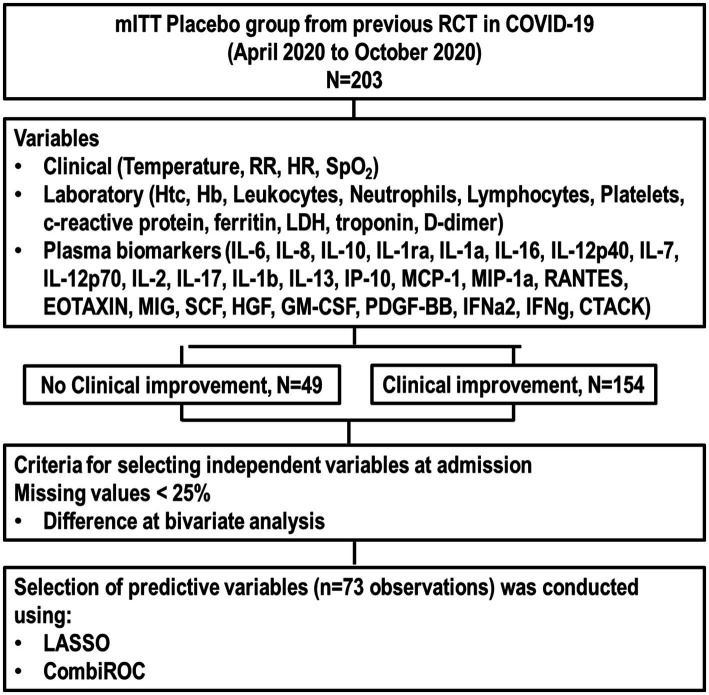
A secondary analysis was conducted on the modified intention-to-treat placebo group from a previous randomized clinical trial (RCT, NCT04561219) of patients with COVID-19. The analysis assessed clinical, laboratory, and blood markers at admission to predict clinical improvement, defined as a two-point increase on the World Health Organization clinical progression scale after 7 days. LASSO and CombiROC were used to select optimal predictive variables. The Youden criteria identified the best threshold for different variable combinations, which were then compared based on the highest area under the curve (AUC) and accuracy. AUCs were compared using DeLong's algorithm.
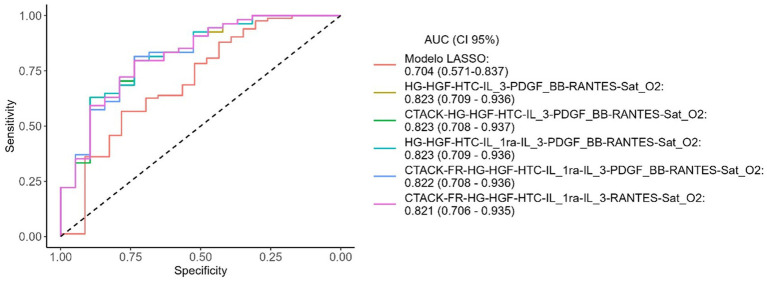
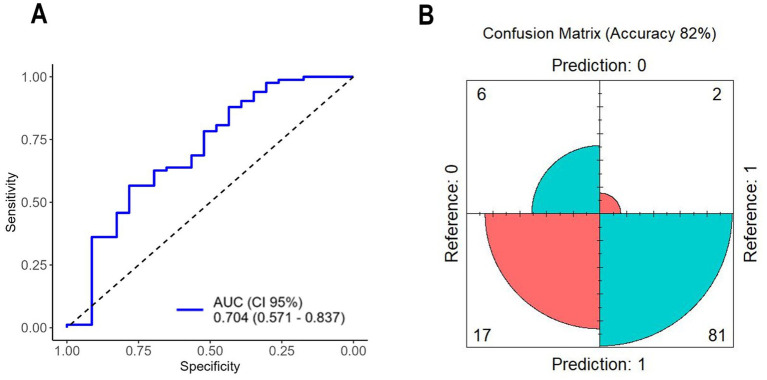
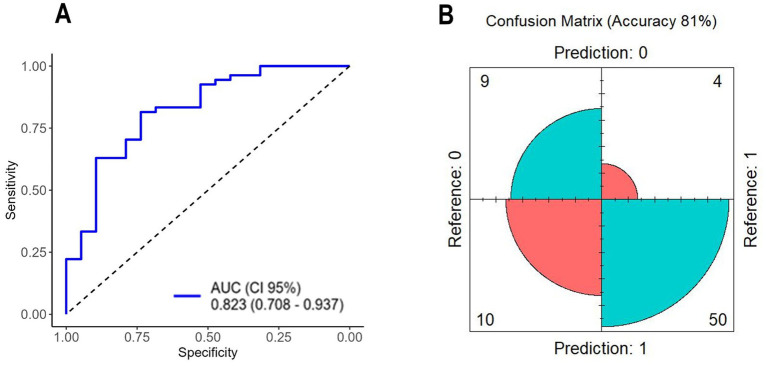
Overall, 203 patients were included in the analysis, and they were divided into two groups; clinical improvement ( = 154) and no clinical improvement ( = 49). The median age was 55 years (interquartile range, 46-66 years); 65% were male. LASSO identified three predictive variables (SaO, hematocrit, and interleukin [IL]-13) with high sensitivity of 98% (95% confidence interval [CI], 92-100%) but low specificity of 26% (95% CI, 10-48%) for clinical improvement. CombiROC selected a broader set of variables (T cell-attracting chemokine, hemoglobin, hepatocyte growth factor, hematocrit, IL-3, PDGF-BB, RANTES, and SaO), achieving balanced sensitivity of 82% (95% CI, 69-91%) and specificity of 74% (95% CI, 49-91%). LASSO and CombiROC showed comparable accuracy (82 and 80%, respectively) and similar area under the ROC curves (LASSO: AUC, 0.704; 95% CI, 0.571-0.837; CombiROC: AUC, 0.823; 95% CI, 0.708-0.937; = 0.185).
For patients hospitalized with COVID-19 pneumonia, predictive variables identified by LASSO and CombiROC analyses demonstrated similar accuracy and AUCs in predicting clinical improvement. LASSO, with fewer variables (SaO, hematocrit, and IL-13) showed high sensitivity but low specificity, whereas CombiROC's broader selection of variables provided balanced sensitivity and specificity for predicting clinical improvement.
Brazilian Registry of Clinical Trials (REBEC) number RBR-88bs9x and ClinicalTrials.gov number NCT04561219.
预测COVID-19患者入院后的临床改善情况对于有效分配资源至关重要。机器学习工具可帮助根据实际数据识别可能出现临床改善的患者。本研究采用两种方法——最小绝对收缩和选择算子(LASSO)以及CombiROC——来识别入院时的预测变量,以检测7天后的临床改善情况。
对先前一项COVID-19患者随机临床试验(RCT,NCT04561219)中改良意向性治疗安慰剂组进行二次分析。该分析评估入院时的临床、实验室和血液标志物,以预测临床改善情况,临床改善定义为7天后世界卫生组织临床进展量表增加两分。使用LASSO和CombiROC选择最佳预测变量。约登标准确定不同变量组合的最佳阈值,然后根据曲线下面积(AUC)最高值和准确性进行比较。使用德龙算法比较AUC。
总体而言,203例患者纳入分析,分为两组;临床改善组(n = 154)和无临床改善组(n = 49)。中位年龄为55岁(四分位间距,46 - 66岁);65%为男性。LASSO识别出三个预测变量(动脉血氧饱和度、血细胞比容和白细胞介素[IL]-13),对临床改善的敏感性高,为98%(95%置信区间[CI],92 - 100%),但特异性低,为26%(95% CI,10 - 48%)。CombiROC选择了更广泛的一组变量(T细胞趋化因子、血红蛋白、肝细胞生长因子、血细胞比容、IL-3、血小板衍生生长因子-BB、调节激活正常T细胞表达和分泌的趋化因子以及动脉血氧饱和度),实现了平衡的敏感性,为82%(95% CI,69 - 91%),特异性为74%(95% CI,49 - 91%)。LASSO和CombiROC显示出相当的准确性(分别为82%和80%)以及相似的ROC曲线下面积(LASSO:AUC,0.704;95% CI,0.571 - 0.837;CombiROC:AUC,0.823;95% CI,0.708 - 0.937;P = 0.185)。
对于因COVID-19肺炎住院的患者,LASSO和CombiROC分析识别出的预测变量在预测临床改善方面显示出相似的准确性和AUC。LASSO变量较少(动脉血氧饱和度、血细胞比容和IL-13),敏感性高但特异性低,而CombiROC更广泛的变量选择为预测临床改善提供了平衡的敏感性和特异性。
巴西临床试验注册中心(REBEC)编号RBR-88bs9x以及ClinicalTrials.gov编号NCT04561219。