Zhang Yuping, Zeng Lingbing, Huang Xinhua, Wang Yuanyuan, Chen Guangsheng, Moses Munika, Zou Yun, Xiong Sichu, Xue Wenwen, Dong Yanmei, Tian Yueru, Guan Ming, Hu Lingfei, Yin Zhe, Zhou Dongsheng, Huang Xiaotian, Chen Changbin
School of Basic Medical Sciences, and the First Affiliated Hospital, Jiangxi Medical College, Nanchang University, Nanchang, Jiangxi, China.
Joint Laboratory for Biomedical Research and Pharmaceutical Innovation, Unit of Pathogenic Fungal Infection & Host Immunity, Key Laboratory of Molecular Virology and Immunology, Shanghai Institute of Immunity and Infection, Chinese Academy of Sciences, Shanghai, China.
Nat Commun. 2025 May 20;16(1):4668. doi: 10.1038/s41467-025-59898-6.
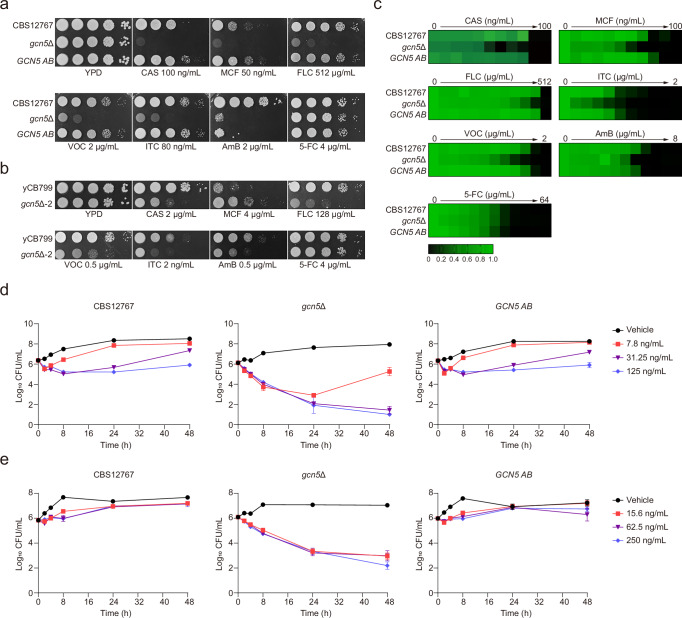
The rise of drug-resistant fungal species, such as Candida auris, poses a serious threat to global health, with mortality rates exceeding 40% and resistance rates surpassing 90%. The limited arsenal of effective antifungal agents underscores the urgent need for novel strategies. Here, we systematically evaluate the role of histone H3 post-translational modifications in C. auris drug resistance, focusing on acetylation mediated by Gcn5 and Rtt109, and methylation mediated by Set1, Set2, and Dot1. Mutants deficient in these enzymes exhibit varying degrees of antifungal drug sensitivity. Notably, we discover that GCN5 depletion and the subsequent loss of histone H3 acetylation downregulates key genes involved in ergosterol biosynthesis and drug efflux, resulting in increased susceptibility to azoles and polyenes. Additionally, Gcn5 regulates cell wall integrity and echinocandin resistance through the calcineurin signaling pathway and transcription factor Cas5. In infection models using Galleria mellonella and immunocompromised mice, GCN5 deletion significantly reduces the virulence of C. auris. Furthermore, the Gcn5 inhibitor CPTH synergizes with caspofungin in vitro and in vivo without notable toxicity. These findings highlight the critical role of Gcn5 in the resistance and pathogenicity of C. auris, positioning it as a promising therapeutic target for combating invasive fungal infections.
耐药真菌物种的出现,如耳念珠菌,对全球健康构成严重威胁,其死亡率超过40%,耐药率超过90%。有效抗真菌药物的有限储备凸显了对新策略的迫切需求。在此,我们系统地评估了组蛋白H3翻译后修饰在耳念珠菌耐药性中的作用,重点关注由Gcn5和Rtt109介导的乙酰化,以及由Set1、Set2和Dot1介导的甲基化。缺乏这些酶的突变体表现出不同程度的抗真菌药物敏感性。值得注意的是,我们发现GCN5的缺失以及随后组蛋白H3乙酰化的丧失会下调参与麦角固醇生物合成和药物外排的关键基因,导致对唑类和多烯类药物的敏感性增加。此外,Gcn5通过钙调神经磷酸酶信号通路和转录因子Cas5调节细胞壁完整性和棘白菌素耐药性。在使用大蜡螟和免疫受损小鼠的感染模型中,GCN5的缺失显著降低了耳念珠菌的毒力。此外,Gcn5抑制剂CPTH在体外和体内与卡泊芬净具有协同作用,且无明显毒性。这些发现突出了Gcn5在耳念珠菌耐药性和致病性中的关键作用,使其成为对抗侵袭性真菌感染的有前景的治疗靶点。